
Would you trust a standard residential agent to accurately value a 100 foot by 200 foot indoor arena or the seniority of your ditch rights? You’ve spent years investing in your land. You know that selling my horse property in Colorado involves far more than just listing bedroom counts. It’s about protecting the lifestyle you’ve built while ensuring you don’t leave money on the table during the transition. Most sellers worry about how to price specialized improvements. Others fear that legal complications with water rights will derail a closing.
We understand these challenges because we’ve spent nearly 40 years helping ranchers and horse lovers achieve their goals. This 2026 guide provides the expert strategies you need to master complex equestrian valuations. You’ll learn how to leverage AI-driven marketing to find out-of-state buyers and secure a high ROI. We’ll also cover how to handle land-use disclosures and showcase your property’s unique features to ensure a smooth, professional transaction. Whether you’re moving to a smaller plot or heading out of state, you deserve a plan that honors your hard work.
Key Takeaways
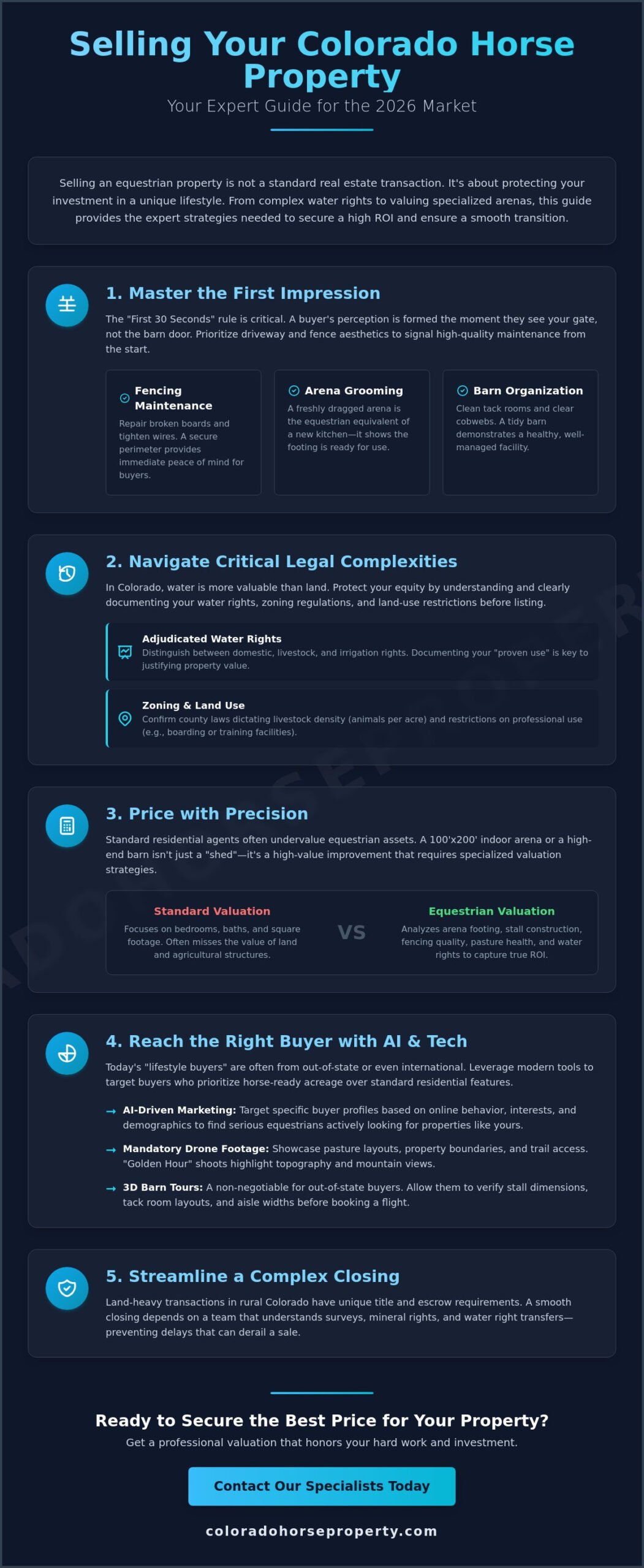
- Learn how to master the “First 30 Seconds” rule by prioritizing driveway and gate aesthetics to capture a buyer’s interest before they even reach the barn.
- Discover how to protect your equity by navigating the complexities of Colorado water rights and zoning laws that dictate livestock density and professional use.
- Gain a competitive edge when selling my horse property in Colorado by applying specialized valuation strategies for high-end arenas and outbuildings.
- Leverage AI-driven marketing tools to target global “lifestyle buyers” who prioritize horse-ready acreage over standard residential square footage.
- Streamline your transition by understanding the unique title and escrow requirements for land-heavy transactions in the rural Colorado market.
Preparing Your Colorado Equestrian Estate for the 2026 Market
Selling my horse property in Colorado involves a strategy far beyond traditional residential staging. While a standard home sale focuses on kitchen counters and neutral paint, an equestrian sale centers on functionality, safety, and land management. Buyers in 2026 are more sophisticated. They evaluate the property as a working facility rather than just a residence. Understanding the requirements of the modern equestrian buyer means recognizing that they prioritize the health of the soil and the security of the fencing over the color of the living room walls.
To better understand how to present your land and home to potential buyers, watch this helpful video:
The “First 30 Seconds” rule is the most critical component of your presentation when selling my horse property in Colorado. This window begins the moment a buyer pulls up to your front gate. A sagging entrance or a driveway filled with washouts signals a lack of maintenance. Buyers assume this neglect extends to the barn and well house. In the 2026 market, high-quality perimeter fencing and a well-maintained entry road offer the highest return on investment. These features provide immediate peace of mind for buyers concerned about the safety of their animals.
Moving on from a legacy ranch or a long-held family farm is an emotional process. You aren’t just selling real estate; you’re transitioning a lifestyle you’ve cultivated over years or decades. Focus on the “lifestyle and dreams” that the next owner will inherit. Highlighting your stewardship of the land helps bridge the gap between your history and the buyer’s future. It’s about finding someone who values the acreage as much as you do.
The Equestrian Curb Appeal Checklist
- Fencing Maintenance: Inspect every foot of post-and-rail or no-climb wire. Repairing broken boards and tightening wires ensures the property looks secure and professional.
- Arena Grooming: A freshly dragged arena is the equestrian equivalent of a high-end kitchen remodel. It shows that the footing is cared for and ready for immediate use.
- Barn Organization: Clean the tack rooms and clear out cobwebs from the rafters. Proper ventilation and organized stalls demonstrate that the facility is healthy for horses.
Professional Photography and Drone Strategy
Static photos cannot capture the scope of a 20-acre or 40-acre ranch. Aerial drone footage is mandatory to show pasture layouts, trail access points, and property boundaries clearly. Timing is everything on the Colorado Front Range. Schedule your shoot for the “Golden Hour” to capture the way the light hits the mountains and highlights the topography of your acreage. 3D barn tours are a non-negotiable requirement for out-of-state buyers who need to verify stall dimensions and aisle widths before traveling for a physical showing.
Navigating Colorado Water Rights, Zoning, and Land Use
In Colorado, the value of your acreage depends heavily on what’s beneath the surface and what the county allows you to build on top of it. When selling my horse property in Colorado, I have to account for the legal framework that governs every gallon of water and every hoof on the ground. Buyers in 2026 are more sophisticated than ever. They don’t just look at the view; they look at the decree. Understanding these complexities is the difference between a smooth closing and a deal that falls apart during inspection.
Deciphering Adjudicated Water Rights
Water is the most valuable asset in the West. A property with “household use only” well permits limits a buyer’s ability to maintain a lush pasture or water a large herd. You must distinguish between domestic wells and those with livestock or irrigation rights. Navigating Colorado Water Rights requires understanding the prior appropriation system. Documentation of your “proven use” over the last 10 years can add six-figure value to your listing. If you claim to irrigate 10 acres, you need the paper trail to back it up. We often suggest working with a water attorney to ensure a clean title transfer during escrow. A simple deed error can stall a closing for months.
Zoning and Permitting for Equestrian Facilities
Zoning laws dictate livestock density, often measured in animal units per acre. For example, some counties allow one horse per 0.5 acres, while others require 2.5 acres. You must verify that your horse barns for sale are fully permitted and code-compliant. Unpermitted structures are a massive red flag during the due diligence phase. If you’ve been running a commercial boarding operation, ensure your Special Use Permit is current and transferable. Addressing non-conforming uses now prevents a buyer from backing out when their lender discovers the indoor arena doesn’t meet the 2026 building code requirements.
Land use restrictions, such as conservation easements or active grazing leases, must be disclosed early. These encumbrances can significantly impact the sale price and the pool of eligible buyers. Disclosing these details upfront protects you from post-closing legal disputes. If you’re unsure how your specific county’s 2026 regulations affect your land value, you can consult with our experienced team to get a clear picture of your property’s potential. Clear communication about land rights ensures a smoother transition for both parties and helps you maintain your reputation in the tight-knit Colorado ranching community.
Pricing and Valuation Strategies for Specialized Horse Properties
Standard residential appraisals rely on “comps,” but these often fail when you’re selling my horse property in Colorado. A suburban house on five acres with a simple shed isn’t comparable to a five-acre estate featuring a professional-grade indoor arena and 4-rail pipe fencing. Most generalist agents struggle to price these differences. We use a hybrid of the Market Approach and the Cost Approach. The Cost Approach calculates the depreciated replacement cost of your infrastructure. If you built a $200,000 barn in 2023, it won’t necessarily add that full amount to your 2026 sale price. However, unique assets like mountain views or direct access to public trail systems command a “Lifestyle Premium” that standard data points can’t capture.
Pricing also depends on the specific utility of the land. We analyze soil quality and drainage to determine if the property is turn-key or requires a massive overhaul. Buyers in 2026 are looking for value in established systems. A property with a functional well and senior water rights will always outpace a dry lot. You’ve got to price the dream of the lifestyle alongside the hard reality of the infrastructure.
Valuing Improvements: Barns, Arenas, and Outbuildings
Specialized equine infrastructure requires a nuanced eye for detail. A heated wash rack or a rubber-paver aisle might seem like luxury additions, but they significantly reduce labor and increase horse safety. These details add more value than most sellers realize because they appeal to high-end buyers who want move-in-ready facilities. You should refer to our Horse Real Estate for Sale: 2026 Market & Valuation Guide for current price-per-acre trends and infrastructure metrics. We evaluate the lifespan of every outbuilding to ensure your list price reflects the true replacement value minus depreciation.
The Role of Land Quality in Your List Price
Not all acreage is equal in the eyes of a horse person. When selling my horse property in Colorado, the physical state of the land dictates the buyer pool. Productive acreage is land that possesses the soil health and water access necessary to yield at least two tons of hay per acre annually or support consistent grazing. Proper cross-fencing and established rotational grazing setups save a new owner thousands in initial setup costs.
Location remains a primary driver for land value. Properties in Douglas County or those near major show circuits fetch higher prices due to proximity to vets, farriers, and competition venues. You must also consider how Colorado’s equestrian zoning laws impact the density of livestock allowed on your specific parcel. Steep slopes or poor forage production can drop land value by 15% to 25% compared to flat, well-drained pastures with high-quality topsoil.
Marketing with AI and Reaching the Modern Equestrian Buyer
Marketing has shifted from broad visibility to surgical precision. When you’re selling my horse property in Colorado, you don’t need every home buyer to see your listing. You need the specific buyer who understands the value of a 12-stall barn, a heated wash rack, and high-tensile fencing. In 2026, we use AI-powered search tools to find that person before they even contact an agent. These tools analyze search patterns to identify high-intent buyers who prioritize horse-ready land over interior square footage.
The Colorado Horse Property AI Advantage
Our proprietary search technology identifies buyers looking for specific barn configurations and soil types. We track data points that general real estate sites ignore. If a buyer spends time looking at properties with indoor arenas or senior water rights, our system flags your listing for them immediately. This data-driven insight allows us to adjust your marketing strategy in real-time. We see which photos are getting the most engagement and can swap out the lead image to match current buyer trends. Our platform remains the first stop for serious equestrians looking for horse property for sale in Colorado because we speak their language.
Niche Multi-Channel Marketing
We target the “Lifestyle Buyer” who is often relocating from California or the East Coast. These buyers aren’t just looking for a house; they’re looking for the Colorado ranching dream. To reach them, we use a multi-channel approach that includes:
- Placement in national equestrian publications and specialized land-sale websites.
- Direct outreach within private equestrian social media groups and regional horse show networks.
- Niche SEO strategies that capture high-intent searches like selling my horse property in Colorado.
- Data-backed email campaigns sent to our exclusive list of out-of-state “refugee” buyers.
We craft a narrative that highlights the freedom of the rural Colorado landscape. We focus on the functionality of the outbuildings and the quality of the pasture. This strategy ensures your property isn’t lost in a sea of suburban listings. We position your land as a specialized asset, attracting buyers who are willing to pay for the infrastructure you’ve built. By leveraging these modern tools, we reduce time on market and connect you with buyers who value your property’s unique equine features.
The Closing Process: Title, Escrow, and Transitioning
Closing on a horse property involves more than just signing a deed. You’re transferring a lifestyle and complex land assets. Unlike standard residential sales, land-heavy transactions require a deep dive into legal descriptions, water rights, and agricultural zoning. When selling my horse property in Colorado, the administrative side requires a specialized eye to ensure no detail regarding land use or water access is missed. These properties often come with specific easements or grazing rights that must be clearly disclosed to avoid post-sale disputes.
Specialized title and escrow companies like Meridian Title are essential for these transactions. They understand how to navigate rural title searches and historical land claims that standard title companies might overlook. During the closing window, you’ll need to coordinate the physical move of your horses and heavy equipment. This requires a synchronized schedule to ensure the property is vacant for the new owners while keeping your animals safe and secure during the transition.
Transaction Management for Ranches
Expert management is vital when dealing with high-value agricultural assets. If you’re reinvesting, a 1031 Tax-Deferred Exchange allows you to defer capital gains taxes, provided you follow the strict 45-day identification and 180-day closing windows. Mineral rights and existing oil or gas leases must be clearly documented to prevent future litigation. Realty Oasis provides the expert-led coordination needed to handle these moving parts. Their team draws on nearly four decades of experience to ensure a seamless transition that protects your financial interests and legacy.
Transitioning Your Horses and Legacy
Moving horses requires meticulous planning. Schedule your haulers at least 30 days in advance to ensure availability. Every horse needs a current Coggins test, which is typically valid for 12 months in Colorado, and a health certificate issued within 30 days of travel. This is a critical step when selling my horse property in Colorado to ensure a smooth hand-off to the next owner. During the final walkthrough, buyers will focus on specific equine infrastructure rather than just the house:
- Fence Integrity: Checking for new breaks or downed lines that occurred since the inspection.
- Barn Systems: Verifying that automatic waterers, stall latches, and wash rack drainage are fully functional.
- Pasture Condition: Ensuring no unauthorized grazing or significant soil disturbance occurred after the contract date.
Leave a “Property Bible” for the new owners. This binder should include well locations, circuit breaker maps, and the contact information for your trusted farriers and veterinarians. Providing these details helps preserve the land you’ve cared for. Handing over the keys to your Colorado legacy is the final step in fulfilling your goals and allowing a new family to start their own journey on the land.
Secure Your Future in the 2026 Colorado Ranch Market
Success in the 2026 market requires more than just a sign in the dirt. It demands a firm grasp of Colorado water rights and a marketing strategy that leverages modern technology to reach the right buyers. Preparing for the reality of selling my horse property in Colorado means focusing on these complex land use issues while utilizing AI-driven buyer targeting to stand out. You’ve learned how zoning laws and specialized valuation impact your bottom line. Now it’s time to put that knowledge into practice. Navigating the transition from a beloved equestrian estate to your next chapter is a significant milestone that deserves expert guidance.
Mark and Alison Eibner bring nearly four decades of specialized Colorado real estate experience to your side. They combine this deep local history with proprietary AI-powered marketing technology to ensure your ranch stands out to the modern equestrian buyer. Their team understands that a horse property represents a lifestyle dream, not just a transaction. You can move forward with confidence knowing your land’s legacy is in capable hands. Your successful sale starts with an accurate assessment of your property’s unique value. It’s time to see what your hard work has built.
Get a Professional Valuation for Your Colorado Horse Property
Frequently Asked Questions
Do I need a specialized realtor to sell my horse property in Colorado?
Yes, a specialized agent understands the complex zoning laws and equine infrastructure that generalists often overlook. When I am selling my horse property in Colorado, I need an expert who can evaluate the market value of a 100×200 foot indoor arena or the quality of senior water rights. Over 90% of successful ranch transactions involve agents with specific land and agricultural designations. This expertise ensures your lifestyle investment is marketed to the right buyers.
How long does it typically take to sell a ranch or horse property?
You should expect a timeline of 90 to 180 days for a successful closing on a rural property. Unlike residential homes in Denver that might sell in 14 days, acreage listings have a smaller pool of qualified buyers. Data from the 2024 Colorado Land Markets report shows that properties with over 35 acres typically stay on the market 45% longer than standard residential listings. Patience is key when waiting for the perfect buyer.
What are the most important disclosures when selling land in Colorado?
You must disclose the source of potable water and any known environmental hazards like abandoned wells. Colorado law requires sellers to provide a Lead-Based Paint Disclosure for structures built before 1978 and a Square Footage Disclosure. If your property is within a Special Taxing District, you must notify the buyer per Colorado Real Estate Commission guidelines. These documents protect you from legal liability after the sale is complete.
Can I sell my horse property if I don’t own the mineral rights?
You can certainly sell your property without owning the mineral rights because severed estates are common in Colorado. Real estate records show that in 60% of rural counties, the surface and mineral estates were separated as early as the Homestead Act of 1862. You must clearly state in the contract that you’re only selling the surface rights to avoid legal disputes. Roughly 75% of buyers in the region understand this standard practice.
How do water rights affect the sale price of my property?
Water rights can increase a property’s market value by 20% to 50% depending on the seniority of the decree. In the semi-arid climate of the Front Range, a property with 2 shares of Colorado-Big Thompson water is worth significantly more than a dry-land parcel. Buyers prioritize properties where the water rights are adjudicated and clearly documented in the deed. Without these rights, your land’s agricultural potential and resale value are limited.
What is the best time of year to list a horse property in Colorado?
The optimal time to list is between late April and early June when pastures are green and the snow has melted. Properties listed in the second quarter of the year historically see 15% more foot traffic than those listed in December. Buyers want to see the condition of the fencing and the drainage in the paddocks before the summer heat arrives. This seasonal window highlights your property’s best aesthetic features.
Should I have a professional inspection for my barn and arena?
You should invest in a professional inspection to identify structural issues in outbuildings before they become deal-breakers. While a standard home inspector looks at the house, a specialized agricultural inspector checks for proper ventilation in stalls and the depth of the arena footing. Fixing a faulty electrical system in a barn can prevent a 10% price reduction during the inspection objection phase. It’s a proactive step for any serious seller.
How does an AI-powered search tool help me as a seller?
An AI-powered search tool matches your listing with buyers based on specific data points like acreage and barn features. This technology analyzes thousands of user searches to place your property in front of the most relevant 5% of active buyers. It reduces time on market by ensuring that only people looking for horse properties see your 40-acre ranch. It’s the most efficient way to reach a niche audience in the modern market.