
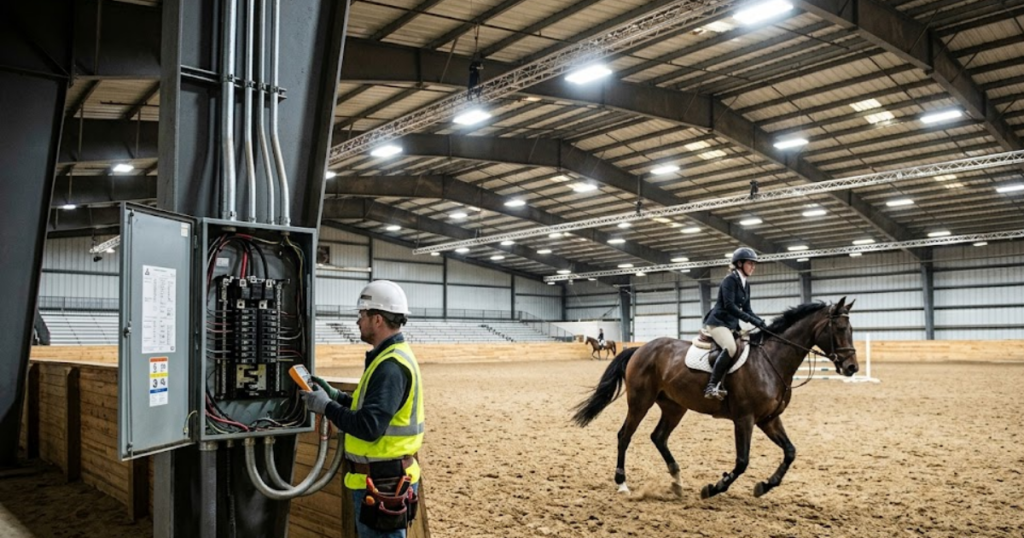
You buy a horse property with a beautiful, sprawling outdoor arena. When the Colorado winter sets in and the sun starts going down at 4:30 PM, you decide it is time to install some stadium lights so you can keep riding after work.
You call a licensed electrician, and they deliver crushing news: your property’s electrical panel is already maxed out. To turn the arena lights on, you would have to turn the heater in your house off. To upgrade the system, you have to pay the county utility company $15,000 for a new transformer.
Equestrians often look at an empty arena and assume they can just “string up some lights” later. But high-intensity lighting requires massive electrical capacity.
If your training schedule requires riding at night, understanding rural electrical infrastructure is critical. Here is how to evaluate a property’s amperage before you buy.
How Many "Amps" Are Available for Arena Lighting?
Quick Summary: The Electrical Bottleneck
- The 200-Amp Limit: Most rural properties only have a standard 200-amp electrical service. If the main house has modern electric appliances, there may not be enough spare amperage to legally run a bank of arena lights.
- The Voltage Drop: Arenas are typically located far away from the main utility meter. Pushing electricity over long distances causes a voltage drop, requiring extremely thick, expensive underground copper wiring to operate safely.
- The LED Necessity: If you have limited amps, modern LED fixtures are no longer an upgrade; they are a necessity. They produce stadium-level brightness while drawing a fraction of the amperage of traditional metal halide bulbs.
- The Phase Problem: Heavy-duty commercial indoor arenas often require three-phase power. Most rural county roads only supply single-phase power, and paying the utility company to bring three-phase to your farm can cost tens of thousands of dollars.
If evening riding is part of your training plan, electrical infrastructure should be evaluated as carefully as the arena footing, fencing, and barn layout.
1. The 200-Amp Standard Limit
You have to look at the power budget of the entire farm, not just the barn.
- The Household Draw: Most rural homes are equipped with a standard 200-amp main service panel. If the house features an electric oven, an electric dryer, a hot tub, central air conditioning, and an electric well pump, that 200-amp budget is likely already spoken for.
- The Sub-Panel Deficit: Buyers often see a sub-panel in the barn and assume they have plenty of power. However, that barn sub-panel feeds directly from the main house panel. If the barn panel is rated for 100 amps, but the house only has 30 amps of spare capacity left, you cannot safely pull 100 amps at the barn without tripping the main breaker.
2. The Distance and "Voltage Drop"
Electricity degrades over distance, which is a massive problem on acreage.
- The Trenching Reality: Arenas are usually situated well away from the house to minimize dust. This means you must trench electrical lines hundreds of feet from the meter to the arena poles.
- The Copper Cost: Pushing 240-volt power over 300 feet of buried conduit causes a severe drop in voltage. To prevent the wires from overheating and the lights from flickering, the electrician must install massive, heavy-gauge copper wire. The cost of that specialized copper wire alone can easily exceed the cost of the actual light fixtures.
The expense of lighting an arena often comes from the underground electrical run, not just from the poles and fixtures you can see above ground.
3. Metal Halide vs. LED Technology
If you are evaluating a property with existing lights, you must look at the bulbs.
- The Old Standard: Older properties usually feature metal halide stadium lights. They take ten minutes to warm up, run incredibly hot, and draw a massive amount of amperage.
- The LED Advantage: Upgrading to modern LED fixtures requires a heavy upfront investment, but it is often the only way to light an arena on an older property. LEDs provide instant, brilliant light while drawing 60% to 80% fewer amps, allowing you to run an entire arena on a single standard breaker.
4. Single-Phase vs. Three-Phase Power
If you are buying a commercial boarding facility or a massive indoor arena, the type of power supplied by the road matters.
- Single-Phase: 99% of rural residential properties operate on single-phase power. It is perfectly fine for running a house, a basic barn, and standard LED arena lights.
- Three-Phase: Massive commercial HVAC systems, heavy-duty agricultural equipment, and large-scale commercial lighting grids often require three-phase power. If you buy a property on a single-phase rural road and want to build a commercial indoor arena, the utility company will charge you by the foot to pull three-phase lines to your property, which is often financially devastating to a business plan.
We Check the Power Before You Buy
We do not just look at the arena footing; we open the electrical panels.
When Mark Eibner and Belinda Seville represent you in buying a horse property, we look for the hidden bottlenecks. We evaluate the main service panels, look at the available amperage, and help you determine if the property’s current electrical infrastructure can actually support your vision for a lighted, year-round training facility.
Contact Us Today to find a property with the infrastructure your training program demands.
Browse Active Colorado Horse Properties: Browse Active Colorado Horse Properties that are fully equipped for evening riding
Frequently Asked Questions (FAQ) About Arena Lighting
Can I use solar-powered lights for my riding arena to save on wiring costs?
Solar technology is advancing, but standard all-in-one solar streetlights generally do not provide the overlapping, high-lumen intensity required for safe jumping or fast barrel work at night. They are acceptable for ambient lighting, but true stadium-level brightness still requires hardwired electrical power.
How much does it cost to upgrade a property from 200 amps to 400 amps?
It varies widely depending on your local rural utility cooperative, but it is never cheap. Between the utility company's fees for a new transformer and a private electrician's labor to rebuild your meter base and main panels, expect to spend anywhere from $5,000 to $15,000 or more.
Do I need a building permit to put up light poles around my arena?
Yes. Almost all Colorado counties require electrical permits for trenching and running new sub-panels. Additionally, many rural counties have strict dark sky ordinances. You may be required to prove that your light fixtures are shielded, face straight down, and will not cause light pollution for your neighbors.