
A buyer in El Paso County recently closed on a 35 acre parcel only to find that their residential zoning strictly prohibited more than two horses, despite the listing’s “equestrian” claims. It’s a devastating mistake that happens when buyers rely on generalist agents who don’t understand the complexities of rural land use. You’ve likely spent years planning for a specific lifestyle and dreams of riding across your own acreage. Finding a realtor for horse property Colorado requires more than a simple search; it demands a partner who understands the 1969 Water Rights Determination and Administration Act and how it affects your livestock’s future.
You already know that buying a ranch is a massive financial and emotional commitment. It’s why you feel that familiar anxiety about well permits or the difference between a domestic and household-use-only well. In this 2026 guide, you’ll learn how to identify and vet a specialized equestrian realtor who can protect your investment. We’ll provide a clear framework for spotting an expert who knows a loafing shed from a barn and can explain the intricacies of Colorado zoning laws. From verifying water rights to ensuring your property is legally equine-friendly, this guide ensures your rural transition is a success instead of a multi-million dollar error.
Key Takeaways
- Understand why standard residential “curb appeal” fails to account for the land utility and infrastructure needed to support a functional equestrian lifestyle.
- Master the “Big Three” technical skills, including Colorado water rights and county zoning, which are essential when finding a realtor for horse property Colorado.
- Learn the five critical questions to ask any prospective agent to ensure they have the specific transaction history and local expertise required to protect your rural investment.
- Identify dangerous red flags in listing agents, such as a lack of knowledge regarding well permit numbers or an over-focus on the home instead of the outbuildings.
- Discover how to bridge the gap between legacy ranching expertise and modern AI-powered search tools to find properties with specific features like arenas and pastures.
Why Generalist Realtors Struggle with Colorado Horse Properties
Most buyers start their search with a traditional real estate agent trained in suburban residential sales. This is a mistake. Curb appeal sells houses, but land utility sustains livestock. A generalist sees a granite countertop; a specialist sees a poorly graded arena that will flood every spring. Finding a realtor for horse property Colorado requires choosing a partner who looks past the square footage to evaluate the fencing type and soil drainage.
Standard MLS searches don’t account for Colorado’s specific equine needs. You won’t find data on hay production per acre or the structural load limits of a barn built in 1950. Generalist agents often rely on automated filters that miss critical infrastructure. They don’t know the difference between safe Centaur fencing and dangerous high-tensile wire. When you transition from a suburban mindset to a rural investment strategy, you must prioritize the land’s ability to support your animals over the paint color in the primary bedroom.
To better understand the specific requirements of these unique properties, watch this helpful video:
The Complexity of the Colorado Rural Market
Colorado’s land use laws are strict and vary by county. The 1972 35-acre rule, known as Senate Bill 35, dictates that parcels smaller than 35 acres are subject to intense county subdivision regulations. This directly impacts your ability to drill a domestic well. A listing might claim a property is horse-friendly because the neighbors have ponies, but if the current zoning code only allows one animal unit per two acres, you’re facing a legal violation. Front Range properties face different water scarcity issues than High Country ranches where 9,000-foot elevations drastically shorten the grazing season.
The Liability of Inexperience
Inexperienced agents often miss critical red flags in outbuildings and infrastructure. They might overlook a prescriptive easement where a neighbor has used a trail for 15 years, potentially creating a permanent right-of-way through your private pasture. Your agent must understand the lifestyle. They should identify if a barn has adequate ventilation and if the access roads can support a 4-horse gooseneck trailer during a heavy January snowstorm. Finding a realtor for horse property Colorado who understands these nuances prevents expensive “city slicker” mistakes that can cost thousands in remediation after closing.
The “Big Three” Technical Skills Your Realtor Must Master
General residential agents often struggle with the complexities of rural transactions. When you’re finding a realtor for horse property Colorado, you need a specialist who understands that a beautiful barn is worthless without the legal right to water your animals. Success in this niche market requires mastery of water law, local zoning codes, and the geological realities of the Front Range and Western Slope.
Navigating Colorado Water Law
Colorado operates under the Doctrine of Prior Appropriation, meaning “first in time, first in right.” Your realtor must distinguish between a “household-only” well, which prohibits outside watering, and a “domestic and livestock” well. An augmentation plan is a court-approved program that allows for the use of a well by replacing the water consumed with an alternative source to prevent injury to senior water rights holders. Before you sign a contract, your agent should contact the Division of Water Resources to pull the specific well permit. When finding a realtor for horse property Colorado, ensure they can verify Colorado well permits for livestock to confirm your horses have legal access to water. They must also investigate “ditch rights” and any associated shares in irrigation companies, which are often deeded separately from the land.
Zoning, Covenants, and Land Use
Zoning designations like A-1 (Agricultural) or RR (Rural Residential) vary significantly between counties like Douglas, Weld, and El Paso. Each county uses a specific “Animal Unit” (AU) calculation to determine how many horses are allowed per acre. For example, some jurisdictions allow 1 AU per 0.5 acres, while others require 2.5 acres for the first horse. Your realtor must also investigate:
- HOA Restrictions: Many subdivisions have “hidden” covenants that ban horse trailers in driveways or limit the height of your arena.
- Commercial Use: If you plan to offer boarding or training, you’ll likely need a Special Use Permit (SUP), a process that can take 6 to 12 months.
- Structure Setbacks: Barns and manure pits must meet strict distance requirements from property lines and existing wells.
Evaluating the Physical Land
The Colorado Front Range is notorious for “expansive soils” containing bentonite clay. These soils can exert 15,000 pounds of pressure per square foot, causing barn foundations to crack if not engineered correctly. A seasoned agent will check for proper drainage to prevent “mud fever” and other hoof issues in your herd. Pasture health is equally vital; a horse typically consumes 1.5% to 2% of its body weight in forage daily. If the land is overgrazed or lacks nutrient-dense grasses, you’ll spend thousands extra on supplemental hay each season. You can browse properties with established pastures and professional fencing by visiting the Colorado Horse Property search tool. Finally, your agent should evaluate existing fencing to ensure it’s safe for horses, as traditional barbed wire used for cattle is a leading cause of equine injury.
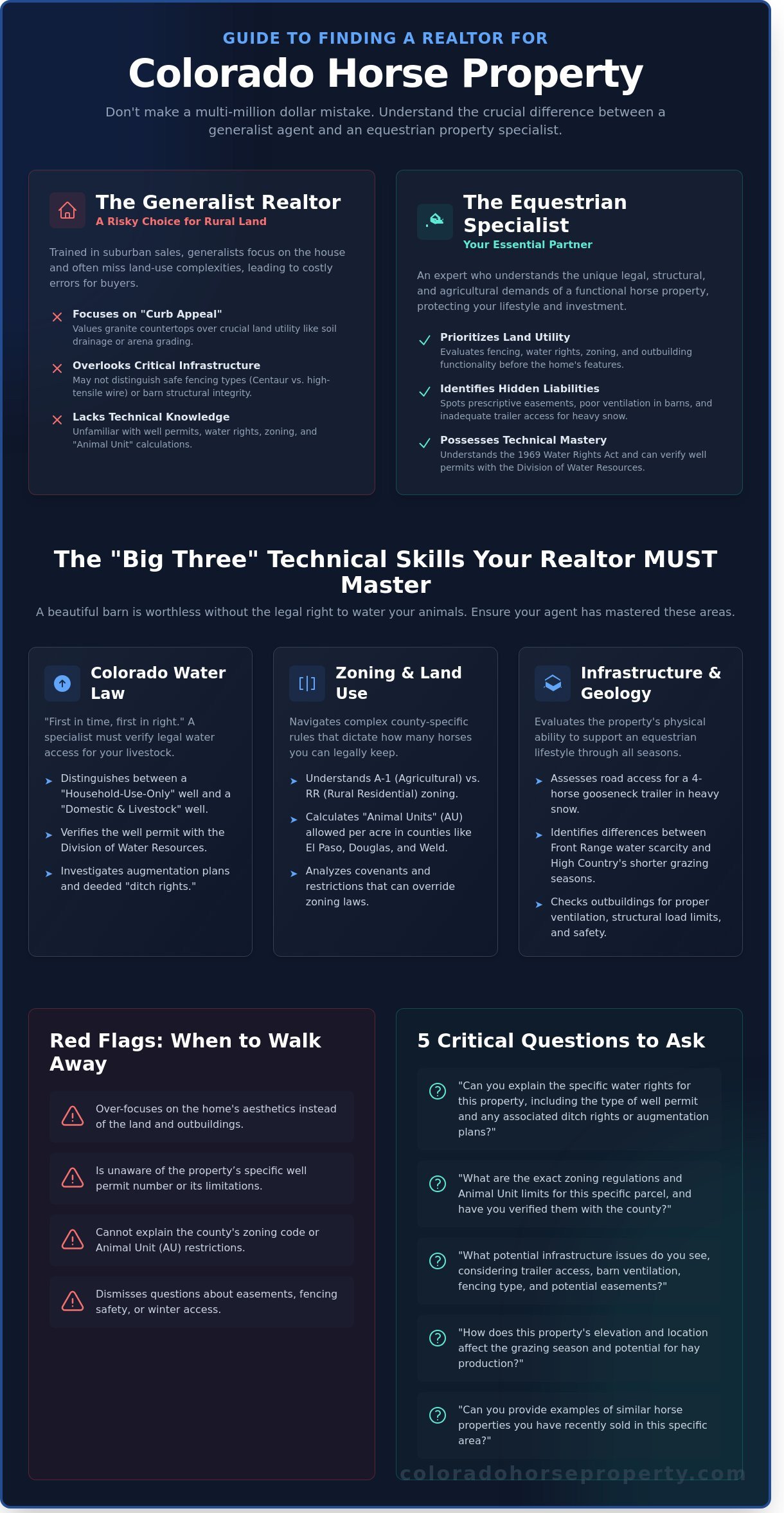
5 Critical Questions to Ask When Finding a Realtor for Horse Property
Selecting the right representative is the difference between a thriving ranch and a legal nightmare. When you’re finding a realtor for horse property Colorado, you need to look beyond their sales volume in the suburbs. You’re hiring a consultant for a complex land acquisition. Use these five questions to separate the generalists from the true ranch experts.
- How many equestrian-specific transactions have you closed in the last 24 months? Look for a minimum of five to ten dedicated rural or equine deals. General residential volume doesn’t translate to knowledge of livestock fencing or manure management plans.
- Can you explain the specific well permit requirements for this county? In areas like Douglas or Elbert County, a “household-use-only” well won’t legally allow you to water a single horse. Your agent must know the difference between exempt and non-exempt permits.
- What is your process for evaluating the structural integrity of a barn or arena? They should inspect the base materials, truss strength, and ventilation systems. A pretty barn with poor drainage is a six-figure liability.
- Do you have a network of rural-specific inspectors? You need professionals who specialize in septic leach fields, well production tests, and soil compaction. Standard home inspectors often lack the equipment to test a 300-foot deep well.
- How do you find “quiet” or off-market listings? In the 2026 market, approximately 15 percent of high-end ranch deals happen before they hit the MLS. Your agent needs a deep network of local landowners and private databases.
Vetting Their Transaction History
Don’t settle for a “hobbyist” agent who simply owns horses. You need a full-time specialist who understands the local land-use board. Ask for three references from clients who purchased at least 35 acres. This ensures they’ve navigated the complexities of Colorado’s specific acreage subdivisions and local zoning variances. A true expert knows the county commissioners and understands upcoming changes to regional grazing laws that could impact your lifestyle and dreams.
Testing Their Technical Knowledge
Test your agent with a “trick” question about water rights. Ask if a standard domestic well permit allows for irrigating a five-acre pasture. If they don’t immediately explain the 1-acre irrigation limit typical of many Colorado permits, they lack the technical depth required. They must also understand the nuances of the valuation of equestrian improvements. For instance, a $300,000 indoor arena might only add $150,000 in appraised value depending on the soil type and local demand. When finding a realtor for horse property Colorado, ensure they can distinguish between “cost to build” and “market value” for specialized outbuildings.
Red Flags: When to Walk Away from a Listing Agent
Selecting the wrong partner can lead to expensive legal battles or a property that can’t actually house your animals. When you’re finding a realtor for horse property Colorado, the first red flag is often on their feet. If an agent shows up in dress shoes or heels and refuses to walk the full perimeter of the fence line, they aren’t the right fit. You need someone willing to check for downed wires or soft spots in the 10-acre back pasture. Professionalism in this niche is measured by mud on the boots, not the shine on a pair of loafers.
Another major warning sign is an agent who obsesses over the kitchen granite while ignoring the structural integrity of the loafing sheds. In rural real estate, the house is often the secondary asset. If they can’t provide a specific well permit number or a copy of the water rights decree, walk away immediately. Colorado’s Division of Water Resources regulates these strictly. A Household Only permit won’t allow you to water a single horse. Many generalist agents don’t know the difference, which could leave you hauling water by hand for the next decade.
Watch out for agents who gloss over local regulations. Every county has specific Animal Unit restrictions. If an agent tells you that you can keep five horses on three acres without checking the 2026 zoning codes for that specific parcel, they are guessing with your money. These limits are non-negotiable and often enforced by local health departments and HOAs.
The “City Slicker” Warning Signs
Generalist agents often use standard residential contracts that lack necessary rural contingencies. They might tell you it’s easy to just build a barn later, ignoring that 2026 setback laws or soil composition might make construction impossible or cost-prohibitive. They often confuse a weed-choked dry lot with a viable grazing pasture. This lack of nuance puts your investment at risk because they don’t understand the caloric needs of a working equine or the cost of hay when a pasture fails.
The Importance of Specialized Inspections
A standard home inspection won’t help you when evaluating a horse property for sale in Colorado. You need a professional infrastructure audit. This includes checking stall drainage, arena footing depth, and the safety of electrical runs in the barn. Your agent must also insist on a 4-hour well-flow test and a comprehensive potability screening. Finding a realtor for horse property Colorado who understands these technical requirements is the only way to ensure your horses have clean, reliable water for the long term.
The Modern Solution: AI-Powered Search + 40 Years of Expertise
Finding a realtor for horse property Colorado means choosing between a tech-savvy newcomer and a seasoned veteran. Colorado Horse Property eliminates that choice by combining both. Mark and Alison Eibner bring nearly 40 years of specialized experience to every transaction. This legacy knowledge serves as your best insurance policy against common pitfalls like undisclosed zoning restrictions or inadequate water rights. They’ve seen every market shift since the 1980s, providing a level of stability that generalist agents can’t match.
The team bridges the gap between traditional ranching wisdom and modern efficiency. By using proprietary tools, they’ve transformed how buyers locate their ideal acreage. You’re no longer stuck scrolling through thousands of irrelevant residential listings; instead, you get a direct path to properties that fit your specific equine needs. This saves time and ensures you’re only touring properties that actually meet your requirements.
Leveraging Proprietary AI Search Tools
Our AI-driven platform handles the heavy lifting of property discovery. It filters listings for specific equestrian features with high precision. You can search by exact barn types, indoor arena dimensions, or senior water rights without manual fatigue. This data-driven approach helps identify undervalued ranch land that doesn’t show up in standard searches. We focus on finding your lifestyle and dreams by analyzing 100% of available market data to ensure you don’t miss a single opportunity. The system identifies trends in land value, helping you make an offer based on facts rather than guesswork.
- Search by precise acreage increments, such as 5, 10, or 35+ acres.
- Filter by water features including domestic wells, streams, and irrigation rights.
- Identify properties with existing infrastructure like pipe fencing, tack rooms, or hay storage.
Full-Cycle Brokerage Support
The journey from initial valuation to the final handshake requires more than just a search engine. Our full-cycle brokerage support streamlines the entire transaction. We leverage the Realty Oasis network to provide Front Range buyers with an edge in competitive markets. By handling in-house title and escrow coordination, we reduce the risk of closing delays. This integrated approach ensures that when you’re finding a realtor for horse property Colorado, you’re getting a partner who manages every legal and financial detail with professional rigor.
Ready to start your search? Find your next Colorado Horse Property with AI
Secure Your Colorado Equestrian Future Today
Finding a realtor for horse property Colorado is about more than just finding a house; it’s about securing a specialized lifestyle that requires technical mastery of water rights, zoning, and soil quality. Generalist agents often overlook the critical technical skills needed to protect your investment, which is why specialized expertise remains your greatest asset. Success means asking the right questions and demanding data-driven answers before you ever sign a contract.
The specialized team led by Mark and Alison Eibner brings nearly 40 years of Colorado real estate experience to your search. We combine this deep historical knowledge with our proprietary AI-powered equestrian search tool to streamline your hunt for the perfect acreage. We’ve spent four decades helping buyers navigate the complexities of rural land to ensure their lifestyle and dreams become a reality. You deserve a partner who knows the difference between a simple residential lot and a functional working ranch.
Search Colorado Horse Properties Now
Your dream of wide-open spaces and mountain views is within reach, and we’re ready to help you find it.
Frequently Asked Questions
Do I need a different realtor for buying a ranch versus a residential home?
Yes, you need a specialist because residential agents usually don’t understand the complexities of rural infrastructure. Finding a realtor for horse property Colorado gives you access to 40 years of experience in land use and zoning. A ranch involves soil tests, manure management plans, and outbuilding permits that 95% of residential agents never handle in their daily work.
How much more does a specialized equestrian realtor cost?
A specialized equestrian realtor typically costs the same as a general agent because their commissions usually mirror the standard 2.5% to 3% buyer’s agent fee. You’re getting expert-level knowledge for the same price as a generalist. This expertise can actually save you $15,000 or more by identifying hidden fencing repairs or well pump issues before you close the deal.
What is the most important thing to look for in a Colorado horse property?
Water rights and legal access to well water are the most critical factors for any Colorado horse property. Without a “Domestic” or “Household Well with Livestock” permit from the Colorado Division of Water Resources, you can’t legally water your animals. Ensure the property has at least 2.5 acres of usable pasture to maintain a healthy stocking rate and prevent overgrazing.
Can a realtor help me determine if I can board horses on a property?
Yes, a qualified realtor will verify the specific zoning codes and “Use by Right” regulations for each county. In Douglas County, for instance, A-1 zoning allows for 1 horse per 35,000 square feet of land. Your agent should review these limits and any Homeowners Association covenants that might restrict your equine lifestyle and dreams.
How do I verify a realtors experience with Colorado water rights?
Ask the agent to explain the difference between adjudicated water rights and exempt well permits. A seasoned expert should know how to navigate the Colorado Decision Support Systems database to find well logs and priority dates. If they can’t discuss the 1969 Water Right Determination and Administration Act, they lack the necessary depth for these complex rural transactions.
What happens if I buy a property and later find out I can’t have horses?
You could face legal action, daily fines, or be forced to relocate your animals if you violate local zoning. This is why finding a realtor for horse property Colorado is vital to protect your investment. Most standard real estate contracts include a due diligence period where your agent must confirm that equine use is legally permitted before you lose your earnest money.
Should I use a local agent or a statewide horse property specialist?
You should prioritize a statewide specialist who has decades of experience across diverse Colorado terrains and legal jurisdictions. While a local agent knows the neighborhood, a specialist understands the broad landscape of Colorado ranching and water law. Our team has spent nearly 40 years helping buyers navigate these complexities across the Front Range and the Western Slope.