
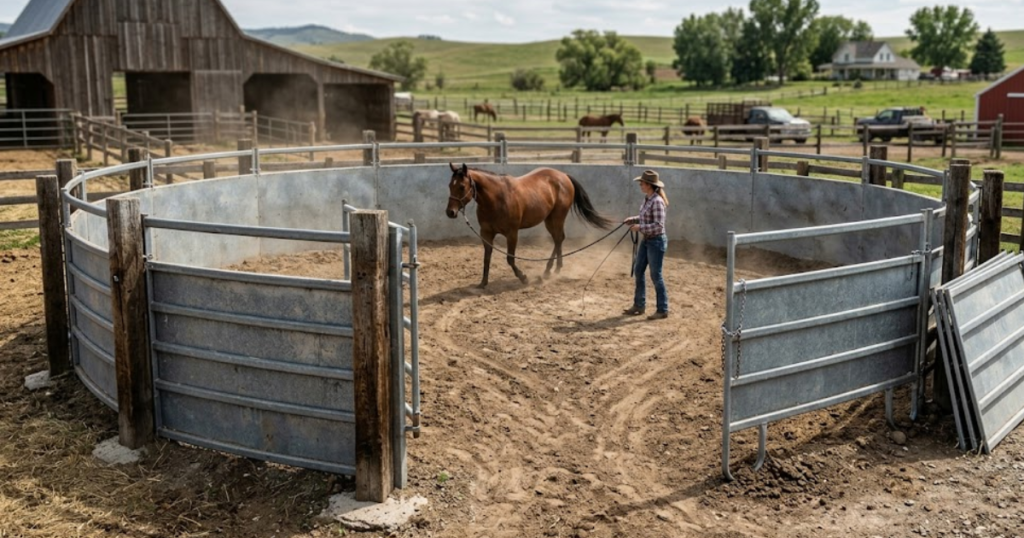
You tour a working horse property and see a 60-foot round pen perfectly situated next to the main barn. You immediately picture yourself out there doing groundwork with your yearling. But on closing day, you pull into the driveway and find nothing but an empty circle of disturbed dirt.
The round pen is the cornerstone of equestrian training. However, in the realm of real estate, its physical construction dictates both its property value and your legal right to keep it.
Assuming a round pen stays with the farm is one of the most common mistakes buyers make. Furthermore, the way a pen is constructed directly impacts how safely and effectively you can use it. Here is how to evaluate the round pen infrastructure before you write an offer.
Are the “Round Pen” Panels Permanent or Portable?
Quick Summary: The Fixture vs. Chattel Reality
- The Contract Trap: Portable panels are considered personal property. If the round pen is not explicitly written into the real estate contract as an inclusion, the seller will likely load it onto their trailer on moving day.
- Structural Integrity: Permanent pens built with deeply set wooden posts or welded steel pipe offer superior safety for starting young horses or handling animals that might test the boundaries.
- Layout Flexibility: Portable pens allow you to chase the good ground. If the current location turns into a mud bog during the spring thaw, you can easily drag the panels to higher ground.
- The Footing Factor: A permanent round pen usually indicates a significant investment in engineered drainage and sand footing. A portable pen is often just set on native dirt, limiting its year-round usability.
On a horse property, a round pen is not just a convenience. Its legal status, construction type, and footing quality directly affect value, safety, and whether it actually stays with the farm.
1. The “Fixture vs. Personal Property” Trap
Real estate law draws a hard line between what is part of the land and what belongs to the seller.
- The Permanent Fixture: If a round pen is built with wooden posts set in concrete, or heavy steel pipe welded to structural supports in the ground, it is considered a permanent fixture. It is legally part of the real estate and transfers to the buyer automatically.
- The Portable Chattel: If the pen is made of galvanized steel panels simply pinned together and resting on top of the dirt, it is classified as chattel or personal property.
- The Contract Requirement: You cannot assume the seller is leaving their expensive portable panels behind. If you want the portable round pen to stay, your real estate broker must explicitly write it into the purchase contract as an included item, just like a tractor or a refrigerator.
2. The Strength of Permanence
A permanent round pen is a massive asset for serious equestrians and trainers.
- Unyielding Safety: When starting a green horse or working with a reactive animal, you need a boundary that will not move. Permanent wooden or heavy pipe pens will not rattle, shift, or collapse if a 1,200-pound horse leans or kicks against them.
- Solid Walls: Many high-end permanent pens feature solid wooden or rubber-lined walls at the bottom. This prevents a horse from getting a hoof caught through the rails and eliminates outside visual distractions, forcing the horse to focus entirely on the handler.
- The Engineered Base: Because a permanent pen cannot be moved, the builder is forced to construct it correctly. This usually means digging out the native soil, laying a compacted road base, and bringing in proper sand footing so it drains efficiently.
A permanent pen often reflects a deeper investment in the overall training infrastructure, including drainage, footing preparation, and long-term usability.
3. The Flexibility of Portability
Portable panel pens are the most common solution on Colorado properties, and they offer unique environmental advantages.
- Chasing the Ground: Colorado weather is unpredictable. If the spot you chose for the round pen turns into a swamp after a heavy monsoon, or gets buried under a massive snowdrift, portable panels allow you to simply unpin the structure and move it to a drier, sunnier pasture.
- Resizing and Repurposing: Portable panels are highly modular. You can easily expand a 40-foot pen into a 60-foot pen by buying a few extra panels, or you can break the pen down completely to create temporary sick pens or isolation paddocks during an emergency.
- The Rattle Factor: The downside is the noise and movement. Lightweight panels clang together when bumped, which can spook a tense horse. Over time, the feet of the panels will also sink into soft dirt, making the gates difficult to open.
4. Evaluating the Footing Beneath
Whether the pen is permanent or portable, the dirt underneath it is just as important as the metal or wood surrounding it.
- The Native Dirt Trap: Many portable pens are just thrown up on a flat patch of native pasture grass. Within a few months of lunging, the horses will churn that grass into deep, dangerous dust in the summer, and a slick, freezing mud pit in the winter.
- The Crowned Center: Just like a riding arena, a proper round pen should have a slight crown in the center so rainwater sheds to the outside edges rather than pooling in the middle where you stand to work the horse.
We Secure the Infrastructure in Writing
We do not leave critical equestrian equipment to chance.
When Mark Eibner and Belinda Seville represent you in buying a horse property, we meticulously inventory the infrastructure. We identify what is permanently attached and what is portable. If that round pen is essential to your training program, we negotiate its inclusion directly into the contract so it is waiting for you on move-in day.
Contact Us Today to find a property with professional training amenities.
Browse Active Colorado Horse Properties: Browse Active Colorado Horse Properties that are ready for your horses
Frequently Asked Questions (FAQ) About Round Pens
Can I make a portable round pen more permanent and secure?
Yes. A common rural trick is to drive heavy steel T-posts or sink wooden posts at every joint where the panels connect, and tightly chain or strap the panels to those posts. This stops the rattling and prevents the pen from shifting if a horse hits the rail.
What is the ideal size for a round pen?
It depends on the discipline. A 40-to-50-foot pen is standard for loose groundwork and lunging because it keeps the horse close to the handler. If you plan to actually ride the horse inside the pen, you need a minimum of 60 feet so the horse does not strain its joints on a continuous tight circle.
Are taller panels better?
For most horses, standard 5-foot or 5.5-foot panels are sufficient. However, if you are working with mustangs, unhandled wild horses, or known jumpers, 6-foot panels are highly recommended to discourage them from attempting to clear the fence.