
What if the most important asset on your future property isn’t the view of the Continental Divide, but the senior water rights established in 1885? It’s a question many prospective buyers overlook while chasing the Colorado ranch lifestyle. You’ve likely spent hours scrolling through listings, feeling a mix of excitement and anxiety about whether you can handle the 4:00 AM winter chores or the complex legal jargon of rural zoning. It’s normal to feel overwhelmed by the gap between a postcard-perfect dream and the grit required to maintain high-country land.
At Colorado Horse Property, we’ve spent nearly four decades helping people bridge that gap. This guide provides a clear-eyed look at the daily rhythms and practical rewards of ranching in 2026. You’ll learn to distinguish between the manageable workload of a hobby farm and the full-time commitment of a working ranch. We’ll break down the essential considerations of climate and infrastructure so you can move forward with the confidence to find a property that truly fits your lifestyle and dreams.
Key Takeaways
- Distinguish between working cattle ranches, ranchettes, and equestrian estates to ensure your land supports your specific stewardship goals.
- Gain a realistic perspective on the Colorado ranch lifestyle by understanding the daily rhythms and seasonal demands of high-country animal care.
- Identify the essential infrastructure needed for year-round riding, including critical considerations for barns, hay storage, and arena types.
- Navigate the complexities of Colorado water rights and zoning laws to secure your property’s long-term viability and legal standing.
- Leverage modern AI-powered search technology to efficiently filter listings by specific ranch features and acreage that match your lifestyle and dreams.
Defining the Colorado Ranch Lifestyle: More Than Just Land
Owning a piece of the high country in 2026 is about more than property lines. It’s a commitment to a specific Colorado ranch lifestyle that prioritizes land stewardship and independence over urban convenience. This lifestyle represents a psychological shift where you transition from a consumer to a producer. You aren’t just living on the land; you’re managing an ecosystem. Whether you’re monitoring soil moisture or maintaining perimeter fencing, the daily rhythm connects you to the Rocky Mountain landscape in a way a suburban backyard never could.
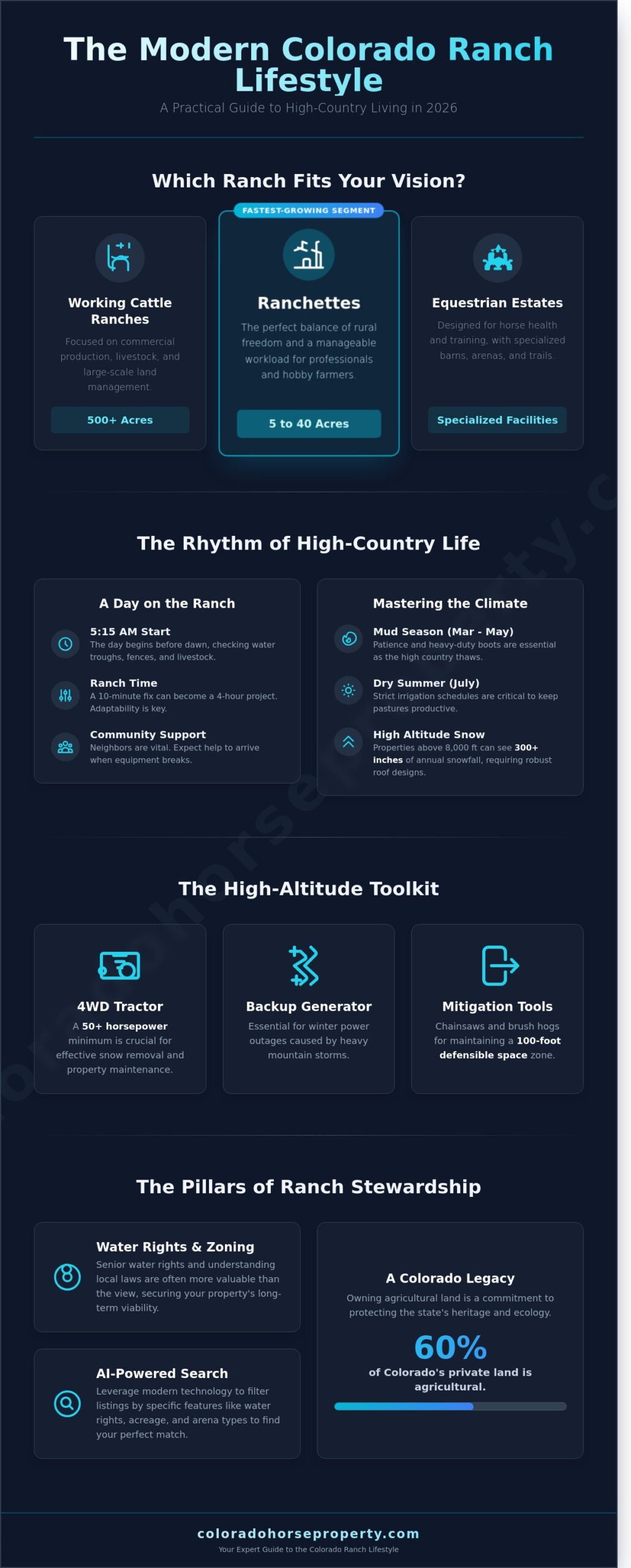
The type of property you choose defines your daily experience. Colorado’s diverse geography plays a massive role here. On the Front Range, you might find an equestrian estate with a 15,000 square foot heated arena and proximity to metropolitan hubs like Denver. Move toward the Western Slope near Montrose or Delta, and the focus shifts to senior water rights and larger acreage for livestock. Understanding these distinctions is vital:
- Working Cattle Ranches: Typically 500+ acres, focused on commercial production and grazing permits.
- Equestrian Estates: Properties designed for horse health, featuring specialized barns, turnouts, and riding trails.
- Ranchettes: Smaller parcels that offer rural benefits without the demands of a full-scale operation.
The Appeal of the Modern Ranchette
The ranchette is the fastest-growing segment of the Colorado ranch lifestyle in 2026. These properties typically range from 5 to 40 acres. They allow professionals to balance a high-level career with a “hobby farm” reality. With high-speed satellite internet now standard across the Rockies, owners manage global businesses from their home offices before heading out to check on their small herd or private greenhouse. It’s about personal freedom on a manageable scale.
Stewardship and the Colorado Legacy
Owning agricultural land comes with a unique set of responsibilities. You’re the protector of the iconic vistas that define the state. Data from 2025 shows that nearly 60% of Colorado’s private land is classified as agricultural, and maintaining this status is essential for local ecology. You’ll need to learn about noxious weed control and water conservation. Engaging with the local community at the Grange or the feed store ensures you’re preserving the heritage of the West while building your own legacy.
The Daily Rhythm: What Living on a Ranch in Colorado Really Looks Like
The Colorado ranch lifestyle begins at 5:15 AM. While the rest of the world sleeps, you’re likely checking water troughs for ice or walking the fence line to spot breaks caused by roaming elk. This daily rhythm isn’t just labor; it’s a meditative connection to your land. High-country living requires managing distinct seasons with precision. Mud season, typically spanning March through May, demands heavy-duty boots and patience as the ground thaws. By July, your focus shifts to strict irrigation schedules to keep your pastures productive during the dry summer heat.
Ranch time is a real phenomenon. A simple gate repair often reveals a rotted post or a rusted hinge, turning a ten-minute task into a four-hour project. These moments feel rewarding because they represent direct stewardship of your investment. In rural Colorado, community means everything. If your baler breaks down during the critical haying window, expect a neighbor to show up with their equipment. It’s a support system built on mutual respect and shared challenges that defines the region.
Mastering the Colorado Climate
Preparing for high-altitude weather is a year-round commitment. Properties above 8,000 feet often face 300 inches of annual snowfall, requiring roof designs that handle heavy snow loads. Every owner needs a specialized toolkit to maintain property value and safety:
- A 4WD tractor with a 50-horsepower minimum for effective snow removal
- A reliable backup generator for winter power outages caused by heavy storms
- Chainsaws and brush hogs for maintaining a 100-foot defensible space zone
Wildfire mitigation isn’t a one-time project. It’s a daily habit of clearing brush and thinning timber to protect your home and improve forest health.
Work-Life Balance on the Range
By 2026, high-speed satellite internet makes integrating remote work seamless. The Colorado ranch lifestyle offers a unique blend of physical labor and digital connectivity. You can manage a global team from a home office that overlooks your grazing horses. Designing your home as a command center is vital. This means building a dedicated mudroom to transition from the field to the desk without tracking in the outdoors. This lifestyle improves mental health by providing physical outlets for stress. Families bond over shared chores, building a legacy that transcends four walls. If you’re ready to start your journey, you can find your next Colorado ranch property with expert guidance.
The Heart of the Home: Colorado Equestrian Life and Facilities
A functional ranch depends on infrastructure that withstands the high-country climate. Your barn serves as the command center for the Colorado ranch lifestyle, requiring 1,200 square feet of hay storage for every four horses to last through a typical 180-day winter. Tack rooms need climate control to prevent leather rot and freezing of veterinary supplies. Efficient layouts prioritize workflow; a 12-foot wide center aisle allows for safe movement and equipment access.
Designing the Perfect Horse Barn
Colorado’s 40-degree daily temperature swings demand superior insulation. Use R-19 rated walls and vented soffits to keep air moving without creating dangerous drafts. For flooring, 3/4-inch recycled rubber mats over a crushed stone base provide the necessary drainage to prevent thrush and joint fatigue. An equestrian house is a residence where human and equine needs are architecturally integrated.
Arena and Trail Access
Year-round riding requires choosing between a $50,000 outdoor arena or a $150,000 indoor facility. Outdoor arenas in the Rockies need a 4-inch sub-base of compacted road base topped with 2.5 inches of washed angular sand to handle rapid snowmelt. Properties with direct gates into National Forest land or local hubs like Fox Run Park command a premium. Investing in professional-grade facilities can increase a property’s resale value by 15% to 22% compared to undeveloped acreage.
Effective pasture management keeps the land productive. Use rotational grazing with at least four distinct paddocks to prevent overgrazing on sensitive native grasses. This method reduces weed pressure by 40% and ensures horses have access to high-quality forage throughout the growing season. Living the Colorado ranch lifestyle means balancing land stewardship with recreational freedom. The social community thrives through local riding clubs and shared trailheads, turning a private ranch into a gateway for lifelong connections.
Beyond the Vista: Practical Realities of Ranch Stewardship
Owning a piece of the high country involves more than admiring the sunset from a wrap-around porch. The Colorado ranch lifestyle demands a hands-on approach to land management and a deep understanding of resource law. Successful owners view themselves as stewards rather than just residents. You’ll spend as much time reviewing water decrees and checking fence lines as you will in the saddle. Proper stewardship ensures your investment remains viable for the next generation while maintaining the agricultural integrity of the land.
Navigating Colorado Water Law
Water is the most valuable asset on any ranch. Colorado operates under the Prior Appropriation Doctrine, which means “first in time, first in right.” Senior water rights, established as far back as the 1860s, take priority over junior rights during dry years. If you hold junior rights, the state engineer can “call” the river, shutting off your supply to satisfy senior holders downstream. Well permits also vary significantly. A domestic well permit typically allows for watering livestock and up to one acre of garden, while a household-only permit restricts use strictly to indoor plumbing. Never purchase land without a certified water audit. This professional review confirms the validity of the water rights and ensures the historical use matches the legal decrees on file with the Colorado Division of Water Resources.
Zoning and Land Use
Zoning determines your daily operations. Most large parcels carry A-1 (Agricultural) zoning, which provides the broadest latitude for raising livestock and building barns. However, smaller parcels often fall under residential-equestrian zoning, which might limit you to one horse per 2.5 acres. You should also evaluate conservation easements. These legal agreements can reduce your property taxes by up to 50% by limiting future development, but they also restrict your ability to subdivide or build additional residences. Colorado’s ‘Right to Farm’ laws protect you from nuisance complaints regarding noise or odors, provided you follow established agricultural practices.
- Hay: High-quality mountain brome or alfalfa averages $14 per small square bale.
- Fencing: Budget $5 to $8 per linear foot for professional four-strand wire or post-and-rail repair.
- Veterinary: Annual equine wellness exams and vaccinations start at $250 per head, excluding emergency call-out fees.
- Taxes: Land with an Agricultural Classification is taxed at a lower assessment rate (currently 26.4% for most properties), saving owners thousands compared to vacant residential land.
Infrastructure requires constant vigilance. Septic systems in high-altitude rocky soils need pumping every three to five years to prevent costly leach field failures. Well pumps typically last 15 years; replacing a deep-well submersible pump can cost $4,000 or more depending on the depth. We help clients navigate these technical details to ensure their dream doesn’t become a financial burden. If you’re ready to find a property with proven water and infrastructure, search our current ranch listings today.
Transitioning to the Ranch: How to Find Your Ideal Colorado Property
Moving into the Colorado ranch lifestyle requires a shift from urban convenience to rural utility. You’ve got to separate your “must-haves,” like senior water rights or a 60-foot round pen, from “nice-to-haves” like updated kitchen cabinetry. In 2026, data shows that 84% of successful ranch buyers prioritize land quality and outbuilding functionality over the main residence’s interior finishes. Your search should focus on the soil, the slope, and the legal right to use the water flowing through the property.
- Identify Water Rights: Verify if the property includes adjudicated springs or well permits for livestock.
- Zoning Verification: Ensure the county allows the specific number of animal units you plan to keep.
- Access Logistics: Check if local roads support hay deliveries and trailer turnarounds during the winter months.
Using AI to Find Your Lifestyle
Standard real estate platforms often group horse properties with general rural residential listings. This leads to wasted hours. You need filters for “cross-fencing,” “loafing sheds,” or “indoor arenas” that standard algorithms miss. By leveraging Colorado Horse Property’s AI tool, you can cut your search time by approximately 40%. This technology scans listing data for specific equine infrastructure, ensuring you only tour properties that actually support your herd. It identifies specific amenities that general sites ignore, like specialized stall flooring or wash racks.
Working with Equestrian Specialists
A general realtor might miss a restrictive covenant that forbids a third horse or a specific type of fencing. You need a broker with “horse sense” and a deep understanding of the Colorado Front Range market. With nearly 40 years of experience, our team identifies red flags in zoning or soil composition long before you sign a contract. We guide you through the complexities of agricultural inspections, title commitments, and escrow. The transition to the Colorado ranch lifestyle is smoother when your advocate knows the difference between a decorative fence and a functional one.
The final hurdle involves more than a home inspection. You’ll need an agricultural assessment. This includes testing well-water flow rates, verifying perimeter fencing integrity, and confirming that the property maintains its tax-saving agricultural status. These steps protect your investment and ensure your move to the high country is a permanent success. Taking the first step from a digital search to your first property tour is about finding a partner who understands the land as well as the ledger.
Claim Your Future in the High Country
Embracing the Colorado ranch lifestyle means more than just owning acreage; it’s a commitment to land stewardship and the daily rhythms of the high country. Successful ranching in 2026 requires a deep understanding of water rights, zoning laws, and the specialized infrastructure needed for equine health. Whether you’re focused on building a premier training facility or maintaining a private family legacy, the right foundation makes all the difference. You don’t have to navigate these complex variables alone when you have access to nearly 40 years of local expertise.
Industry veterans Mark and Alison Eibner have spent four decades helping buyers find properties that align with their specific lifestyle and dreams. Their team uses proprietary AI search technology to filter listings by precise equestrian features like soil type, barn configurations, and pasture quality. This data-driven approach ensures you find a home that supports your goals from day one. It’s time to turn your vision of rural freedom into a reality. Start your AI-powered search for the perfect Colorado ranch today and join a community that values the heritage of the American West.
Frequently Asked Questions
Is living on a ranch in Colorado a full-time job?
Living on a Colorado ranch is a full-time commitment if you manage livestock or production land. For a 35 acre parcel with four horses, expect to spend 15 to 20 hours weekly on basic chores like mucking, feeding, and fence repair. Larger operations exceeding 200 acres typically require 40 plus hours of labor per week. It’s a demanding schedule that follows the sun rather than a clock.
How many acres do I need for two horses in Colorado?
You need a minimum of 5 to 10 acres to support two horses in Colorado’s semi-arid environment. The Colorado State University Extension recommends 2.5 to 5 acres of grazeable land per horse to prevent overgrazing of native grasses. If you have less than 10 acres, you’ll likely need to supplement their diet with hauled-in hay for 12 months of the year to maintain pasture health.
What are the biggest challenges of the Colorado ranch lifestyle?
Managing extreme weather and water scarcity are the most significant hurdles for owners. In 2024, high-country ranchers faced snowfalls exceeding 40 inches in single storms, requiring heavy machinery for basic access. The Colorado ranch lifestyle also requires navigating complex water laws. Since 80 percent of the state’s water is on the Western Slope, property owners must strictly follow their decreed water rights to avoid legal fines.
Can I have a ranch lifestyle if I work a 9-to-5 job?
You can balance a professional career with a ranch if you choose a property under 40 acres with automated infrastructure. Remote work in rural Colorado grew by 25 percent since 2020, allowing more people to manage chores between meetings. You’ll need to invest in heated automatic waterers and solar-powered gate systems. These tools help you maintain the Colorado ranch lifestyle without needing to be physically present every hour of the day.
How do water rights affect my daily life on a Colorado ranch?
Water rights dictate exactly how and when you can use water for irrigation, livestock, or domestic needs. Colorado uses the Prior Appropriation System, meaning a 1910 water decree has priority over a 1980 decree during dry seasons. You can’t simply dig a pond or divert a stream because you own the land. Understanding your specific priority date is vital for planning your summer grazing and hay production schedules.
Is it difficult to find horse-ready properties near Denver?
Finding turnkey horse properties within 45 minutes of Denver is challenging because only 12 percent of current listings feature existing barns and arenas. Most buyers look toward Douglas or Elbert counties, where 5 to 20 acre parcels are more common. You should expect to pay a 15 to 20 percent price premium for properties that already have perimeter fencing and permitted domestic wells that allow for livestock watering.
What is the difference between a ranch and a ranchette?
A ranch is typically a property over 40 acres used for commercial agriculture, while a ranchette is a residential lifestyle property between 2 and 15 acres. Ranchettes focus on hobby animals and privacy rather than generating primary income from the land. In 2025, the market for 10 acre ranchettes saw an 18 percent increase in demand from buyers who wanted the rural feel without the massive overhead of a production ranch.
What should I look for in a Colorado horse barn?
You must prioritize structural integrity for 30 pound snow loads and excellent ventilation to handle the dry, dusty climate. Look for 12×12 foot stalls and a concrete center aisle to reduce dust and improve horse respiratory health. A 2023 survey of local builders showed that barns with insulated roofs stay 10 degrees warmer in January, which is a critical factor when Colorado temperatures drop below zero for extended periods.