
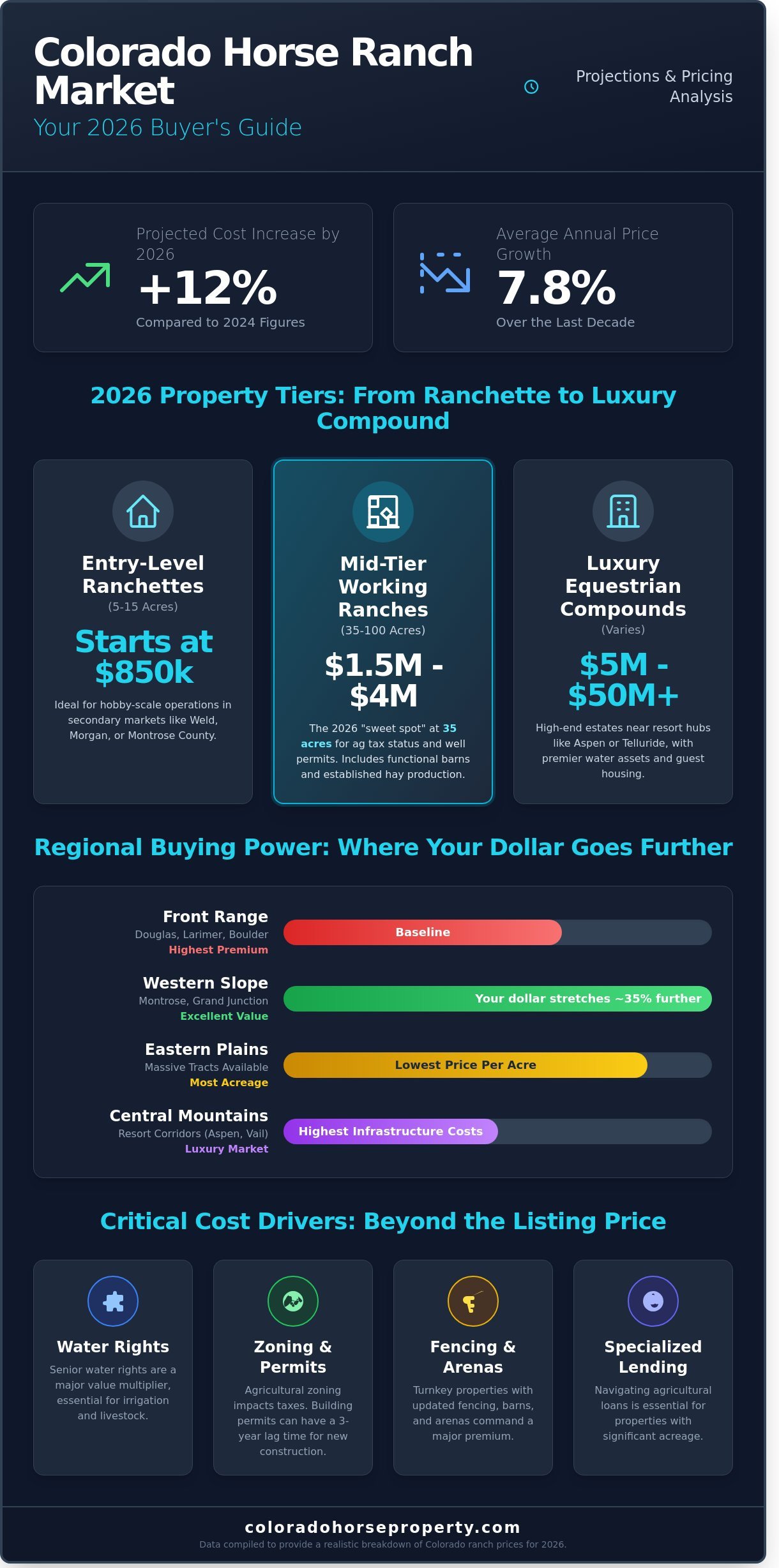
By 2026, the average cost of buying a horse ranch in Colorado’s Front Range is projected to sit 12% higher than 2024 figures, placing a major premium on well-maintained equine facilities. You’ve likely experienced the sticker shock that comes with searching for land near Denver or Colorado Springs, only to find that the listing price doesn’t include the infrastructure you actually need. It’s a common frustration to realize that a 40 acre property might look perfect on paper but lacks the senior water rights or updated fencing required for a functional ranch. We know you’re looking for more than just a home; you’re looking for a property that supports your lifestyle and dreams.
This guide delivers a realistic breakdown of Colorado ranch prices, regional variations, and the hidden costs of equestrian ownership in 2026. We will walk you through a clear regional price map, explain the complexities of financing rural land, and provide a checklist of non-negotiable cost drivers like well permits and arena grading. With nearly four decades of experience in the rural market, we’ve compiled the data you need to move from browsing listings to making a confident, informed offer on your next horse property.
Key Takeaways
- Identify 2026 market entry points for “ranchettes” and understand why the shift toward turnkey equestrian estates is driving current valuations.
- Compare the “Front Range Premium” against high-value opportunities on the Western Slope to determine where your budget buys the most acreage.
- Learn how water rights and specific zoning regulations directly impact the total cost of buying a horse ranch in Colorado.
- Navigate the complexities of agricultural lending and discover why specialized ranch loans are essential for properties with significant acreage.
- Leverage AI-driven search strategies and decades of expertise to find mispriced listings and fulfill your dream of a rural lifestyle.
The 2026 Colorado Ranch Market: Current Price Ranges
The 2026 market marks a definitive shift toward turnkey equestrian estates. Buyers now prioritize properties with existing infrastructure like indoor arenas and fenced pastures to avoid the three-year lag time typical of new construction permits. This demand keeps the cost of buying a horse ranch in Colorado competitive, especially for parcels with senior water rights. This market stability is anchored by Colorado’s $47 billion agriculture industry, which provides a solid economic foundation for land values across the Front Range and Western Slope.
To see how luxury features and functional ranching intersect in today’s market, watch this tour of a premier Western Colorado property:
Pricing in 2026 falls into three distinct categories based on acreage and infrastructure quality:
- Entry-level Ranchettes (5-15 acres): These hobby-scale properties start at $850,000 in secondary markets like Weld, Morgan, or Montrose County.
- Mid-tier Working Ranches (35-100 acres): Expect a price range of $1.5M to $4M for properties with functional barns, equipment sheds, and established hay production.
- Luxury Equestrian Compounds: High-end estates near resort hubs like Aspen, Steamboat Springs, or Telluride command between $5M and $50M depending on water assets and guest housing.
Ranchette vs. Working Ranch
Smaller parcels often carry a higher price-per-acre ratio. This happens because the fixed costs of a high-end home and a professional barn are compressed into fewer acres. For private horse owners, the 35-acre parcel remains the 2026 sweet spot. This size typically allows for domestic well permits and agricultural tax status without the heavy overhead of a commercial cattle operation. It’s the ideal balance for those seeking the cost of buying a horse ranch in Colorado that offers both privacy and manageable maintenance.
The 2026 Appreciation Outlook
Colorado land values have consistently outpaced residential-only real estate over the last 24 months. High-speed satellite internet expansion has made 40-acre parcels viable for remote executives, sustaining high demand in previously isolated rural corridors. Over the last decade, Colorado horse property has seen an average annual price growth of 7.8%. This steady climb reflects the dwindling supply of large, unfragmented parcels near major metropolitan hubs like Denver and Colorado Springs.
Regional Price Breakdown: Where Your Dollar Goes Furthest
Geography dictates the cost of buying a horse ranch in Colorado more than any other factor. You aren’t just paying for the acreage; you’re paying for the view, the water rights, and the commute. The Front Range, including Douglas, Larimer, and Boulder counties, carries a significant premium. In 2025, a functional 10-acre horse property in Parker or Castle Rock often starts at $1.8 million. These areas stay expensive because they offer proximity to Denver’s job market and the state’s premier show circuits.
The Western Slope provides a different value proposition. In Montrose and Grand Junction, your dollar stretches roughly 35% further than in the Front Range. These regions offer longer growing seasons and better access to public land riding. If your goal is pure acreage, the San Luis Valley remains the state’s final frontier for affordability. It’s common to find 40-acre parcels here for under $600,000, though you must account for the high-altitude climate and limited local services. For those seeking luxury, resort corridors like Aspen or Steamboat Springs operate on a different scale. Scarcity in these valleys pushes 20-acre ranch prices well above $8 million.
Comparing Cost Per Acre by Region
- Front Range: Expect high demand and limited supply. Prices reflect the value of the “lifestyle” commute and proximity to the Colorado Horse Park.
- Central Mountains: You’ll pay more for less usable dirt. Buildable, flat terrain is rare, and winter access requirements drive up infrastructure costs.
- Eastern Plains: This region offers the lowest price per acre. While you can secure massive tracts of land, you’ll face higher costs for hay delivery and specialized equine veterinary travel.
According to the latest data on Colorado agricultural land values, the state’s farm real estate value has seen a steady climb of approximately 6% annually since 2022. This trend directly impacts the cost of buying a horse ranch in Colorado, especially in areas where agricultural land is being converted to residential equine estates.
Proximity to Equestrian Hubs
Location relative to the Colorado Horse Park in Parker adds a 15% to 20% price floor to nearby properties. Serious competitors often prioritize being within a 45-minute drive of this venue. Distance also impacts your monthly overhead. Being “near town” means lower trip charges for mobile vets and more reliable hay delivery. If you choose a true off-grid ranch in a remote county, expect to pay a premium for every service call. Before you commit to a specific zip code, browse current listings by county to see how regional prices shift in real-time.
Critical Cost Drivers: Beyond the Listing Price
Calculating the true cost of buying a horse ranch in Colorado requires looking past the glossy listing photos. In 2026, land use regulations and utility access carry more weight than the square footage of the home. You must verify the specific zoning for any property before making an offer. Many buyers assume a 10-acre lot automatically permits a dozen horses, but county codes in areas like Douglas or Boulder often limit density to one or two animal units per half-acre of grazeable land. If the soil is degraded or the topography is too steep, your actual carrying capacity drops significantly.
Soil quality directly impacts your monthly overhead. In 2026, local alfalfa-grass mixes average $14 per small square bale. A property with high-quality mountain brome or orchard grass can save a rancher $2,500 per horse annually in supplemental feed costs. Conversely, land with poor drainage or high alkaline levels will require expensive soil amendments and frequent pasture rotation to remain viable.
The Value of Colorado Water Rights
Colorado operates on the “first in time, first in right” doctrine. Senior water rights, often dating back to the 1880s, ensure your pastures stay green while neighbors with junior rights get shut off during August droughts. For those looking to secure land with these essential assets, Colorado’s Beginning Farmer Program offers specialized financing to help new owners manage these high-capital acquisitions. Well permits also vary; a “household use only” well won’t allow you to water a single horse. In the high desert, a ranch without adjudicated water rights is not an asset; it is a financial liability that limits your herd size and kills resale value.
Equestrian Infrastructure Costs
Building new facilities in the Rockies is a major investment. Construction costs for agricultural buildings have surged 28% since 2023 due to labor shortages and material transport fees. To help you budget, here are the 2026 price estimates for common additions:
- 4-Stall Barn: A standard 36×48 foot barn with a tack room and wash rack costs between $160,000 and $195,000.
- Outdoor Arena: A 100×200 foot arena with professional-grade footing and drainage starts at $58,000.
- Indoor Arena: Insulated steel structures of 80×120 feet currently average $275,000 before electricity and lighting.
- Fencing: Three-rail wood fencing costs $14 to $19 per linear foot. Perimeter fencing for a 35-acre parcel can easily exceed $30,000.
When evaluating the cost of buying a horse ranch in Colorado, properties with existing, well-maintained infrastructure usually offer better value than raw land. Retrofitting an old cattle barn for equine safety often costs more than building from scratch once you account for stall kits and floor leveling.
Financing Your Dream: Ranch Loans and Incentives
Traditional lenders often stumble when a property exceeds 10 acres. Most big-box banks use automated underwriting systems designed for suburban subdivisions; they simply don’t have the data to value a $200,000 indoor arena or 40 acres of sub-irrigated pasture. If the “dirt value” of the land outweighs the value of the home, your standard 30-year fixed mortgage will likely be denied. You’ll need to work with specialized agricultural lenders like American AgCredit or Premier Farm Credit. These institutions understand the cost of buying a horse ranch in Colorado and base their valuations on the land’s production capacity rather than just comparable neighborhood sales.
Expect higher entry costs for these transactions. While a residential home might require only 3.5% or 5% down, land-heavy ranch deals usually demand 20% to 35% down. Lenders view large acreage as a higher risk because it’s less liquid than a standard home. You’ll also need to demonstrate a “path to production” if you’re seeking the best rates, which might include a business plan for boarding horses or harvesting hay.
Agricultural vs. Residential Financing
Most buyers aim for agricultural tax status to keep ownership costs manageable. In Colorado, properties classified as “Ag” can see property tax reductions of up to 90% compared to residential rates. To qualify, you must prove the land is used for a primary purpose of making a profit, such as grazing livestock or commercial equine operations. Additionally, you might consider a conservation easement. This legal agreement restricts development on your land in exchange for significant state tax credits; often worth 50% to 90% of the donated land value; which you can sell for cash to offset your initial purchase price.
Hidden Closing Costs for Ranches
Beyond the down payment, ranch buyers face unique due diligence expenses. You’ll likely spend $3,000 to $8,500 on an ALTA survey to verify fence lines and easements. Title insurance is also more complex here. Because water is a severed right in Colorado, you must pay for a specialized water rights search to confirm your wells or ditch shares are senior and valid. Don’t forget the Phase I Environmental Site Assessment; costing roughly $2,500; which lenders require to ensure the land isn’t contaminated by old fuel tanks or agricultural chemicals. To navigate these complexities, consult with our ranch specialists who understand the nuances of rural Colorado transactions.
Finding Value with Colorado Horse Property
Securing a fair price in the 2026 market requires more than just browsing public listings. The true cost of buying a horse ranch in Colorado is often hidden in the details of water seniority, soil composition, and existing equine infrastructure. Many buyers overpay because they lack the tools to identify mispriced assets or properties with undervalued improvements. We bridge that gap by combining high-tech data analysis with four decades of boots-on-the-ground experience.
Our team focuses on the specific variables that dictate long-term ranch value. We don’t just look at the house; we analyze the utility of the barn, the condition of the fencing, and the legality of the well permits. This specialized approach ensures that your investment supports both your financial goals and your daily riding needs. From the initial valuation to the final escrow coordination, we manage every technical hurdle to ensure a clean title and a fair closing.
Our AI-Driven Approach
We’ve streamlined the search process by deploying proprietary AI tools that filter listings based on professional equine standards. Instead of wading through generic “rural” properties, our system targets specific features like 100×200 foot indoor arenas, sub-irrigated pastures, and sandy loam soil types. This technology allows us to pinpoint properties that are priced below market value due to poor categorization in the standard MLS.
- Water Rights Verification: We filter for senior rights and domestic well permits that allow for livestock watering.
- Infrastructure Analysis: Our system calculates the replacement cost of existing barns and outbuildings to determine true asset value.
- Efficiency: Clients save an average of 45 to 60 days of searching by only touring properties that meet 95% of their “Lifestyle and Dreams” criteria.
By connecting with the Realty Oasis ecosystem, you gain access to a seamless closing process. We coordinate with specialized inspectors and agricultural lenders who understand the nuances of the cost of buying a horse ranch in Colorado, ensuring your financing stays on track.
Your Next Steps in the Colorado Market
The first step toward owning your dream ranch is a strategy session with Mark and Alison Eibner. We’ll help you define your must-have features, from turnout sheds to trail access, and build a customized search profile that works while you sleep. Our 40 years of local connections often grant our clients early access to “off-market” gems that never reach the public eye.
Don’t settle for a generic real estate experience. You need a partner who knows the difference between a hobby farm and a functional equine facility. Start your AI-powered horse property search today and let us find the value others are missing.
Secure Your Colorado Ranch Legacy Today
Navigating the 2026 market requires a sharp eye for value and a deep understanding of rural infrastructure. You’ve seen that entry-level horse properties now start near $1.2 million, while premier equestrian estates frequently top the $10 million mark. Location remains the biggest variable; properties on the Western Slope often provide twice the acreage for the same price as Front Range listings. Remember that senior water rights and pre-existing arenas can add 20% or more to a property’s long-term valuation.
Calculating the total cost of buying a horse ranch in Colorado is simpler when you have nearly four decades of specialized real estate experience on your side. We offer full-cycle transaction management to ensure every barn, pasture, and water right is legally protected. Our specialized AI search for barns, arenas, and water rights helps you find the perfect fit without the manual headache. It’s time to stop searching and start living the lifestyle you’ve worked for.
Find your next Colorado Horse Property with AI
Colorado’s wide-open spaces and mountain vistas are waiting for you and your horses.
Frequently Asked Questions
How many acres do I need for two horses in Colorado?
You should plan for at least 5 to 10 acres to sustainably support two horses in Colorado’s semi-arid environment. While some local zoning codes allow one horse per 0.5 acres, the actual carrying capacity of native shortgrass prairie is much lower. In counties like Douglas or Elbert, 10 acres ensures your horses have enough room to move without completely destroying the sensitive topsoil and vegetation.
Is it cheaper to buy raw land or a developed horse ranch?
Buying an existing, developed ranch is almost always cheaper than building from scratch because infrastructure costs have risen 35% since 2022. When you buy raw land, you’ll spend between $150,000 and $400,000 just for a well, septic system, power lines, and basic perimeter fencing. Established properties include these essentials in the purchase price, saving you from the two-year timeline required for new construction permits and contractor schedules.
What is the average property tax on a Colorado horse ranch?
Property taxes for a residential ranch average about 0.50% to 0.70% of the market value, but this changes if the land is classified as agricultural. For a $1,200,000 property without an exemption, you might pay $7,200 annually. Properties with an “Ag” status see their land value assessed based on production capacity rather than market price, which often slashes the tax bill by 75% or more compared to standard residential rates.
Do all Colorado ranches come with water rights?
No, water rights are a separate real estate interest in Colorado and don’t automatically transfer with the land. You must verify that the deed specifically includes “absolute” or “conditional” water rights as defined by the 1876 State Constitution. Many smaller properties rely solely on a “household use only” well permit, which legally prevents you from watering a large garden or providing water for more than a few head of livestock.
Can I get a VA or FHA loan for a horse property?
You can use VA or FHA loans for horse properties, but these programs often limit the land’s value to 30% of the total appraised price. Lenders also require the property to be primarily residential rather than a commercial boarding operation. When calculating the cost of buying a horse ranch in Colorado, many buyers find that a 20% down payment on a conventional or farm credit loan provides better terms for large acreage parcels.
What are the most affordable counties for horse property in Colorado?
Huerfano, Las Animas, and Morgan counties currently offer the lowest prices for equine-ready acreage in 2026. In these areas, 35-acre parcels with existing homes often list for under $575,000. This is a significant discount compared to the Front Range corridor, where similar properties in Boulder or Jefferson counties frequently command prices exceeding $2,500,000 due to high demand and limited land availability.
How does the “Agricultural Exemption” work for property taxes?
The Agricultural Exemption reduces taxes by assessing land based on its ability to generate income from livestock or crops. To qualify under Colorado Revised Statute 39-1-102, you must prove the land was used for a primary purpose of making a profit for the previous two years. This might involve leasing your pasture to a local cattle rancher or keeping a specific number of horses for a commercial breeding or training business.
What should I look for in a ranch inspection that is different from a home inspection?
A ranch inspection must include a 4-hour well recovery test and a specialized septic inspection designed for high-capacity systems. You need to confirm the well produces at least 5 to 10 gallons per minute to handle both household and livestock needs during dry summer months. Inspectors should also check the structural integrity of barn foundations and the safety of electric fencing, as replacing these items can cost $12 per linear foot.