
What if the 10-acre lot you just fell in love with has zero legal right to pump more than 0.5 acre-feet of water annually for your livestock? It’s a harsh reality that many buyers face when they don’t account for the complex water decrees in Douglas County. You’ve likely spent months scrolling through listings, searching for Castle Rock CO equestrian homes that offer both the space for a professional-grade arena and a reasonable 40-minute drive to the Denver Tech Center.
We understand that you aren’t just buying a house; you’re investing in your lifestyle and dreams. With nearly four decades of experience in the Colorado horse market, we’ve seen how quickly a dream property can turn into a legal headache without the right expertise. This guide provides the exact roadmap you need to navigate 2026 market trends, from securing sustainable water rights to identifying move-in-ready properties with direct access to the 1,000-acre Dawson Butte trail system. You’ll learn how to interpret current zoning laws and why a specific well permit can make or break your ability to keep three or more horses on your land.
Key Takeaways
- Discover why premier neighborhoods like Keene Ranch and Bell Mountain Ranch set the gold standard for luxury acreage and private trail systems.
- Master the complexities of Douglas County zoning and water rights to ensure your land legally supports your specific animal unit requirements.
- Learn how to evaluate professional-grade equestrian facilities, from critical barn ventilation to selecting the ideal arena footing for your riding discipline.
- Navigate the competitive market for Castle Rock CO equestrian homes with expert insights into balancing rural functionality with proximity to major employment hubs.
- Leverage proprietary AI technology to identify specialized property features like senior-horse-friendly topography and indoor arenas that traditional search platforms miss.
Why Castle Rock CO Equestrian Homes are the Front Range Gold Standard
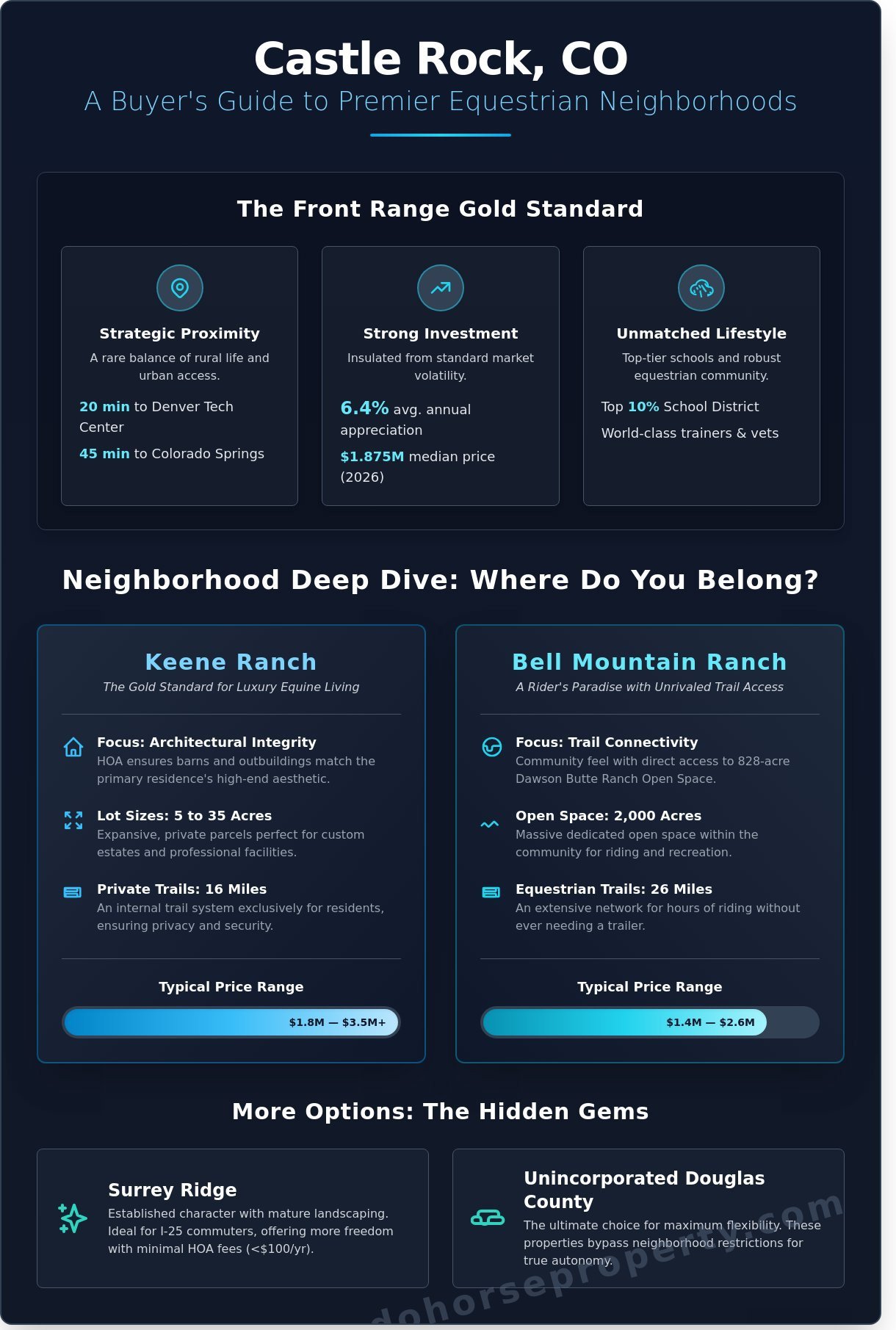
Castle Rock represents a rare balance in Douglas County. It is the place where high-end custom builds meet the gritty requirements of a working horse ranch. These properties offer a 20-minute commute to the Denver Tech Center and a 45-minute drive to Colorado Springs. This accessibility makes Castle Rock CO equestrian homes the top choice for professionals who need to be in the boardroom by day and in the arena by sunset. The local market stays resilient because it caters to a specific, high-intent buyer who values both land and luxury.
The local culture supports this lifestyle through every season. You will find a dense network of support including:
- World-class trainers specializing in hunter-jumper and western pleasure disciplines located near Bell Mountain Ranch.
- Specialized equine veterinarians and mobile clinics located within a 15-mile radius.
- Proximity to the Colorado Horse Park in nearby Parker for competitive events.
- High-end tack shops and feed stores like Murdoch’s Ranch & Home Supply that understand the needs of Douglas County ranchers.
The Lifestyle and Dreams of Douglas County Living
Mornings here mean saddling up with clear views of Pikes Peak and the Sleeping Indian. You get the privacy of a 5 to 35-acre ranchette while staying within the boundaries of the Douglas County School District. This district consistently ranks among the top 10% of performers in the state. Many buyers choose Castle Rock over Parker or Elizabeth because it offers a more refined infrastructure and quicker access to the I-25 corridor. It is the perfect middle ground for those who want a rural feel without the isolation of the eastern plains.
Investment Potential of Castle Rock Horse Properties
Land is a finite resource along the Front Range. In the 80104 and 80109 zip codes, 5+ acre parcels have maintained an average annual appreciation rate of 6.4% over the last decade. The scarcity of large acreage near major transit corridors drives consistent long-term demand. Investors and homeowners recognize that Castle Rock CO equestrian homes are insulated from the volatility often seen in standard suburban housing markets. In 2026, the median price for Castle Rock horse properties featuring a minimum of five acres and established equine facilities is $1,875,000.
Premier Equestrian Neighborhoods in Castle Rock
Castle Rock provides a diverse landscape for horse owners, ranging from high-desert mesas to lush creek bottoms. Finding the right fit depends on your specific needs for acreage, trail access, and local regulations. The market for Castle Rock CO equestrian homes stays competitive because of the unique topography that allows for both privacy and community connectivity. Buyers often choose this area to balance a professional career in the Denver Tech Center with a rural lifestyle.
Keene Ranch vs. Bell Mountain Ranch: Which is Right for You?
Keene Ranch is often considered the gold standard for luxury equine living. It features 535 custom home sites on lots ranging from 5 to 35 acres. The HOA here is diligent about architectural integrity; you’ll find that barns and outbuildings must mirror the primary residence’s aesthetic. If you want 16 miles of private, internal trails, this is your spot. Prices here typically start at $1.8 million and can climb well past $3.5 million for estates with professional-grade indoor arenas.
Bell Mountain Ranch offers a different lifestyle focused on massive trail connectivity. With 26 miles of equestrian trails and 2,000 acres of dedicated open space, it’s a rider’s paradise. It sits adjacent to the 828-acre Dawson Butte Ranch Open Space, providing hours of riding without ever trailering your horse. While lot sizes are generally smaller than the largest Keene Ranch parcels, the community feel is strong. You’ll find most properties here priced between $1.4 million and $2.6 million.
Hidden Gems: Surrey Ridge and Unincorporated Douglas County
Surrey Ridge is an established neighborhood located near I-25 at exit 192. It’s a favorite for those who need a quick commute to Denver. Homes here were often built in the 1970s and 1980s, offering more architectural variety and mature landscaping. The HOA fees are minimal, often staying under $100 annually, which provides more freedom for your property’s layout. It’s an excellent place to find Castle Rock CO equestrian homes with character and lower overhead costs.
For those seeking maximum flexibility, unincorporated Douglas County is the best bet. These “pocket” listings often bypass traditional neighborhood restrictions altogether. If you plan to run a small boarding or training business, look for A-1 zoned land. This zoning typically allows one horse per half-acre of land, though it’s vital to verify specific water rights for any commercial use. If you’re ready to narrow down your search, you can view current listings and search by acres to find the perfect fit for your herd.
- Castlegate: Smaller 2-5 acre options perfect for hobbyists or those with one or two retired horses.
- Plum Creek Corridor: Features lush valley views and sub-irrigated meadows that provide excellent soil for grazing.
Navigating Douglas County Zoning and Water Rights
Douglas County’s Large Rural Residential (LRR) designation governs the majority of Castle Rock CO equestrian homes. This zoning typically requires a minimum of 5 acres to qualify for horse privileges. Understanding the math of animal units is vital before you sign a contract. In Douglas County, the LRR zoning allows for 2 animal units on the first 5 acres. One horse equals one animal unit. If you scale up to a 35-acre parcel, the density rules change, often allowing for more significant numbers based on land health and specific sub-area plans. You’ll find these details buried in Section 17 of the Douglas County Zoning Resolution, which also dictates how you manage manure and grazing rotation.
Don’t assume a large lot automatically comes with the right to build a massive indoor arena. The county limits the total square footage of accessory buildings based on your primary residence’s size and total acreage. For properties between 5 and 10 acres, you’re often looking at a maximum footprint that prevents commercial-scale operations. If your dream includes a 20,000-square-foot riding hall, you’ll likely need to focus your search on parcels exceeding 35 acres where “Use by Right” rules are more flexible.
Colorado Water Law 101 for Horse Owners
Your well permit is the most critical document in a rural real estate transaction. Many properties under 35 acres operate on “Household Use Only” permits issued after May 8, 1972. These permits don’t legally allow you to water a single horse or garden. You must verify that the property has a “Domestic and Livestock” permit. During your 30-day due diligence period, hire a licensed professional to perform a four-hour drawdown test. A well producing 5 gallons per minute is standard; however, a 10-gallon-per-minute flow provides a much safer buffer during dry Front Range summers.
Zoning Restrictions for Barns and Arenas
Building codes in Castle Rock are strict regarding structure placement and height. Most LRR zones cap accessory building heights at 35 feet, which can be tight for professional-grade indoor arenas requiring high clearances. You must adhere to a 50-foot setback from all property lines for any building housing livestock. If you plan to install outdoor lighting for night riding, you’ll need to follow “Dark Sky” ordinances. This means all fixtures must be fully shielded and downward-facing to prevent light spill onto neighboring 35-acre tracts. You’ll also need a specific drainage plan to manage runoff from large roof surfaces into local watersheds.
Evaluating Equestrian Facilities: Beyond the House
When you tour Castle Rock CO equestrian homes, your inspection must extend far beyond the kitchen and bedrooms. The utility of the land determines your daily workload and your horses’ safety. Start with the “Trailer Test” before you even unbuckle your seatbelt. A standard three-horse gooseneck trailer requires at least a 50-foot turning radius to maneuver without jackknifing. Check that driveways offer 14 feet of vertical clearance to avoid low-hanging branches or eave strikes. If you can’t comfortably park and turn a large rig, the property’s functional value drops significantly.
Arena quality is another critical factor. Many properties in Douglas County sit on clay-heavy soil which retains water and creates slick spots. Look for existing arenas that have a 4-to-6-inch compacted sub-base. The top layer or “footing” should ideally be a mix. While pure sand is common, a 20% addition of GGT felt or crumb rubber provides the rebound necessary for high-performance disciplines. This reduces joint strain and extends your horse’s competitive career.
The Essentials of a High-Quality Horse Barn
Colorado winters demand specific barn features. A wash rack without a 4-inch dedicated drain and a commercial-grade heating element becomes a block of ice by December. Ensure the tack room has 3.5-inch fiberglass batts or spray foam insulation to keep temperatures above 50 degrees. This protects expensive leather and prevents medications from freezing. Existing outbuildings should have 200-amp service to handle tank heaters and arena lighting simultaneously. For safety, prioritize barns built with fire-resistant steel framing or CMU blocks rather than traditional timber to mitigate risks during the dry season on the Front Range.
Pastures and Fencing: Safety and Sustainability
Castle Rock sits in a high-desert climate where 35 inches of annual evaporation makes pasture management a challenge. Most 10-acre parcels can’t support 24/7 grazing without turning into dust bowls. Look for Castle Rock CO equestrian homes with established dry lots or “sacrifice zones” and cross-fencing for strict rotation. Pipe fencing is the most durable choice for this terrain, though 4-strand Centaur polymer offers excellent visibility and “give” for spirited horses. Be vigilant about Douglas County’s native vegetation; identify and remove toxic plants like Locoweed or Houndstongue which can thrive in overgrazed areas.
Find Your Dream Property with Our AI-Powered Search
Finding the right Castle Rock CO equestrian homes requires more than a standard real estate search engine. General property search platforms often overlook the granular details that matter to horse owners. Our proprietary AI technology analyzes listing data to identify specific features like loafing sheds, hay storage capacity, and perimeter fencing types. You can filter your search for properties with 10+ acres, existing indoor arenas, or even senior-horse-friendly topography that avoids steep, rocky inclines. We combine this cutting-edge tech with our 40 years of boots-on-the-ground experience to ensure you don’t waste time on properties that look good on paper but fail the practical test.
Specialized buyer representation is a critical advantage in this niche market. While our services are free for you as a buyer, our expertise saves clients an average of $12,500 through savvy negotiations and identifying hidden property defects. We understand the value of a well-maintained barn versus a teardown, and we use that data to protect your investment.
The Realty Oasis Difference: Expertise You Can Trust
Mark and Alison Eibner bring nearly four decades of specialized knowledge to every transaction. They understand that an agricultural estate isn’t just a house; it’s a complex asset involving water rights, specific zoning laws, and specialized infrastructure. Our network includes vetted partners like arena builders, hay suppliers, and title companies who specialize in rural land. We manage these intricate details so you can focus on your horses. We’ve closed hundreds of transactions involving complex land use issues, ensuring your lifestyle and dreams are protected by solid contracts.
Start Your Castle Rock Search Today
Don’t miss out on the perfect acreage in the 80104 or 80109 zip codes. You can set up custom alerts that notify you the second new Castle Rock CO equestrian homes hit the market. Whether you’re looking for a private 35-acre ranch or a luxury estate in a community like Bell Mountain Ranch, we provide the data you need to move fast. Contact us to schedule a private tour of the area’s most exclusive equestrian properties.
Ready to begin? Search Castle Rock Equestrian Homes with our AI Tool Now
Secure Your Future in Castle Rock’s Premier Horse Country
Finding the right property in 2026 requires more than just a love for horses; it demands a deep understanding of Douglas County’s specific zoning laws and complex water rights. You now know that evaluating a high-quality barn or professional arena is just as vital as inspecting the home’s interior. Navigating these technical details is easier when you have 38 years of Colorado real estate experience on your side. We specialize in the nuances of local land, ensuring your investment supports your long-term lifestyle and dreams.
Our platform uses proprietary AI technology to filter listings by the exact number of acres and specific equine amenities you need. This saves you hours of manual searching and prevents the frustration of looking at properties that don’t meet your technical requirements. Whether you’re looking for a private trail setup or a professional-grade training facility, the right Castle Rock CO equestrian homes are currently hitting the market. We’re ready to help you find the perfect match for your herd and your family.
Find Your Castle Rock Equestrian Home with Our AI Search Tool
Frequently Asked Questions
How many horses can I have on a 5-acre property in Castle Rock?
You can typically keep 4 horses on a 5-acre property in Douglas County under Large Rural Residential (LRR) zoning. This standard allows 1 horse per 1/2 acre of usable land after accounting for your home, driveway, and other structures. Always verify your specific parcel’s plat map at the Douglas County Planning Office. They enforce these limits to prevent overgrazing and protect the local watershed.
What are the best equestrian trails near Castle Rock, Colorado?
Dawson Butte Ranch Open Space offers the premier trail experience with an 8-mile loop designed specifically for riders. It features 16 horse-friendly obstacles and soft surface paths that are easy on hooves. Another top choice is the 4.7-mile trail at Hidden Mesa Open Space. These trails provide the direct access to nature that buyers of Castle Rock CO equestrian homes prioritize for their daily rides.
Do I need a specific well permit to water my horses in Douglas County?
You need a “Domestic” or “Domestic and Livestock” well permit from the Colorado Division of Water Resources to legally water horses. A standard “Household Use Only” permit, often found on lots smaller than 35 acres, prohibits outdoor watering or livestock. If your permit number starts with “Domestic,” you can typically water your animals and up to 2,000 square feet of garden or lawn.
What is the average price for a horse property in Castle Rock in 2026?
Market projections suggest the average price for a 5-acre horse property in Castle Rock will reach $1.85 million by 2026. This estimate reflects a 4.5% annual appreciation rate based on Douglas County sales data from 2020 to 2024. Demand for luxury Castle Rock CO equestrian homes continues to outpace supply. Buyers should budget at least $2.2 million if they require a professional-grade indoor arena.
Are there any equestrian-friendly HOAs in Castle Rock?
Bell Mountain Ranch and Keene Ranch are the two most prominent equestrian-friendly communities in the area. Bell Mountain Ranch features 20 miles of private equestrian trails and allows outbuildings on most 5-acre to 10-acre lots. Keene Ranch offers similar amenities with a focus on larger custom estates and private barn structures. Both communities have specific architectural committees that review barn designs to ensure they meet neighborhood standards.
What should I look for in a riding arena’s footing before buying?
Look for a sub-base consisting of 4 to 6 inches of compacted crushed stone or clay. The top layer should have 2.5 inches of washed angular sand mixed with geotextile fibers to provide stability and cushion. Avoid arenas with “round” sand because it shifts too much under a horse’s weight. Proper drainage is vital; the arena should have a 1% slope to prevent water from pooling after a Colorado thunderstorm.
How do water rights affect the resale value of a Castle Rock ranch?
Deeded water rights can increase the resale value of a Castle Rock ranch by 15% to 25% compared to properties without them. In an arid climate, the legal right to pump water from the Denver, Arapahoe, or Laramie-Fox Hills aquifers is a massive asset. Buyers will pay a premium for adjudicated rights because they guarantee a long-term water supply for pastures and livestock during drought cycles.
Can I build a second dwelling for a ranch hand on my property?
You can build an Accessory Dwelling Unit (ADU) for a ranch hand if your property is zoned A1 or LRR and exceeds 2 acres. Douglas County regulations limit these secondary structures to 1,000 square feet or 25% of the primary home’s total square footage. You’ll need to submit a site plan to the Douglas County Zoning Department and ensure your septic system can handle the additional load from a second kitchen.