
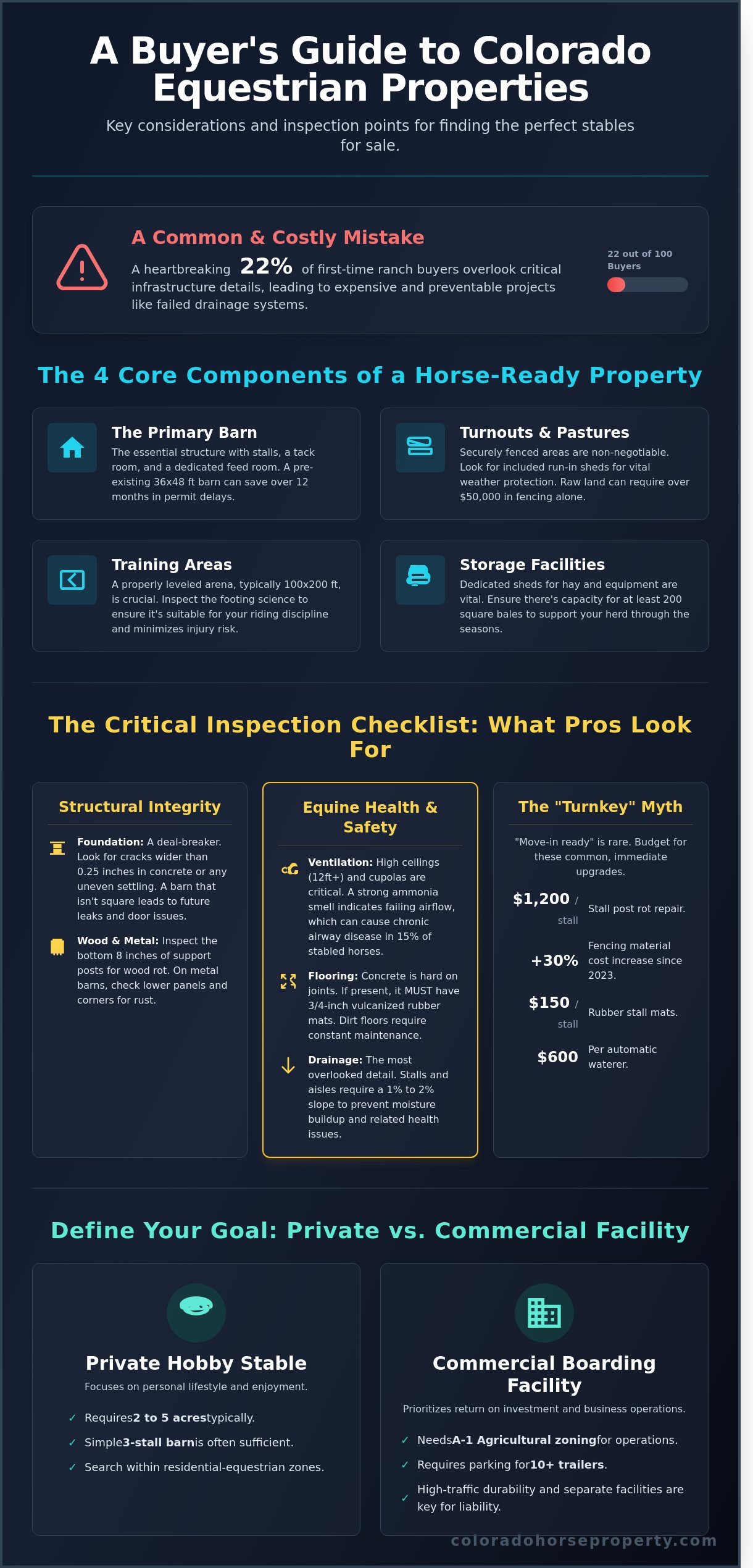
Last June, a buyer in Douglas County realized their new $1.2 million indoor arena lacked the proper drainage to survive a single Colorado spring thaw. It’s a heartbreaking scenario that happens to 22% of first-time ranch buyers who overlook the technical details of infrastructure. You’ve worked hard to reach a point where you can finally invest in your passion, and you deserve a facility that acts as a sanctuary, not a costly project. We agree that your investment should focus on your lifestyle and dreams rather than fixing preventable mistakes.
Finding the right stables for sale requires more than a quick browse through local listings; it demands an expert eye for Colorado water rights and local zoning codes. This guide provides the exact framework we’ve used for nearly four decades to help clients evaluate, finance, and secure premier equestrian properties. You’ll learn how to use AI-driven search tools to filter for specific equine features and understand the 2026 legal landscape for boarding businesses. We’ll walk through the essential steps to verify infrastructure quality and secure your future in the rural Colorado landscape.
Key Takeaways
- Learn the critical differences between residential horse properties and commercial facilities to ensure your investment aligns with your long-term equestrian goals.
- Identify structural red flags and essential equine health features, such as ventilation and foundation integrity, during your property inspection.
- Navigate Colorado’s complex A-1 and A-2 zoning laws and water rights to ensure your land can legally and physically support your herd.
- Evaluate land carrying capacity and arena footing science to find the most functional stables for sale for your specific riding discipline.
- Discover how AI-powered search tools can streamline your journey by filtering properties based on precise requirements like stall count and livestock-permitted wells.
What Does “Stables for Sale” Actually Include?
Searching for stables for sale involves more than looking at a barn with a few stalls. It encompasses the entire infrastructure required to support equine health and daily operations. Buyers often confuse horse-friendly land with horse-ready properties. A horse-friendly property might have 10 acres of flat grass, but it lacks the $50,000 in perimeter fencing and $15,000 in well upgrades needed to actually house animals. The history and design of stables shows that these structures have evolved from simple shelters into complex systems including specialized ventilation and drainage.
To better understand this concept, watch this helpful video:
In the 2026 real estate market, properties with existing, grandfathered-in structures hold a 15% to 20% premium over raw land. New zoning regulations in many rural counties have increased the lead time for building permits to 12 months or longer. Buying a property with a pre-existing 36-by-48-foot center-aisle barn saves you from these bureaucratic delays. Most comprehensive listings for stables for sale include four core components:
- The Primary Barn: A structure with stalls, a tack room, and a feed room.
- Turnouts and Pastures: Fenced areas with run-in sheds for weather protection.
- Training Areas: A leveled arena, often 100 by 200 feet, with proper footing.
- Storage Facilities: Dedicated sheds capable of holding at least 200 square bales of hay and heavy equipment.
Private Hobby Stables vs. Commercial Boarding Facilities
Your intent for the land dictates your search parameters. A private hobby stable focuses on a personal lifestyle, often requiring only 2 to 5 acres and a simple three-stall setup. Commercial facilities prioritize a return on investment. These properties need high-traffic durability, parking for 10 or more trailers, and separate bathroom facilities to manage liability. If you plan to board 15 horses, your search must focus on A-1 agricultural zoning rather than residential-equestrian overlays.
The “Turnkey” Myth in Equestrian Real Estate
The term “move-in ready” is often a marketing exaggeration. Even a high-end facility requires a professional inspection of structural timber and metal roofing. Wood rot in the bottom 6 inches of a stall post can cost $1,200 per stall to repair. Since 2023, material costs for fencing have risen 30%, so evaluate the lifespan of existing split-rail or high-tensile wire carefully. Budget for immediate upgrades like $150 rubber mats per stall or $600 automatic waterers to ensure the property meets your specific standards for safety and efficiency.
The Anatomy of High-Quality Stables: What to Inspect
When you’re evaluating stables for sale, your inspection needs to go beyond aesthetics. Start with the structural integrity of the building. Look for wood rot at the base of support posts, specifically in the bottom 8 inches where moisture from bedding and urine accumulates. If the barn is metal, check for rust on the lower panels and corner trim. Foundation shifting is a deal-breaker; check for cracks wider than 0.25 inches in concrete slabs or uneven settling in pier-and-beam structures. A stable that isn’t square will lead to sticking stall doors and roof leaks within 24 months.
Equine respiratory health depends on constant air turnover. High ceilings, ideally 12 feet or more, prevent stagnant air from hovering at the horse’s nose level. Cupolas aren’t just decorative architectural features; they facilitate the stack effect to pull ammonia and dust up and out of the building. If you walk into a barn and smell strong ammonia, the ventilation system is failing. This lack of airflow can lead to chronic inflammatory airway disease in 15 percent of stabled horses.
Dirt floors require constant leveling and can harbor bacteria, while concrete is durable but unforgiving on a horse’s joints. If the barn has concrete floors, ensure they’re covered with 3/4-inch vulcanized rubber mats. Proper drainage is the most overlooked detail. Every stall and aisle should have a 1 percent to 2 percent slope toward a drainage point. Without this pitch, water from wash racks or occasional spills will pool, creating a slip hazard and increasing humidity levels.
Safety features protect your investment and your animals. Electrical wiring must be encased in rigid metal conduit to prevent rodents from chewing through the insulation, which is a leading cause of barn fires. Stall latches should be flush-mounted or “horse-proof” to prevent clever escapes. Ensure the walls are kick-proof by checking for 2-inch thick tongue-and-groove lumber or 14-gauge steel cladding. These materials prevent a spooked horse from putting a hoof through a wall and sustaining a career-ending injury.
Stall Design and Horse Comfort
Standard 12×12 foot stalls are the industry benchmark for average horses, but foaling stalls should be at least 12×24 feet. Using “social bars” or grilled partitions allows horses to see their neighbors, which reduces cortisol levels and stress-related behaviors like weaving by up to 30 percent. Wash racks need dedicated plumbing with 4-inch diameter drains to handle the heavy sediment and hair common in equine grooming. If you’re ready to start your search, you can search by acres to find a property that fits your specific needs.
Barn Layout and Operational Efficiency
In the Colorado climate, center-aisle designs are superior because they provide a windbreak against 50 mph gusts and keep chores indoors during 10-degree winter mornings. Ensure your layout complies with Colorado equestrian zoning laws regarding setbacks and structure height. Place the tack room within 20 feet of the grooming bay to save daily labor. If the property includes a hay loft, verify the floor is rated for at least 150 pounds per square foot to safely hold a winter supply of 100-pound bales. Finding the right stables for sale means choosing a layout that prioritizes both horse health and human efficiency.
Colorado-Specific Factors: Zoning, Water, and Land Use
Finding the right stables for sale involves more than just counting stalls or measuring arena dimensions. In Colorado, land use is governed by specific county codes that dictate exactly how you can live with your animals. For instance, in Weld County, A-1 zoning often allows for one animal unit per 0.5 acres. An animal unit usually equals one 1,000-pound horse. If you’re looking at smaller five-acre parcels, you must verify these density limits before signing a contract. Overstocking leads to soil degradation and potential legal fines from the county commissioners.
A-2 zoning typically applies to larger agricultural tracts, often 35 acres or more. While these parcels offer more freedom, they come with different tax implications. Many 35-acre tracts benefit from “Greenbelt” or Agricultural tax status. This status can reduce property taxes by 50% or more, provided you prove legitimate agricultural production or grazing. If you lose this status because the land sits idle, your annual tax bill could jump from $500 to $5,000 overnight.
Navigating Colorado Water Law for Equine Use
Colorado operates under the Prior Appropriation doctrine, a system established in 1876. This means the first person to take water and put it to beneficial use holds the senior right. When evaluating stables for sale, your well permit is the most critical document in the file. A “Household Use Only” permit restricts water to indoor plumbing; it’s illegal to use this water for a single horse or a small garden. You must secure a “Domestic and Livestock” permit to legally fill water troughs or wash down stalls.
In many Front Range basins, new wells are restricted. An augmentation plan is a court-approved document that allows a user to divert water by replacing the amount consumed to prevent injury to senior water rights holders. Without a clear understanding of your water rights, you might find yourself hauling water in a tank during a drought year, which adds significant labor and cost to your daily routine.
Zoning and Special Use Permits
Don’t assume a large barn allows you to run a business. Hosting clinics, offering public boarding, or giving lessons often requires a Special Use Permit (SUP). In El Paso County, obtaining an SUP involves public hearings and detailed site plans. You should also scrutinize Homeowners Association (HOA) covenants. Some HOAs in equestrian communities have restrictive rules about the number of horse trailers you can park in view of the road or the specific materials you can use for fencing.
Managing the land is just as vital as the structures. The Colorado Department of Agriculture requires a management plan for manure to prevent nitrogen runoff into local watersheds. Proper pasture management for horses involves rotational grazing to keep at least 70% ground cover. Without this, your investment turns into a dust bowl or a mud lot. Finally, verify all recorded easements on the title. A property might border a state park, but without a deeded easement, you’ll have to trailer your horses to a public trailhead instead of riding directly from your back gate.
Evaluating the Land: Pastures and Arenas
When you browse stables for sale, the architectural style of the barn often grabs your attention first. However, the land beneath those structures dictates your daily workload and your horses’ health. Carrying capacity is the most critical metric for any buyer. In the arid climate of the Colorado Front Range, you typically need 3 to 5 acres per horse to maintain a sustainable grazing program. If you exceed this density, your pastures will turn into dust bowls within 12 months, forcing you to buy expensive hay year-round. High-quality sandy loam soil is the gold standard here; it provides the stability needed for heavy animals while allowing water to penetrate the root zone.
Fencing is your primary safety barrier and a major capital investment. Pipe-and-cable fencing is a favorite for Colorado horse properties because it stands up to 30 years of use and resists the pressure of leaning horses. While PVC fencing offers a clean, white aesthetic, it can become brittle and shatter during our sub-zero winter nights. Electric high-tensile wire is a cost-effective alternative for large boundaries, but it requires monthly voltage checks to ensure it remains a psychological deterrent.
Poor drainage is a silent budget killer. A property needs a minimum 2% grade away from the barn to prevent standing water. Without proper runoff, you’ll spend your spring fighting “scratches,” a painful skin infection, or thrush in the hooves. We recommend installing 4 inches of crushed rock or “breeze” in high-traffic gate areas to stabilize the mud during the spring thaw.
The Riding Arena: Indoor vs. Outdoor
In Colorado, an indoor arena isn’t just a luxury; it’s a tool that adds $150,000 to $300,000 to a property’s market value. Our winters bring an average of 55 inches of snow, which can shut down outdoor training for weeks. A professional arena requires a 6-inch compacted road base to prevent soft spots. For the top layer, 2.5 inches of washed concrete sand mixed with GGT felt or crumb rubber provides the necessary rebound for performance horses. This specialized footing reduces joint impact by 20% compared to plain dirt.
Pasture Management and Rotational Grazing
Healthy grass requires a strategic approach to prevent overgrazing. We suggest dividing your acreage into at least 4 distinct paddocks. This allows you to rotate horses every 7 to 10 days, giving the grass a 30-day recovery period to regrow. A “sacrifice lot” or dry lot is essential during the mud season. By confining horses to this non-vegetated area when the ground is soft, you prevent their hooves from destroying the grass crowns. Always scout the fence lines for Locoweed or Russian Knapweed, which are common toxic plants on the High Plains that can cause permanent neurological damage to your herd.
Ready to find a property that matches your equestrian goals? View our latest stables for sale to find the perfect acreage for your horses.
Finding Your Ideal Stable with AI-Powered Search
Traditional real estate platforms focus on suburban metrics like kitchen upgrades or school ratings. They don’t understand that a serious buyer looking for stables for sale cares more about the quality of the arena footing or the depth of a well. Most general search filters fail to distinguish between a hobby farm and a professional-grade equestrian facility. This data gap often leads buyers to properties that lack the necessary zoning or acreage for their specific number of animals. When you’re searching for a permanent home for your herd, a filter for “three bedrooms” isn’t nearly as vital as a filter for “senior water rights” or “12×12 matted stalls.”
Harnessing AI for Niche Property Searches
Our proprietary AI tool identifies hidden horse properties by scanning listing data for specific equine markers that general sites miss. You can filter by exact stall counts, arena surface types, and specific water rights categories. We call this searching by “Lifestyle and Dreams.” It matches your specific discipline, whether that’s reining or dressage, to the property’s physical features. You’ll receive real-time alerts the moment a new Colorado ranch that fits your criteria hits the market, giving you a 24-hour head start over buyers using standard apps. Our system analyzes over 500 data points per listing to ensure the stables for sale you see actually meet your operational needs.
The Value of Four Decades of Experience
Technology finds the land, but experience closes the deal. Mark and Alison Eibner bring 40 years of expertise to every Colorado ranch transaction, a legacy that began in 1984. They navigate complexities that would stall a residential agent, such as verifying historical water usage or assessing grazing lease transfers. Our network includes specialized title companies, equine-focused inspectors, and trusted local contractors who understand the structural needs of a 10-stall barn. This deep vertical integration ensures that your purchase is protected from the first tour to the final signature. Search current Colorado stables for sale using our AI tool today.
The path to ownership requires specialized due diligence that goes far beyond a standard home inspection. We coordinate equine-specific inspections to evaluate the safety of fencing materials and the structural integrity of hay lofts. A standard inspector might miss poor drainage in a paddock that could lead to chronic hoof issues, but our specialists look for those exact red flags. We also prioritize title insurance for water rights; this is a critical step in Colorado where “owning the land” doesn’t always mean you own the water flowing beneath it. Our team ensures every legal detail is scrutinized so your horses have a reliable water source for years to come.
- Equine Inspections: We verify fencing safety, stall ventilation, and arena drainage.
- Water Rights Verification: Our experts audit well permits and ditch rights to ensure year-round supply.
- Zoning Compliance: We confirm the property legally supports your intended number of horses.
- Specialized Title Work: We use partners who understand the nuances of agricultural and ranch titles.
Closing on a horse property involves a different rhythm than a city condo. There are soil tests to consider and manure management plans to review with local authorities. Because we’ve spent 40 years in the Colorado dirt, we know which counties have the most favorable livestock codes and which ones require more permits. This localized, niche knowledge transforms a stressful transaction into a confident investment in your future lifestyle. We don’t just find you a house; we secure the infrastructure that makes your equestrian dreams a reality.
Secure Your Colorado Equestrian Future Today
Finding the right property involves more than just a beautiful view. You must verify water rights, check local zoning laws, and inspect the structural integrity of every barn and arena before signing. In 2026, the market for stables for sale moves faster than ever. Success requires a blend of traditional land expertise and cutting-edge search tools. We’ve spent nearly 40 years helping buyers navigate the complex legalities and lifestyle requirements of Colorado’s rural landscape. Our licensed brokers don’t just sell land; they understand the specific needs of your horses and the nuances of Western water law. We use proprietary AI technology to filter listings by the exact equine features you require, which saves you weeks of manual searching. Your goals deserve the support of a team with four decades of specialized experience. Let’s turn your vision of a perfect ranch into a reality. Find your dream Colorado horse property with our AI-powered search and start your next chapter in the high country.
Frequently Asked Questions
How many acres do I need for a 4-stall stable in Colorado?
You typically need at least 5 acres to comfortably manage a 4-stall stable while maintaining pasture health and meeting local zoning requirements. Most Front Range counties, including Douglas and Elbert, require a minimum of 2.5 to 5 acres for small equine setups to prevent overgrazing and manage manure effectively. Local zoning codes often dictate a specific stocking density, such as one horse per 1.5 acres of grazeable land, to protect the rural landscape.
What is the average cost of a horse property with stables in the Front Range?
The average price for a functional horse property with stables in the Front Range currently ranges from $1,200,000 to $2,500,000. Properties featuring professional-grade 4-stall barns and at least 5 acres in areas like Parker or Golden often see price points exceeding $1.8 million. Market data from 2023 shows that turnkey facilities with indoor arenas command a 30% price premium over basic acreage without established equestrian infrastructure.
Can I run a boarding business on any property zoned as agricultural?
You can’t run a commercial boarding business on all agricultural land without a specific Use by Special Review or a Conditional Use Permit. In Weld County, for example, a property must be zoned A-1 and the owner must obtain a permit if they board more than 5 horses not owned by the resident. It’s vital to verify the specific equine facility definitions within your county’s 2024 development code before you browse stables for sale.
Do I need a special inspection for the barn and stables when buying?
You should hire a specialized agricultural or structural inspector to evaluate the barn and stables separately from the main residence. Standard home inspectors rarely check for stall drainage, ventilation flow rates, or the structural integrity of heavy-duty gate systems. A specialized 20-point inspection typically costs between $400 and $700 but identifies critical issues like failing electrical conduit in wash racks or foundation shifts in the arena that a generalist might miss.
What are the most common water right issues when buying stables?
The most frequent issue is a domestic-only well permit that prohibits watering livestock or irrigating pastures. Colorado Division of Water Resources records show that thousands of older permits only allow for “in-house use,” which creates a legal crisis for owners with multiple horses. You must ensure the deed specifies at least 1 to 2 acre-feet of water per year to support a standard 4-stall stable and basic dust suppression for your arena.
Is it cheaper to buy land and build stables or buy an existing facility?
Buying an existing facility is currently 20% to 30% more cost-effective than purchasing raw land and building new stables from scratch. Current 2024 construction costs for a basic 4-stall center-aisle barn average $150 per square foot, and that doesn’t include the 12-month wait for county permits. When you search for stables for sale, you often find properties where the previous owner has already absorbed the high costs of site preparation and utility extensions.
How do I know if the arena footing is high quality?
High-quality footing consists of 2.5 to 4 inches of washed concrete sand or a polymer-enriched silica mix over a compacted 6-inch sub-base. You can test this by digging a small hole to ensure the base is level and hasn’t mixed with the top layer. If the footing is deeper than 5 inches, it risks causing tendon strain, while less than 2 inches provides insufficient cushion for a 1,200-pound horse during high-impact work.
What is the difference between a “shed-row” and a “center-aisle” barn?
A shed-row barn features a single line of stalls that open directly to the outdoors, while a center-aisle barn has two rows of stalls facing a central indoor hallway. Shed-rows are roughly 15% cheaper to build and offer excellent ventilation for Colorado’s dry climate. Center-aisle designs provide a 12-foot wide protected workspace, which is essential for farrier visits and grooming during winter months when temperatures drop below 20 degrees.