
A 40 acre parcel in the High Rockies means nothing in 2026 if you don’t hold the senior water rights to keep it green. You already know that searching for ranches co involves much more than just admiring mountain views. It’s about the technical grit of understanding mineral rights and the reality of annual maintenance costs that can easily exceed $15,000. You want a property where your horses can roam, but the complex legal landscape of Colorado land use often feels like a barrier to that lifestyle dream.
Our team has spent nearly 40 years helping buyers turn these aspirations into secure, tangible assets. This guide provides the expert brokerage insights you need to distinguish between a high-maintenance hobby farm and a high-ROI recreational ranch. We’ll explain how to use AI-powered search tools to find niche, off-market equestrian properties before the general public sees them. From securing deeded water to choosing a local partner who knows the local zoning laws, you’re about to get the clear roadmap for your Colorado land investment.
Key Takeaways
- Distinguish between income-focused working operations and recreational properties to ensure your land supports your specific lifestyle and dreams.
- Master the legal landscape of water and mineral rights, the most critical factors in determining a property’s long-term value and viability.
- Learn how to evaluate specialized infrastructure, from arena drainage to barn “horse-readiness,” before committing to an equestrian property.
- Utilize AI-powered search tools to efficiently find the best ranches co has to offer while navigating modern due diligence and land financing.
- Access a specialized network of land managers and attorneys by partnering with experts who bring nearly four decades of Colorado experience to your search.
Understanding the Different Types of Ranches in CO
Colorado’s landscape offers diverse opportunities for land ownership. Whether you’re looking for a legacy property or a small hobby farm, the market for ranches co provides options that vary significantly in scope and purpose. Before you sign a contract, you must identify the property’s primary function. A foundational understanding of What is a Ranch? helps clarify these distinctions, especially when dealing with water rights, grazing leases, and agricultural zoning.
To better understand the scale and beauty of these properties, watch this helpful video:
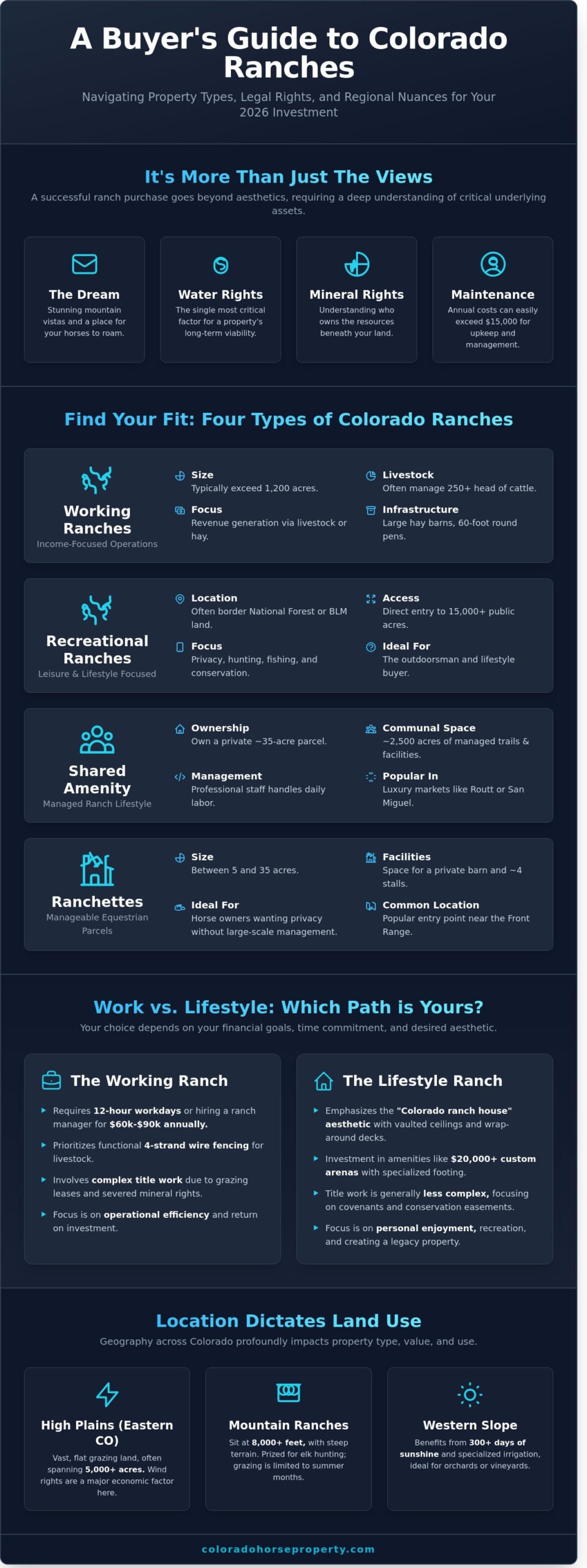
- Working Ranches: These function as active businesses. Properties typically exceed 1,200 acres and focus on generating revenue through livestock or hay production. Owners often manage 250 or more head of cattle and prioritize functional infrastructure like 60-foot round pens and 5,000-square-foot hay barns.
- Recreational Ranches: These prioritize leisure over profit. Properties often border National Forest or BLM land, providing direct access to 15,000+ acres of public hunting grounds or private trout streams. They’re designed for the outdoorsman who values privacy and wildlife conservation.
- Shared Amenity Ranches: You own a private 35-acre parcel while a professional staff manages 2,500 acres of communal trails, equestrian facilities, and lodge spaces. This model is popular in luxury markets like Routt or San Miguel counties, where homeowners want the ranch lifestyle without the daily labor.
- Ranchettes: Usually between 5 and 35 acres, these cater to horse owners who want a private barn and 4 stalls without the burden of large-scale land management. These smaller parcels are the most common entry point for buyers looking at ranches co near the Front Range.
Working vs. Lifestyle Ranches: Which Fits Your Dream?
Your choice depends on your financial goals. A working ranch requires a commitment to 12-hour workdays or hiring a full-time ranch manager at a cost of $60,000 to $90,000 annually. Lifestyle ranches focus on the “Colorado ranch house” aesthetic, featuring vaulted ceilings and 1,000-square-foot wrap-around decks. Cattle operations prioritize sturdy 4-strand wire fencing. In contrast, equestrian estates invest in $20,000 custom arenas with specialized sand footing. The title work for a working ranch is often more complex due to active grazing leases and mineral rights that have been severed since the early 1900s.
Regional Diversity: From the Front Range to the Western Slope
Geography dictates land use across the state. High Plains ranches in Eastern Colorado often span 5,000+ acres of flat grazing land where wind rights are a major factor. Mountain ranches sit at 8,000 feet or higher, where steep terrain and 100-plus inches of annual snowfall limit grazing to the summer months. These properties are prized for elk hunting, often falling within high-draw Game Management Units. On the Western Slope, properties benefit from 300 days of sunshine and specialized irrigation, making 40-acre parcels ideal for peach orchards or vineyards. These regional differences impact everything from property taxes to the complexity of your title search.
The Legal & Ecological Foundation: Water, Mineral, and Land Rights
When evaluating ranches co buyers target for long term investment, the price tag rarely tells the whole story. The true value of a Colorado property rests on the bundle of rights attached to the deed. Unlike a standard residential sale, a ranch transaction requires a deep dive into the legal and ecological history of the land. You aren’t just buying dirt; you’re buying the legal authority to use the resources on and under that dirt. Understanding these foundational elements prevents expensive surprises after the closing documents are signed.
Decoding Colorado Water Law for Ranch Buyers
Water is the lifeblood of any agricultural operation. In Colorado, water law follows the Doctrine of Prior Appropriation, which operates on a “first in time, first in right” basis. This means the age of a water decree determines its reliability during dry seasons. A senior right dating back to 1885 will receive its full allocation before a junior right from 1975 gets a single drop. When you review the Colorado Water Rights system, you’ll see how these priorities dictate the productivity of your hay fields and the health of your livestock.
Buyers must verify if the water rights are adjudicated for the specific uses they intend, such as irrigation, stock watering, or domestic use. Whether the property relies on decreed springs, tributary wells, or shares in a mutual ditch company, the title search must confirm these rights are actually transferable. For a deeper look at these complexities, read our detailed guide on Water Rights in Colorado to ensure your future operations remain viable.
Mineral Rights and Surface Use Agreements
In Colorado, it’s common for the mineral estate to be “severed” from the surface estate. This means the person who owns the pasture might not own the oil, gas, or gold beneath it. If you purchase a ranch with a severed mineral estate, the mineral owner generally has the legal right to enter your property to extract those resources. This is why a specialist title search is non-negotiable for ranches co investors. You need to know exactly who holds the subsurface rights before you commit.
To protect your equine facilities or cattle operations, we look for Surface Use Agreements (SUAs). These contracts dictate where a mineral owner can place a well pad or road and how they must reclaim the land afterward. A strong SUA can preserve the integrity of your ranching lifestyle even if extraction occurs. If you’re looking for a property with specific protections already in place, you can search our latest ranch listings to find estates with unified rights.
- Conservation Easements: These are voluntary legal agreements that permanently limit land use to protect its conservation value. While they can provide significant state tax credits, often up to $5 million as of 2021, they also restrict your ability to subdivide or develop the land in the future.
- Access Rights: Many Colorado ranches border Bureau of Land Management (BLM) or National Forest land. While this provides incredible backyard access, you must verify documented legal access. A “landlocked” parcel with no recorded easement across neighbor property can lead to permanent legal battles.
- Public Land Grazing Permits: If the ranch includes a BLM grazing allotment, remember these permits are privileges, not permanent rights. They typically require renewal every 10 years and are subject to federal environmental reviews.
Navigating these layers of ownership requires a team that understands the rural landscape. By verifying every easement and decree, you ensure the dream of ranch ownership doesn’t turn into a legal headache. Our team brings decades of experience to this process, helping you secure a legacy that stands the test of time.
Evaluating Ranch Infrastructure: Barns, Arenas, and Fencing
When you’re scouting ranches co, the quality of the “sticks and bricks” determines your immediate operational costs. A property that’s truly horse-ready saves you the $150,000 or more it often costs to build a basic four-stall barn in today’s market. You aren’t just buying land; you’re buying the functionality of the existing structures. High-quality infrastructure should facilitate daily chores while ensuring the safety of your livestock. If a barn has poor drainage or a fence line is leaning at a 20-degree angle, those are immediate capital expenditures you’ll need to negotiate during the title and escrow process.
Utilities in rural areas require a different level of scrutiny than suburban homes. You’ll want to verify the age and capacity of the septic system, as a replacement can easily exceed $25,000. Off-grid capabilities are increasingly popular in Colorado. Check for solar arrays with lithium-ion battery storage and backup propane generators. For those working remotely, confirm the availability of high-speed options like Starlink, which consistently delivers 100 Mbps or more in areas where traditional cable fails.
The Anatomy of a High-Quality Horse Barn
A functional barn is more than just a shelter. Look for 12×12 foot stalls as a minimum standard for most breeds. Proper ventilation is non-negotiable to prevent respiratory issues; look for cupolas, ridge vents, and Dutch doors. Tack rooms should be climate-controlled to protect expensive leather gear from Colorado’s dry air and temperature swings. For more details on building or evaluating these structures, see our guide on Equestrian Facilities: From Barns to Arenas. Durable materials like powder-coated steel or reinforced masonry withstand the 60 mph wind gusts common on the Front Range better than standard wood siding.
Arena quality depends entirely on what’s beneath the surface. A professional-grade arena requires a 4-to-6-inch compacted base of crushed rock topped with 2 to 3 inches of specialized footing like washed sand or rubber crumb. If you see standing water after a light rain, the drainage is failing. Lighting is another major asset; a well-lit 100×200 foot outdoor arena adds significant value for riders who train after work during the shorter winter days.
Fencing is your most important tool for land management. Perimeter fencing should be secure 4-rail pipe or high-tensile coated wire. Cross-fencing allows you to implement pasture rotation, which prevents overgrazing and keeps your soil healthy. Look for gates that are at least 12 feet wide to accommodate tractors and hay delivery trucks.
Land Management and Pasture Health
The productivity of ranches co is measured by its carrying capacity, often expressed as an Animal Unit Month (AUM). One AUM represents the amount of forage needed by one 1,000-pound cow and her calf for one month. In many parts of Colorado, it takes 15 to 30 acres to support one AUM without supplemental feeding. You’ll need to evaluate the soil quality and check for the presence of noxious weeds like leafy spurge or Canada thistle, which are regulated under the Colorado Noxious Weed Act.
If the property includes hay ground, you must investigate the Colorado water rights associated with the deed. Without senior water rights, your ability to irrigate and produce high-quality alfalfa or grass hay is at the mercy of the “Prior Appropriation System.” This legal framework dictates who gets water first during a drought. We’ve spent nearly four decades helping buyers understand these complexities so they can find a property that truly fits their lifestyle and dreams.
The 2026 Purchase Process: AI Search and Due Diligence
The process of acquiring land in Colorado has evolved rapidly. By 2026, the traditional methods of scouring paper listings have been replaced by high-speed data analysis. Finding the ideal ranches co buyers are looking for now requires a blend of advanced technology and old-fashioned grit. This five-step process ensures you don’t just find a property, but you secure a legacy that’s legally and environmentally sound.
Step 2: Financial Pre-qualification. Agricultural loans differ significantly from standard residential mortgages. Lenders in 2026 often require a 20% to 35% down payment for large acreage. Securing a commitment from a lender who understands the nuances of land production and livestock grazing is essential before you begin the physical search.
Step 3: Boots on the Ground. Technology gets you to the gate, but it doesn’t replace the physical walk. This phase involves inspecting fence lines, checking the integrity of outbuildings, and assessing the health of the pasture. You’re looking for signs of erosion or invasive species that a drone might miss.
Step 4: Title and Escrow Coordination. This is the most complex phase of the land transfer. Your title company must verify that the mineral rights, water rights, and surface rights all align. In Colorado, these can be owned by three different entities. Coordination between the escrow officer and the title examiner is the only way to prevent future litigation.
Step 5: Closing and Transition. Once the deed is recorded, the transition begins. This involves transferring grazing leases, updating well permits with the Division of Water Resources, and moving livestock. It’s the moment your dream of a rural Colorado lifestyle becomes a legal reality.
How AI is Changing the Colorado Ranch Search
Modern search tools now use predictive modeling to identify the best ranches co offers before they even hit the open market. By filtering for specific equestrian features like 100-foot by 200-foot arenas or heated barn stalls, you save dozens of hours. These tools also analyze regional growth, helping you predict which areas will see a 10% or higher increase in land value over the next decade. Search CO Ranches with our AI Tool to see these filters in action.
The Due Diligence Checklist for Large Acreage
Due diligence on a ranch isn’t a suggestion; it’s a necessity. You must conduct a Phase I Environmental Site Assessment (ESA) to check for old fuel tanks or chemical runoff, which can cost between $2,500 and $5,000 but saves millions in liability. Verify all 35-acre or larger zoning laws to ensure you can build guest houses or commercial arenas. Finally, a new boundary survey is vital to identify encroachments that may have existed for 20 years or more.
We’ve spent nearly 40 years helping buyers navigate these complex transactions. Our team understands that a ranch is more than just dirt; it’s a functioning business and a personal sanctuary. If you’re ready to start your journey, contact our expert ranch brokers today to find your perfect Colorado property.
Why Partner with Colorado Horse Property for Your Ranch Sale
Buying or selling ranches co involves layers of complexity that a standard residential broker isn’t equipped to handle. Since 1987, Colorado Horse Property has spent 39 years specializing in the nuances of equestrian and agricultural real estate. We’ve seen every type of market shift in the Rocky Mountain region. Our team understands that a ranch isn’t just a piece of real estate; it’s a specialized asset requiring a deep knowledge of soil types, grazing capacities, and complex water law. We treat your lifestyle and dreams as the primary objective, ensuring the land you acquire actually supports the goals you’ve envisioned for your horses or livestock.
Our founder-forward approach ensures you’re never passed off to a junior assistant who doesn’t know a headgate from a handline. We manage the entire transaction lifecycle from the initial search to the final closing table. This includes coordinating with a vetted network of niche experts that most generalists simply don’t have on speed dial. We regularly collaborate with water attorneys to verify tributary and non-tributary rights, professional surveyors to confirm boundary lines, and land managers to assess the health of your acreage. This level of technical oversight prevents the common hurdles that cause 18% of rural land deals to fall through during the due diligence period.
We provide a comprehensive management style that covers the “unseen” elements of a sale. We look at the structural integrity of outbuildings, the condition of perimeter fencing, and the accessibility of local veterinary services. By the time you reach the closing date, every technical detail has been scrutinized. We make sure the title is clear and the land is ready for your arrival. It’s about more than just a transaction. It’s about protecting your investment and your future on the Colorado range.
Expert Representation: Beyond the Standard Broker
Generalist realtors often miss critical ranch-specific details like senior water rights or specific zoning setbacks for indoor arenas. These oversights lead to expensive legal fixes later. Our team focuses on your specific equine or agricultural needs, matching you with properties that offer the right drainage and pasture quality. Our strategic partnership with Realty Oasis and Meridian Title ensures every title commitment is thoroughly vetted for restrictive easements that could hinder your plans. We find the right ranches co by looking past the aesthetics to the functional utility of the land.
Ready to Find Your Colorado Ranch?
The 2026 market is shaping up to be a pivotal year for Colorado land investment as inventory for high-quality acreage remains tight. Local knowledge is your most valuable currency in this competitive environment. We provide the data-driven insights and expert tools you need to secure a legacy property that will last for generations. Don’t leave your rural investment to chance. Contact Mark and Alison Eibner Today to leverage 39 years of specialized experience and turn your ranching vision into a reality.
Secure Your Colorado Legacy in 2026
Owning a ranch in the Centennial State is about more than just land; it’s about securing a legacy through smart due diligence and expert guidance. You’ve learned how to navigate the complex water rights and equestrian zoning laws that define property value in 2026. You also know that evaluating infrastructure like barns and arenas requires a keen eye for specialized detail. Modern tools make this process more efficient than ever. Our AI-driven search platform helps you filter listings by specific acreage and soil types instantly.
Colorado Horse Property brings nearly 40 years of local expertise to your search. We specialize in the intricate details of mineral rights and rural zoning that general realtors often miss. As a featured partner on the Realty Oasis network, we provide the concrete data you need to make a confident investment in ranches co. Don’t let the complexities of rural real estate hold you back from your lifestyle goals.
Start Your AI-Powered Colorado Ranch Search Now
We’re ready to help you find the perfect acreage where your horses can roam and your dreams can take root.
Frequently Asked Questions
How many acres do I need for a horse ranch in Colorado?
You generally need at least 2.5 acres for the first horse in most Colorado counties, with additional acreage required for each subsequent animal. For a sustainable lifestyle on ranches co buyers often look for 35 acres or more to avoid strict subdivision regulations. This larger size allows for rotational grazing and reduces the need for supplemental hay, which can cost 10 dollars per bale.
What are the tax advantages of buying a working ranch in CO?
Owners of working ranches benefit from agricultural tax status, which can reduce property taxes by 50 to 90 percent compared to residential rates. To qualify, you must show a primary intent to profit from activities like livestock or hay production. The Colorado Department of Revenue requires consistent documentation of these operations to maintain this lower assessment rate. It’s a vital tool for preserving both the rural landscape and your budget.
Is it possible to find a ranch with deeded water rights near Denver?
It’s possible to find a ranch with deeded water rights near Denver, though these properties often carry a 20 to 30 percent price premium. Look in areas like Douglas or Elbert County where senior water rights from the 1860s still exist. You must verify these rights during the escrow process to ensure they include irrigation and domestic use. Without confirmed rights, your property value could drop significantly.
What is the difference between a ranch and a ranchette?
A ranchette is typically a small acreage property between 2 and 15 acres, while a true ranch usually exceeds 40 acres. Ranchettes focus on a residential lifestyle with a few horses or a small garden. In contrast, ranches co listings of a larger scale focus on commercial production or extensive land management. The distinction impacts your zoning, water requirements, and potential for agricultural tax exemptions.
How do I verify mineral rights on a Colorado property?
You verify mineral rights by hiring a specialized title examiner to perform a mineral chain of title search dating back to the original land patent. Standard title insurance often excludes mineral interests, so this separate search is essential. In Colorado, about 80 percent of rural land has severed mineral rights. Knowing who owns the subsurface is critical before you close escrow on any property.
Can I use a 1031 exchange to purchase a Colorado ranch?
You can use a 1031 exchange to purchase a Colorado ranch if the property is held for productive use in a trade or business. This allows you to defer capital gains taxes, which can range from 15 to 20 percent at the federal level. You must identify the replacement ranch within 45 days of selling your previous asset. The entire transaction must be completed within 180 days to meet IRS requirements.
What are the common maintenance costs for a 40-acre ranch?
Do I need a special permit to run a guest ranch in Colorado?
You need a Conditional Use Permit from the county planning department to operate a guest ranch in Colorado. Each county has specific regulations, such as Park County’s requirements for waste management and guest capacity. You might also need a liquor license or food service permit from the Colorado Department of Public Health and Environment. Expect the application process to take 6 to 12 months for full approval.