
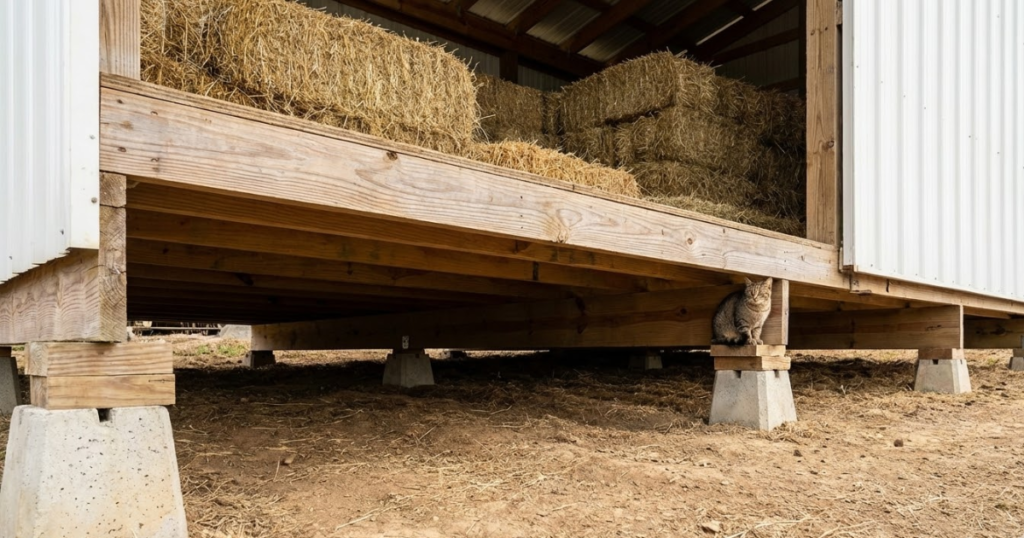
You open your barn in the middle of February and grab a bale from the bottom of the stack. It feels unusually heavy. You cut the twine, and a cloud of white dust puffs into the air. The inside of the bale is hot, black, and smelling of mildew.
You just lost a critical piece of your winter feed supply, and you might have exposed your horse to dangerous mycotoxins.
Many buyers look at a large, dry outbuilding and assume it is the perfect place to store hay. However, a roof overhead is only half of the equation. The floor underneath is just as important. In Colorado, the ground temperature and the air temperature constantly fluctuate, creating a hidden moisture trap right beneath your boots.
If a hay storage area is not properly prepared to elevate the bales, you are guaranteed to lose money to rot. Here is how to evaluate a property’s hay storage foundation before you buy.
Is the Hay Storage “Elevated” to Prevent Moisture Wicking From the Ground?
Quick Summary: The Ground Trap
- The sponge effect: Hay is incredibly absorbent. If you place a dry bale directly on dirt, concrete, or gravel, it will actively pull moisture up from the ground, causing the bottom layer to mold and rot.
- The pallet solution: The simplest and most effective way to elevate hay is to use wooden shipping pallets. This creates a crucial 4 to 6-inch air gap between the cold ground and your expensive feed.
- Concrete condensation: Do not assume a concrete floor is safe. Concrete sweats during temperature changes. A bale sitting on bare concrete will still wick moisture and spoil.
- The cost of spoilage: Losing just the bottom layer of a 10-ton hay stack to ground moisture can cost you hundreds of dollars in ruined feed, not to mention the veterinary bills if a horse eats the mold.
A dry roof does not guarantee dry hay. The floor underneath the stack matters just as much as the roof above it.
1. The Physics of Moisture Wicking
Hay is essentially dried grass, and it desperately wants to absorb water.
The capillary action
- When a dry bale sits on the ground, the natural moisture in the earth is drawn upward into the hay through capillary action.
- The bale acts like a giant green sponge.
The mold cycle
- Once the moisture enters the bale, dormant mold spores begin to multiply.
- This process generates heat and breaks down the nutritional value of the forage.
The bottom tier loss
- In a poorly prepared storage shed, it is common to completely lose the entire bottom row of bales.
- If your stack is five bales high, you are automatically losing 20% of your total investment.
2. The Danger of Bare Concrete
Many buyers think a poured concrete floor is the ultimate moisture barrier. This is a costly misconception.
The sweating floor
- Concrete is porous. It absorbs moisture from the soil below.
- When the air temperature in the barn warms up faster than the cold concrete slab, condensation forms directly on the surface.
The vapor barrier myth
- Even if the builder installed a plastic vapor barrier under the concrete, temperature differences can still cause the slab to sweat.
- Your hay will absorb this surface condensation instantly.
You still need an air gap. Never stack hay directly on a concrete slab without an elevation layer.
3. Creating the Air Gap
The goal is to physically separate the hay from the ground and allow air to flow underneath the stack.
Wooden pallets
- This is the industry standard.
- Laying down a grid of clean, dry wooden shipping pallets keeps the hay 4 to 6 inches off the floor.
- It is cheap, effective, and allows cats to hunt rodents under the stack.
Gravel and timbers
- For dirt-floor sheds, some owners put down a thick layer of crushed gravel for drainage, topped with parallel railroad ties or thick wooden beams to rest the bottom bales on.
The tarp mistake
- Never put a plastic tarp on the ground and stack hay on top of it.
- The tarp will trap ground moisture underneath, and any condensation that forms will pool on the plastic, soaking the bottom bales.
4. Ventilation Above and Below
Elevation only works if there is actual airflow moving through that gap.
The perimeter space
- When you stack the hay on pallets, you must also leave a gap of at least 12 inches between the hay stack and the barn walls.
- If the hay touches metal or wood siding, you cut off circulation and invite wall condensation to rot the sides of the bales.
The chimney effect
- Proper elevation allows fresh air to be drawn under the stack and up through the gaps in the bales.
- This carries away naturally occurring moisture and helps keep the entire supply dry and sweet.
We Inspect the Storage Infrastructure
We know that keeping your feed safe is just as important as keeping your horses safe.
When Mark Eibner and Belinda Seville tour an equestrian property, we evaluate the outbuildings with a critical eye. We check if the existing hay sheds have properly elevated floors, good drainage, and adequate ventilation. We want to ensure your property is set up to protect your expensive winter feed supply from the ground up.
Contact Us Today to find a property with professional agricultural storage.
Browse Active Colorado Horse Properties: View All Available Listings
Frequently Asked Questions (FAQ) About Hay Storage
Can I use straw bales as a base layer instead of pallets?
Yes. This is an old farmer’s trick. You can lay down a bottom tier of cheap straw bales and stack your expensive grass hay on top. The straw will absorb the ground moisture and rot, sacrificing itself to keep the good hay dry. However, pallets are generally cleaner and provide better airflow.
Does a wooden barn floor need pallets?
Usually, yes. A wooden floor suspended over a dirt crawlspace is better than bare dirt, but the wood can still absorb moisture and transfer it to the hay. Using pallets on a wood floor is still the safest practice to guarantee airflow.
How do I get rid of the mice that live under the pallets?
Pallets do create a perfect habitat for rodents. The best defense is a working barn cat. You should also keep the perimeter of the barn free of tall weeds and debris, and avoid leaving spilled grain near the hay shed, which attracts the mice in the first place.