
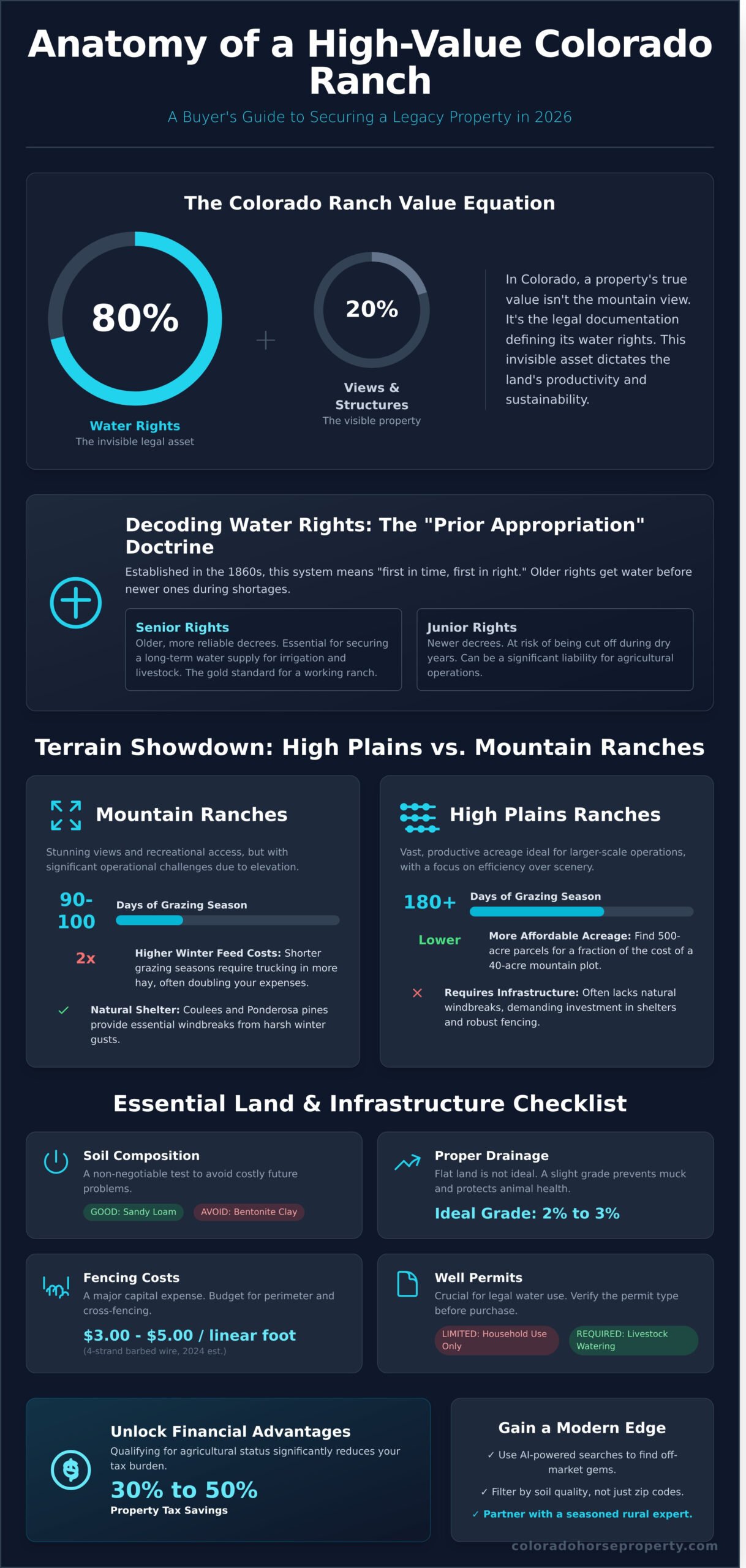
In Colorado, 80% of a property’s true value isn’t found in the mountain views, but in the invisible legal documents defining its water rights. Buying ranch land in 2026 requires more than a keen eye for scenery; it demands a technical understanding of senior versus junior decrees. You’ve probably felt the weight of 104,185 square miles of geography while worrying if a potential purchase is a hidden dry lot. We agree that the fear of buying land without sustainable resources is the biggest hurdle to achieving your rural lifestyle and dreams.
Our decades of experience have taught us that the right data makes the difference between a liability and a legacy. This guide will teach you how to evaluate soil quality for grazing, navigate the complexities of agricultural zoning, and use AI-driven search strategies to find off-market gems. You’ll learn exactly how to secure a property with senior water rights and understand the 30% to 50% property tax savings offered by agricultural status. We’re breaking down the essential steps to ensure your investment provides both the freedom you crave and the financial return you deserve.
Key Takeaways
- Learn to identify high-value ranch land by evaluating specific infrastructure needs and the impact of Colorado’s semi-arid climate on your livestock.
- Compare the distinct advantages of High Plains versus Mountain ranches to determine how elevation will affect your annual grazing season and hay costs.
- Master the complexities of Colorado water rights, including how to verify adjudicated usage to ensure your property has a secure and legal water supply.
- Use AI-powered search strategies to find hidden opportunities by filtering for soil quality and equestrian potential rather than just zip codes.
- Understand why partnering with a seasoned rural expert is vital for navigating complex zoning laws and securing a property that matches your lifestyle and dreams.
What Defines High-Value Ranch Land in Colorado?
Colorado ranch land represents more than just a large plot of dirt. It’s acreage specifically designated for livestock, agriculture, or equestrian use. Unlike general acreage, these properties require specific infrastructure to support the daily operations of a working spread. To understand the history and technical requirements of these properties, many buyers start by asking What is a Ranch? to better grasp the scale of management and historical context involved in Western land ownership.
Colorado’s terrain creates a unique environment for buyers. You’re dealing with a high-altitude climate and semi-arid conditions that dictate what the land can produce. The state operates under “prior appropriation” water laws, a system established in the 1860s where the first person to use water for a beneficial purpose gains the senior right. This makes water rights the most critical asset on any Colorado property. Without adjudicated rights, your 40-acre dream might not legally support a single irrigated pasture.
By 2026, market data indicates that “lifestyle ranches” are outpacing traditional production ranches in total value. Buyers today often prioritize recreational access and scenic views over pure cattle poundage. This shift means a 35-acre parcel with a well-designed arena and luxury home often commands a higher price per acre than a 1,000-acre grazing lease in the eastern plains. Distinguishing between raw land and improved ranch land is essential. Raw land requires years of permitting and utility installation, while improved land offers immediate equestrian use with existing power, water, and shelter.
The Core Elements of a Functional Ranch
Functional ranch land requires secure boundaries. You’ll need a mix of perimeter fencing and cross-fencing to manage grazing rotations effectively. A standard four-strand barbed wire fence costs approximately $3.00 to $5.00 per linear foot in 2024, a cost that adds up quickly on large tracts. Beyond fencing, access to water is paramount. Most rural properties rely on wells rather than municipal connections. You’ll need to verify if a well permit allows for “household use only” or includes “livestock watering,” as this distinction affects your ability to keep animals legally. Evaluating existing structures is also vital; look for “good bones” in barns built before 1970, as their timber frames often outlast modern pole barns if they’ve been kept dry.
Ranch Land vs. General Acreage
Many buyers assume flat land is ideal, but pure flatness often leads to poor drainage and “muck” issues that cause thrush in horses. A 2% to 3% grade is preferred for natural runoff. In the Rockies, natural shelters like stands of Ponderosa pine or deep coulees provide essential windbreaks during 60-mph winter gusts that can sweep across the Front Range. Ranch land is defined by its inherent capacity to yield agricultural or equestrian productivity through its soil quality, water access, and infrastructure rather than its total square footage.
Evaluating Terrain: High Plains vs. Mountain Ranches
Colorado’s geography isn’t a monolith, and the ranch land you choose will dictate your daily operations for decades. The state splits into three primary profiles: the Front Range, the Eastern Plains, and the Western Slope. The Front Range offers a mix of rolling hills and proximity to urban centers, but you’ll pay a premium for the location. The Eastern Plains provide vast, flat expanses where you can find 500-acre parcels for a fraction of the price of a 40-acre mountain plot. On the Western Slope, you’ll deal with rugged canyons and high-desert terrain that requires a different approach to livestock management.
Elevation dictates your bottom line more than any other factor. At 5,000 feet, you might enjoy a 180-day grazing season. Once you climb above 8,500 feet, that window shrinks to 90 or 100 days. This shorter season forces you to buy or grow more hay, often doubling your winter feed costs. If you’re looking at mountain acreage, calculate the cost of trucking in alfalfa from the valley floor before you sign a contract. You can explore the legalities of water access for these different regions by researching Colorado water rights through the state’s official database.
Soil composition is another practical hurdle. Sandy loam is the gold standard for horse owners because it drains quickly and provides a stable, cushioned surface for arenas. However, many Colorado regions are heavy with Bentonite clay. This “blue clay” expands when wet, turning your pasture into a slick, dangerous mess and potentially cracking your barn’s foundation. Testing the soil before buying ranch land is a non-negotiable step that saves thousands in future excavation costs.
The High Plains Ranch Profile
The Eastern Plains offer massive scale for cattle operations. You’ll find thousands of acres of buffalo grass and blue grama, which are incredibly resilient and nutrient-dense for grazing. The main challenge here is water scarcity. You’ll likely need to drill deep wells, sometimes reaching 1,000 feet into the Arapahoe or Laramie-Fox Hills aquifers. Wind is your constant companion on the plains, so look for properties with established shelterbelts or topographical draws that protect livestock from the 50 mph gusts common in late spring.
Mountain and Foothill Ranching
Properties tucked into the Rockies offer unmatched beauty and higher natural precipitation, but they come with physical limits. Steep topography often restricts your building sites to just 10% of the total acreage. You’ll also share your land with elk and deer, which can consume significant amounts of your pasture. Managing a mountain ranch means preparing for snow loads that can exceed 40 pounds per square foot on roof structures. It’s a rugged lifestyle that requires heavy equipment for snow removal and a tolerance for cooler summer temperatures that horses generally love.
Climate management varies by zip code. While a plains rancher worries about summer droughts and wind desiccation, a mountain rancher is focused on the “mud season” during the spring thaw. Understanding these micro-climates ensures you don’t buy a property that’s unusable for four months of the year. Our team can help you find a property that matches your specific climate and terrain preferences at coloradohorseproperty.com.
Navigating Colorado Water Rights and Land Zoning
Colorado’s water law follows the “First in time, first in right” principle, known as the Prior Appropriation doctrine. This system creates a hierarchy where a water right established in 1875 holds absolute priority over a right from 1985. During dry seasons, the state engineer can “call” the river, meaning junior holders must stop diverting water until senior holders receive their full decree. When you evaluate ranch land, the date of the water right is often more critical than the volume of water promised on paper.
The distinction between adjudicated and non-adjudicated water determines your legal security. Adjudicated rights have been confirmed by a Colorado Water Court, giving you a specific priority date, source, and amount. Non-adjudicated water, often found in older “historical use” claims, lacks this legal shield and can be challenged by neighbors or the state. You must verify these decrees during your 30-day or 60-day due diligence period to ensure the water actually belongs to the deed.
Agricultural zoning, specifically Ag-1 and Ag-2 designations, directly impacts your annual overhead. These classifications often provide a 50% to 80% reduction in property taxes compared to residential zoning, provided the land is used for primary production or grazing. However, these zones come with strict building codes. For instance, a conservation easement might offer a massive federal tax deduction under Section 170(h), but it may permanently strip your right to subdivide the parcel or build more than one primary residence.
Decoding Water Rights in 2026
Surface water rights allow you to pull from streams or ditches for hay production, but they rarely cover your horses’ drinking needs. For livestock, you typically need a domestic or livestock well permit. If your parcel is smaller than 35 acres, you might not qualify for a “household use only” well without an augmentation plan. These plans require you to purchase “replacement water” from a provider like the Colorado-Big Thompson Project to offset your usage. In Colorado, land ownership does not automatically include the water beneath it. Always confirm the permit number with the Division of Water Resources before closing.
Zoning and Land Use Regulations
County-specific rules dictate the daily operations of your property. In Douglas County, zoning often limits you to one animal unit per 0.5 acres in rural residential zones, whereas Weld County provides more flexibility for higher-density grazing. You must also account for Senate Bill 23-097. This legislation updated the 2021 International Energy Conservation Code for rural jurisdictions, which can add $7,000 to $12,000 to the cost of permitting a new heated barn or indoor arena. If you plan to host clinics or board more than 10 horses, you will likely need a Special Use Permit (SUP). These permits often require a public hearing and can take 6 to 9 months to secure. The long-term viability of your ranch land investment depends on knowing these density and usage caps before you sign the contract.
- Verify Seniority: Ensure water rights date back to the late 19th century for maximum reliability.
- Check Well Permits: Confirm if the permit allows for “livestock” or is strictly “domestic.”
- Audit Zoning: Review the specific “animal unit” definitions for your chosen county.
- Review Easements: Read the “baseline documentation report” for any existing conservation restrictions.
The Modern Ranch Search: Using AI to Find Value
Finding the right ranch land in Colorado used to require months of physical boots-on-the-ground scouting and manual record digging. By 2026, the process has shifted toward data-driven precision. AI-powered search tools now analyze decades of geological and agricultural data to reveal what the naked eye misses. These systems identify subsurface soil drainage patterns and track historic water usage across specific parcels over the last 50 years. This level of insight prevents buyers from investing in land that looks lush in June but turns into a dust bowl by August.
Predictive modeling now uncovers off-market opportunities before they hit a public database. In 2024, data-driven platforms saw a 15% increase in identifying “distressed” or “ready-to-sell” properties by monitoring tax liens, aging ownership demographics, and zoning changes. You aren’t just looking at what is for sale; you’re looking at what will be for sale. This gives you a competitive edge in a market where prime acreage moves fast.
Beyond the MLS: Proprietary Search Tech
Standard real estate websites frequently fail the equestrian buyer. They categorize properties by zip code or bedroom count, but they rarely understand the nuances of ranch land. Our proprietary technology filters for “Equestrian Potential.” This means the system evaluates the true carrying capacity of the soil. If a 40-acre lot only produces enough forage for two horses due to high alkalinity, the AI flags it immediately. We also use geospatial mapping to find properties directly adjacent to BLM or National Forest land. This grants you access to thousands of acres of riding trails without the tax burden of owning them. It’s about finding the highest utility for every dollar spent.
- Carrying Capacity: Automated calculations of Animal Unit Months (AUM) based on current vegetation maps.
- Zoning Alerts: Instant notification if local county commissioners propose changes to livestock density limits.
- Topography Filters: Identifying level ground for arenas versus steep terrain that complicates barn construction.
Due Diligence in the Digital Age
The due diligence phase has shortened by nearly 14 days thanks to digital integration. Virtual site visits are no longer just grainy videos. High-definition drones equipped with LiDAR technology can strip away foliage in a digital render to show the raw topography of a ranch. This reveals hidden draws, old irrigation ditches, or potential flood zones that traditional maps miss. You see the skeleton of the land before you ever book a flight to Colorado.
Digital title and water right searches have also revolutionized transaction management. In 2019, verifying a senior water right could take weeks of courthouse research. Today, encrypted digital ledgers provide a 98% accuracy rate on water priority dates in seconds. This speed allows you to move from an initial interest to a firm offer with total confidence in your legal standing. We’ve spent nearly four decades helping clients find their Colorado dreams, and these tools are the latest evolution in that mission.
Ready to see how advanced data can simplify your hunt? Try our AI-Powered Horse Property Search today to find the perfect fit for your lifestyle.
Why Expert Representation is Non-Negotiable
Buying ranch land is a high-stakes investment that requires more than a standard real estate license. A “city” agent who spends their time selling condos in Denver or suburban homes in Aurora won’t understand the nuances of rural Colorado. They often lack the technical knowledge to evaluate well augmentation plans, grazing rights, or historical access easements. This knowledge gap can lead to expensive legal battles or a property that doesn’t serve your needs. At Colorado Horse Property, we leverage nearly 40 years of local ranching experience to protect our clients. We’ve spent decades analyzing soil types, inspecting perimeter fencing, and evaluating the structural integrity of outbuildings.
This principle of seeking out specialists applies to all aspects of rural life, where general services can be scarce. For instance, owners of high-performance European vehicles often rely on dedicated experts like Euro Performance Auto Shop LLC to keep their cars running reliably, recognizing that local options may not have the required expertise.
Our team provides a specialized network that generalists simply can’t match. We maintain direct lines to water attorneys who understand the specific decrees of the South Platte and Arkansas River basins. We also work with ranch-hand contractors who specialize in building arenas and installing frost-free hydrants. Managing a transaction for an equestrian estate involves more than just a home inspection. We coordinate with surveyors and environmental consultants to ensure every acre is accounted for. We handle the complexities of agricultural tax status and the transfer of equipment via separate bills of sale. This level of detail ensures your closing is smooth and your investment is secure.
The Value of Local Brokerage Expertise
In November 2023, the Eibner team identified a significant title flaw during a 50-acre ranch land sale in Elbert County. A historical access easement from 1948 had been omitted from the preliminary title report. We caught the error before the buyer committed; this saved them from future litigation with neighbors. Our negotiation strategies also account for existing agricultural leases. If a cattle producer has a grazing lease on the property, we ensure the terms align with your timeline. We make sure your lifestyle and dreams aren’t sidelined by the legal reality of the property’s zoning or deed restrictions.
Your Next Steps in the Colorado Ranch Market
Success starts with a clear “Must-Have” list for your property features. Determine if you require a 100-foot by 200-foot indoor arena or if 10 gallons per minute of well production is your baseline. Once your criteria are set, it’s time to see the land in person. We offer specialized land tours that focus on the infrastructure, water rights, and pasture health of each listing. You won’t just see a house; you’ll see the potential of the entire acreage. Contact Mark and Alison Eibner to start your ranch search and find a property that truly fits your vision.
Secure Your Colorado Legacy in 2026
Success in the 2026 market hinges on two factors: technical data and local expertise. You’ve seen how mountain terrain and senior water rights dictate long-term property value. Navigating these complexities requires more than a general search; it demands the specialized tools we’ve spent decades refining. Mark and Alison Eibner bring nearly 40 years of specialized Colorado real estate experience to your search, ensuring you don’t overlook critical zoning details or land use restrictions.
Our proprietary AI technology changes the game for modern buyers. It filters thousands of listings to find ranch land that meets your exact equestrian needs, from soil composition to specific barn configurations. You’re not just buying acreage; you’re investing in a lifestyle that matches your vision. Trust the experts who’ve spent four decades helping ranchers and horse lovers find their place in the West. It’s time to start your next chapter on the right soil. We’re ready to help you find the perfect gate to call your own.
Find your dream Colorado ranch land with our AI-powered search
Frequently Asked Questions
What is the difference between ranch land and farm land in Colorado?
Ranch land is primarily used for grazing livestock on native grasses, while farm land is dedicated to growing harvested crops like alfalfa or corn. Most Colorado ranch land parcels require at least 35 acres to qualify for a domestic well permit that allows for livestock watering. Farming often requires intensive irrigation systems and water rights, whereas ranching relies more on the natural carrying capacity of the acreage for cattle or horses.
How many acres do I need for two horses in Colorado?
You’ll need a minimum of 5 acres to comfortably keep two horses on your property. Colorado State University Extension recommends 2 to 4 acres of managed pasture per horse to sustain grazing without relying entirely on supplemental hay. Having 5 acres provides enough space for a barn, a small arena, and rotational grazing areas to prevent your soil from becoming compacted or overgrazed during dry seasons.
What are ‘senior’ water rights and why do they matter for ranch land?
Senior water rights are claims established earliest in Colorado history, with many dating back to the 1860s. They follow the “first in time, first in right” doctrine, meaning senior holders receive their full water allocation before junior holders get any. This is vital for ranch land because it protects your ability to irrigate pastures during drought years when the state engineer shuts off water to newer, junior users.
Can I build a second home or ADU on my Colorado ranch land?
Building a second home depends on your specific county zoning and your well permit’s legal limits. In Larimer County, you can often build one ADU if your lot meets the 1 acre minimum size and your septic system can handle the load. You must also check that your well permit isn’t restricted to a single “household use only” dwelling, as many rural permits forbid a second kitchen on the same tap.
How do I qualify for the agricultural tax exemption on my land?
You qualify for the agricultural tax exemption by proving the land is used for the primary purpose of making a profit from livestock or crops. Colorado Revised Statute 39-1-102 requires the land to be in active production for the 2 years immediately preceding the assessment year. This status can lower your property tax assessment rate from 26.4% down to 6.7%, saving you thousands of dollars annually on your tax bill.
What is a ‘ranchette’ and is it right for a first-time buyer?
A ranchette is a small-scale ranch typically ranging from 5 to 35 acres. It’s an ideal choice for first-time buyers who want the rural lifestyle without the massive overhead and labor of a commercial operation. You get enough space for a custom home and a few horses, but the maintenance is manageable for a single family. It’s the perfect entry point for those transitioning from suburban living to the country.
How does being adjacent to BLM land affect my property value?
Being adjacent to Bureau of Land Management (BLM) land typically increases your property value by 15% to 20%. It provides you with a permanent “extended backyard” for riding and recreation that you don’t have to pay taxes on. This adjacency also guarantees that no developers will build a subdivision against your fence line, which protects your privacy and your views of the Colorado landscape for decades.
Is ranch land in Colorado a good investment for 2026?
Ranch land remains a strong investment for 2026 because the supply of large, contiguous parcels is shrinking as the state’s population grows. Data from the last 3 years shows that rural land values in counties like Elbert and Park have appreciated by roughly 8% annually. Buying now secures your piece of the dream before prices rise further, as the demand for private, recreational acreage continues to outpace the available inventory.