
By 2026, a single junior water right decree can determine whether a $5 million investment stays productive or becomes a liability during a dry cycle. You already understand that successful Colorado ranching requires more than just a love for the open range and a reliable tractor. It’s a high-stakes technical challenge where 100 years of “first in time, first in right” legal history meets the practical reality of managing cattle at 8,000 feet. You need a property that doesn’t just look good in July but sustains your livestock through the harshest February freezes.
The same high-altitude environment poses risks for the ranch’s indispensable working dogs. Constant exposure to sun, dust, and dry air can lead to serious ocular conditions. Ensuring the long-term health of these key assets is just as important as managing the herd, and specialized products like Canine Eye Drops can help prevent and treat common eye ailments in these loyal partners.
We promise to give you the exact framework needed to evaluate high-altitude forage and master the latest 2026 land-use regulations with confidence. This guide analyzes the real-world ROI of hay production versus cow-calf operations and details the specific infrastructure required for a truly balanced ranch. You’ll learn how to secure your water future and find a property that perfectly aligns with your equestrian lifestyle and long-term financial goals.
Key Takeaways
- Understand regional landscape differences and operational requirements to ensure your property aligns with your long-term production and lifestyle goals.
- Navigate the complexities of colorado ranching by mastering water rights and the “First in time, first in right” doctrine to protect your land’s most vital asset.
- Learn how to conduct a professional audit of working ranches, from soil nutrient density to topographic drainage, before making a commitment.
- Discover why specialized expertise and advanced search tools are essential for identifying off-market opportunities and securing a legacy property.
The Landscape of Colorado Ranching in 2026
Modern Colorado ranching in 2026 looks different than the open range of the 1800s. Today, a ranch is a multi-functional asset. It combines traditional livestock production with conservation easements and high-end recreation. Understanding the History of American Ranching helps buyers see how these properties evolved from simple grazing lands into complex legacy estates. A successful buyer identifies whether they want a production-heavy operation or a lifestyle property that balances wildlife habitat with personal enjoyment.
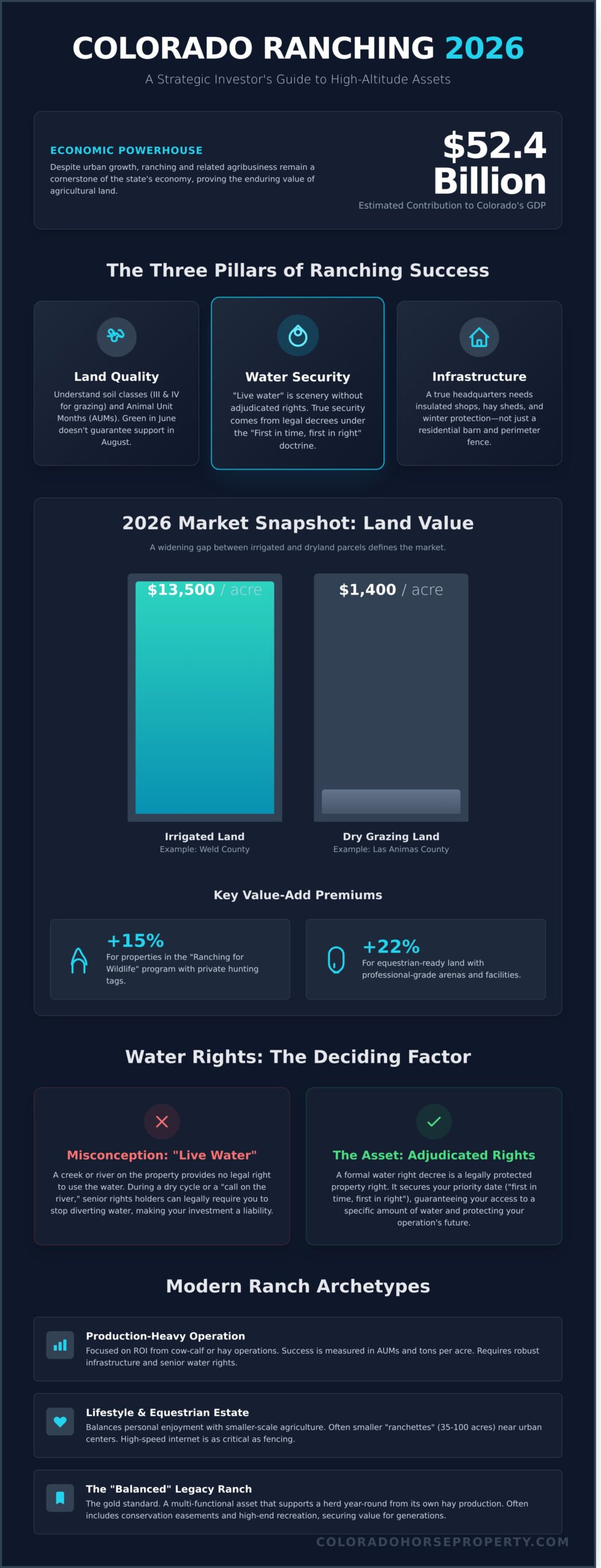
Regionality dictates your daily operations and long-term appreciation. The Front Range sees high demand for equestrian estates near urban centers like Fort Collins or Castle Rock. The Western Slope focuses on irrigated hay and fruit, while the San Luis Valley remains a stronghold for high-altitude cattle operations. In 2026, ranching and related agribusiness contribute an estimated $52.4 billion to Colorado’s GDP. This represents nearly 10% of the state’s total economic output, proving that the agricultural sector remains a powerhouse despite urban growth.
To better understand the daily reality of these operations, watch this helpful video:
The 2020s brought a surge in “ranchettes.” These are typically 35 to 100-acre parcels that allow for a rural lifestyle without the overhead of a 10,000-acre operation. Buyers in this segment now prioritize high-speed fiber-optic internet as much as perimeter fencing. This shift has changed the face of colorado ranching, turning former sheep and cattle outfits into subdivided hobby farms and equestrian retreats. It makes the market more accessible but also more competitive for those seeking smaller acreages.
The Three Pillars of Ranching Success
Land quality is your foundation. You must understand soil classes, specifically Class III and IV soils which are common in productive grazing areas. Grazing capacity is measured in Animal Unit Months (AUMs). A property that looks green in June might only support a handful of head by August. Water security is the second pillar. Many buyers think “live water” like a creek provides security. It doesn’t. Without adjudicated water rights, that creek is just scenery. Finally, infrastructure defines the property’s utility. A true headquarters includes insulated shops, hay sheds, and winter protection, whereas a residential property might only offer a barn and a fence.
The 2026 Market: Trends in Land Value
Current price trends show a widening gap between irrigated and dryland parcels. In 2026, irrigated land in Weld County averages $13,500 per acre, while remote grazing land in Las Animas County stays closer to $1,400 per acre. The “Ranching for Wildlife” program significantly influences these values. Properties enrolled in this program receive private hunting tags for elk and deer, which can add a 15% premium to the listing price. Equestrian-ready land also commands a major premium. Properties with professional-grade indoor arenas and engineered drainage sell for 22% more than raw land in the same zip code. If you are looking for colorado ranching opportunities, these value drivers are essential to your search strategy.
Operational Realities: Cattle, Hay, and Horses
Colorado ranching is a business of tight margins and high-altitude variables. Success here isn’t just about owning land; it’s about understanding how that land produces. Cow-calf operations remain the cornerstone of the state’s rural economy. In this model, producers maintain a permanent herd of mother cows that produce a calf crop every spring. These calves are typically sold in the fall, meaning your entire annual income often arrives in a single window. According to Colorado agricultural statistics, cattle and calves are the top agricultural commodity in the state, generating billions in cash receipts annually. This makes water rights the literal lifeblood of your investment, as they dictate how many head your acreage can actually support.
The “Balanced Ranch” is the gold standard for sustainability in the West. This concept describes a property that can support a herd year-round without the owner needing to purchase outside feed. To achieve this, a ranch must have a precise ratio of summer grazing land to irrigated hay meadows. If you have to buy hay at $250 per ton because your water rights didn’t provide enough irrigation for a second cutting, your profit margins will vanish. In high-altitude regions like the San Luis Valley or South Park, hay production is often limited to one substantial cutting per year. A well-managed field at 7,500 feet might yield 2.2 tons per acre, while lower elevations with better water seniority can sometimes see 4 tons per acre across multiple harvests.
Integrating professional equestrian facilities requires additional planning for the Colorado climate. A standard 60-foot round pen is essential for daily work, but serious owners prioritize 100-foot by 200-foot heated indoor arenas. These structures are mandatory if you plan to train through January when 40-mph winds and sub-zero temperatures make outdoor work impossible. Stalls should be at least 12-foot by 12-foot with rubber matting and automated, frost-free waterers to ensure horse health during deep freezes.
Livestock Management in the High Country
Managing cattle above 6,000 feet introduces unique biological challenges. High Altitude Pulmonary Hypertension, commonly known as Brisket Disease, can cause heart failure in cattle not acclimated to thin air. Savvy buyers look for “PAP tested” bulls to ensure their herd has the genetic resistance to thrive at elevation. Wintering strategies are equally critical. You’ll need natural windbreaks or man-made calving sheds to protect the herd during February storms. For ranch work, hardy breeds like American Quarter Horses or Morgans are preferred; they possess the lung capacity and bone density required for rugged, rocky terrain.
The Forage Science of the Rockies
Pasture quality varies wildly across the state. Native grasses like Blue Grama and Buffalo Grass are drought-resistant and provide excellent protein, but they grow slowly. Improved pastures featuring Timothy, Orchard grass, or Alfalfa offer higher yields but require consistent, senior water rights to remain productive. Many larger colorado ranching operations rely on Bureau of Land Management (BLM) or National Forest grazing permits to supplement their deeded acres. These permits are often attached to the property title and allow you to scale your herd size significantly. Before committing to a purchase, you should ask, how many acres do you need for a horse property? to ensure the land matches your specific goals. If you’re ready to start your search, you can explore our exclusive ranch listings to see these operational features in person.
Water Rights: The Most Critical Asset in Colorado Ranching
In Colorado, land without water is just dirt. The state operates under the Doctrine of Prior Appropriation, a system established in the 1876 State Constitution. This framework follows a “first in time, first in right” philosophy. It’s a strict hierarchy. If you’re investing in colorado ranching, you’ve got to understand that the oldest water rights, known as senior rights, get their full legal allocation before newer junior rights receive anything. During the severe drought of 2012, many junior holders saw their headgates locked by the Water Commissioner while senior holders continued to irrigate their hay fields.
The distinction between senior and junior rights becomes a life-or-death matter for your livestock and crops during dry cycles. Owning 100 acres with a 1970 priority date is significantly less secure than owning 20 acres with an 1885 priority date. You aren’t just buying the water; you’re buying a spot in a very long line. When the snowpack in the Rockies drops below 80% of the median, those at the back of the line often go dry.
Water in Colorado is categorized into three main types. Tributary water is the most common, legally connected to surface streams and rivers. Non-tributary water comes from deep aquifers where pumping doesn’t impact surface flows for at least 100 years. Finally, designated basins, primarily found on the Eastern Plains, are managed by the Ground Water Commission under separate rules. Beyond these categories, the hidden value of a property often lies in ditch company shares. These shares represent a pro-rata portion of a larger, older water right and are treated as personal property. Well permits are also vital; a standard domestic permit might only allow for 15 gallons per minute, which won’t suffice for colorado ranching operations that require large-scale stock watering or arena dust control.
Auditing a Property’s Water Portfolio
A Water Court decree serves as the “birth certificate” for a water right. It specifies the priority date, the source of the water, and the volume measured in cubic feet per second (cfs) or acre-feet. You must verify the “beneficial use” history. Colorado law dictates a “use it or lose it” policy. If a right hasn’t been put to beneficial use for 10 consecutive years, the Division of Water Resources can place it on the decennial abandonment list. Don’t be fooled by “live water” like a creek flowing through a pasture. Without an adjudicated decree, you have no legal right to divert that water for your horses or hay.
Irrigation Systems and Maintenance
Choosing an irrigation method dictates your daily labor and your profit margins. Traditional flood irrigation is common but often only 40% efficient. In contrast, modern center pivots reach 90% efficiency but require massive capital investment; a new 125-acre pivot system typically costs between $85,000 and $120,000. Maintenance is a constant reality. Replacing a single rusted headgate or cleaning a mile of lateral ditch can cost $10,000 to $20,000 in heavy equipment rentals and labor. Prospective owners should study Water Rights in Colorado: What Every Buyer Must Know to understand how these infrastructure costs impact the long-term viability of a ranch.
Evaluating Potential: How to Audit a Working Ranch
Success in colorado ranching depends on more than a scenic view; it’s about the land’s measurable performance. When you’re on-site, you need to look past the aesthetic and focus on the biological and structural integrity of the property. A thorough audit ensures the acreage can support your livestock and your long-term financial goals.
Topography determines your daily workload and the health of your herd. You’ll want to look for a 3% grade in high-traffic areas to ensure proper drainage without causing topsoil erosion. Pay close attention to the solar aspect of your pastures. South-facing slopes are invaluable in a Colorado winter because they clear of snow 20% faster than north-facing aspects, providing your animals with critical access to forage during the coldest months.
Soil health is the foundation of any productive operation. Don’t guess about the quality of the ground; use a soil probe to collect samples from the top 6 inches of your primary grazing areas. You’re looking for nitrogen levels above 20 parts per million and organic matter between 3% and 5%. These numbers indicate the land’s ability to sustain perennial grasses like Western Wheatgrass without requiring expensive annual fertilization.
Fencing is often the most expensive infrastructure item to repair or replace. Colorado is an “Open Range” state under CRS 35-46-102, which means it’s your responsibility to fence livestock out of your property. Inspect the perimeter for 4-strand barbed wire or high-tensile smooth wire. Replacing a mile of fence costs between $13,500 and $26,000 depending on the terrain. Effective cross-fencing is equally vital; it allows for rotational grazing which can increase your forage yield by 30% compared to continuous grazing models.
Zoning restrictions and conservation easements can permanently alter your plans. Many Colorado ranches are zoned A-1 or A-2, but you must verify the specific “Use by Right” categories for your county. Check the title commitment for conservation easements held by organizations like the Colorado Cattlemen’s Agricultural Land Trust. These often limit residential construction to a single building envelope of 2 to 5 acres, which prevents future subdivision or the addition of multiple guest houses.
A functional headquarters serves as the brain of the ranch. The main barn needs at least 14-foot clearance for modern tractors and hay squeeze equipment. Your hay storage must be sized to hold 150% of your expected winter requirement to account for drought years. Ensure the tack room has climate control; Colorado’s dry air and temperature swings can ruin leather equipment in less than 24 months if it isn’t protected.
The Equestrian Audit: Beyond the Barn
High-quality arena footing requires a 4-inch sub-base of compacted road base topped with 2.5 inches of washed angular sand. This specific composition prevents tendon strain and maintains drainage. For logistics, you’ll need a 60-foot turning radius on all driveways to accommodate a 40-foot gooseneck trailer. Always verify if the property is zoned for commercial equestrian use or strictly private use, as changing this status can take 12 months in some counties.
Environmental and Wildlife Factors
Colorado’s “Ranching for Wildlife” program offers a unique ROI through private hunting tag allocations, but it requires a minimum of 12,000 contiguous acres. On smaller parcels, you’ll need to identify noxious weeds like Leafy Spurge or Musk Thistle. Management costs for these invasive species often exceed $50 per acre annually. You should also check for predator patterns, as proximity to state forest land increases the need for secure, night-time enclosures for smaller livestock.
View our current listings to find a Colorado ranch for sale that meets your audit standards.
Securing Your Legacy: The Strategic Acquisition
Buying a ranch isn’t like buying a suburban home. Generalist realtors often fail because they don’t understand the technical nuances of water decrees or the specific demands of colorado ranching. A standard residential agent might see a beautiful stream; a seasoned expert sees a potential abandonment issue or a junior right that won’t survive a dry July. In fact, roughly 85% of standard real estate agents have never read a water court decree or calculated the carrying capacity of a pasture. This lack of specialized knowledge leads to expensive mistakes during the due diligence phase.
Negotiation strategies for water-heavy land require a data-driven approach. You aren’t just buying dirt; you’re buying a legal priority. We focus on the “historic consumptive use” rather than just the face value of the water shares. If a seller claims 5 CFS but records show they’ve only diverted 2 CFS over the last 10 years, the price must reflect that reality. Closing the deal involves more than a standard title policy. You need a specialized water attorney to issue a Title Opinion, as standard title insurance explicitly excludes water rights in 98% of Colorado ranch transactions.
AI-Powered Search: The Future of Land Acquisition
Our proprietary technology changes how buyers find land. We use AI to scan thousands of data points, identifying specific soil markers like sandy loam or alluvial deposits that are ideal for equine health. Our system filters for “Horse-Ready” features, such as existing 12×12 stalls and perimeter fencing, rather than just raw acreage. This tech identifies off-market opportunities that haven’t hit the MLS yet, giving our clients a 15% advantage in competitive markets. The Realty Oasis advantage combines this tech with nearly 40 years of local expertise to ensure you don’t just find a property, but a sustainable investment.
Next Steps for the Aspiring Rancher
Once the contract is signed, your focus shifts to the “Ranch Team.” You’ll need to coordinate with water attorneys, livestock managers, and equine vets to ensure a smooth transition. Transitioning from a buyer to a steward of the land means understanding your role in the local ecosystem. You’re now responsible for maintaining headgates and managing grazing rotations to preserve the colorado ranching heritage. We help you navigate the transition, including maintaining your agricultural tax status which can reduce your property tax burden by as much as 30% compared to residential rates.
- Verify Tax Status: Ensure the property has maintained its “Ag-valuation” for at least two consecutive years to avoid immediate tax spikes.
- Audit the Infrastructure: Test well pumps and inspect ditch liners during the 30-day inspection period.
- Secure Your Team: Establish relationships with local ditch riders and neighbors within the first 60 days of ownership.
Your dream of owning a legacy property is within reach, but it requires the right tools and a specialized partnership. Don’t leave your investment to chance or generalist advice. It’s time to leverage professional insights and cutting-edge technology to find the perfect fit for your lifestyle and dreams. Start your AI-powered Colorado ranch search today and secure the future of your equine legacy.
Secure Your Legacy in the Colorado High Country
Success in colorado ranching throughout 2026 depends on two non-negotiable factors: securing senior water rights and understanding specific agricultural zoning laws. It’s a complex landscape where a single water decree determines your ranch’s long-term viability. You need to audit every acre and infrastructure detail before you sign your name. We’ve spent nearly four decades mastering these technical nuances for our clients. Our team combines this deep local history with proprietary AI search technology to find equestrian features that standard platforms miss. We specialize in the grit and data of land acquisitions, from soil quality to hay production capacity. Whether you’re managing 40 acres or 4,000, the right expertise makes the difference between a liability and a legacy. We’re here to ensure your transition to the rural lifestyle is seamless and profitable. Don’t settle for a generalist when you can work with specialists who know the dirt. Find Your Colorado Ranch with Our AI-Powered Search Tool today. The right property is out there waiting for you.
Frequently Asked Questions
Is ranching in Colorado profitable in 2026?
Profitability in 2026 depends on diversifying your income through carbon credits, agritourism, or niche meat marketing. Traditional cow-calf operations typically see net margins between 2% and 4% after all operating expenses are paid. Successful colorado ranching families often utilize USDA conservation programs, which provided $1.8 billion in support to farmers in 2023, to help stabilize their bottom line against market volatility.
How much does a working cattle ranch in Colorado cost?
Expect to pay between $1,500 and $4,500 per acre for a productive cattle ranch in today’s market. A self-sustaining operation usually requires at least 500 acres, which puts the entry price near $750,000 in remote areas like the Eastern Plains. High-demand regions in mountain valleys or near the Front Range frequently see prices exceeding $12,000 per acre for land with senior water rights.
What is the difference between a ranch and a ranchette?
A ranchette is a small-scale lifestyle property that typically ranges from 2 to 40 acres. It’s designed for hobby farming or keeping a few horses rather than generating a full-time living. A true ranch exceeds 40 acres and has the scale necessary for commercial colorado ranching activities. Ranchettes often rely on individual residential wells, while larger ranches require complex decreed water rights for irrigation.
Do I own the water that runs through my Colorado property?
You don’t automatically own the water because Colorado follows the Doctrine of Prior Appropriation established in the 1876 State Constitution. Ownership of the land is legally separate from the right to use the water flowing across it. You must verify the deed for specific water shares or decreed rights. Without these legal documents, using water from a stream on your property can result in a cease and desist order from the State Engineer.
How many acres do I need to qualify for agricultural tax status in Colorado?
Colorado law doesn’t set a strict minimum acreage, but most county assessors require at least 35 acres to grant agricultural status without intensive documentation. You must prove the land was used for the primary purpose of making a profit from crops or livestock for the previous two years. This status is vital because it can reduce your property tax bill by 50% or more compared to standard residential rates.
What are grazing permits, and do they transfer with the land?
Grazing permits allow you to run livestock on federal land managed by the Bureau of Land Management or U.S. Forest Service. These permits don’t automatically transfer with a property deed; they’re privileges that the federal agency must approve for the new owner. About 65% of ranches on the Western Slope rely on these 10 year permits to expand their herd capacity beyond what their private acreage can support.
What is the “Ranching for Wildlife” program, and how do I join?
The Ranching for Wildlife program is a partnership with Colorado Parks and Wildlife that grants landowners private hunting tags in exchange for habitat improvement. You need a minimum of 12,000 contiguous acres to qualify for the program. Applications are competitive and require a detailed 10 year management plan. Currently, only 28 ranches statewide participate in this exclusive program due to the strict acreage and conservation requirements.
How do I verify the mineral rights on a Colorado ranch?
You must hire a professional landman or title attorney to conduct a specialized mineral chain of title search back to the original 1800s land patent. A standard title insurance policy doesn’t cover minerals, and surface rights are often severed from the mineral estate in Colorado. Statistics show that roughly 80% of rural land in the state has some degree of severed mineral ownership, meaning a third party could own the oil or gas beneath your soil.