
Finding the perfect ranch land for sale in Colorado is about more than just a beautiful view; it’s about securing a legacy that stands the test of time. However, for many buyers, the dream of wide-open spaces is often clouded by the complexities of Colorado water law and the fear of investing in “dry land” that lacks utility potential. Navigating these hurdles-along with the challenge of sourcing off-market equestrian acreage-requires a specialized level of expertise that goes beyond a standard real estate transaction.
With nearly four decades of experience, we understand that you aren’t just buying property; you are investing in your lifestyle and dreams. In this 2026 guide, we provide a clear roadmap to evaluating, financing, and securing high-value legacy acreage. You will discover how to leverage our AI-powered search tools to find niche equestrian infrastructure, understand the significant tax benefits of agricultural status, and ensure your investment includes the vital water rights necessary for a thriving, multi-generational Colorado ranch.
Key Takeaways
- Navigate the 2026 Colorado market by identifying high-value acreage across the Front Range and Western Slope.
- Protect your investment by mastering the complexities of water rights, mineral rights, and legal access before you commit.
- Use cutting-edge AI search tools to uncover hidden ranch land for sale that meets your exact requirements for equestrian infrastructure.
- Distinguish between production-scale operations and hobby farms to ensure your property supports your specific lifestyle and dreams.
- Leverage decades of specialized expertise to streamline the transition from searching for land to securing your legacy property.
Understanding the Colorado Ranch Land Market in 2026
In 2026, the Colorado ranch land for sale market is defined by a sophisticated blend of legacy preservation and modern utility. Whether you are scouting the rolling shortgrass prairies of the Front Range or the rugged, high-altitude basins of the Western Slope, ranch land is distinguished by its focus on livestock grazing and natural resource management. This differs from farm land, which centers on intensive crop production. The ongoing “shift to rural” has evolved into a permanent market fixture, as buyers prioritize autonomy, food security, and a connection to the history of ranching in the United States.
To better understand the practical application of rural land ownership in Colorado, watch this helpful video showcasing a localized property:
The 35-Acre Rule and Colorado Zoning
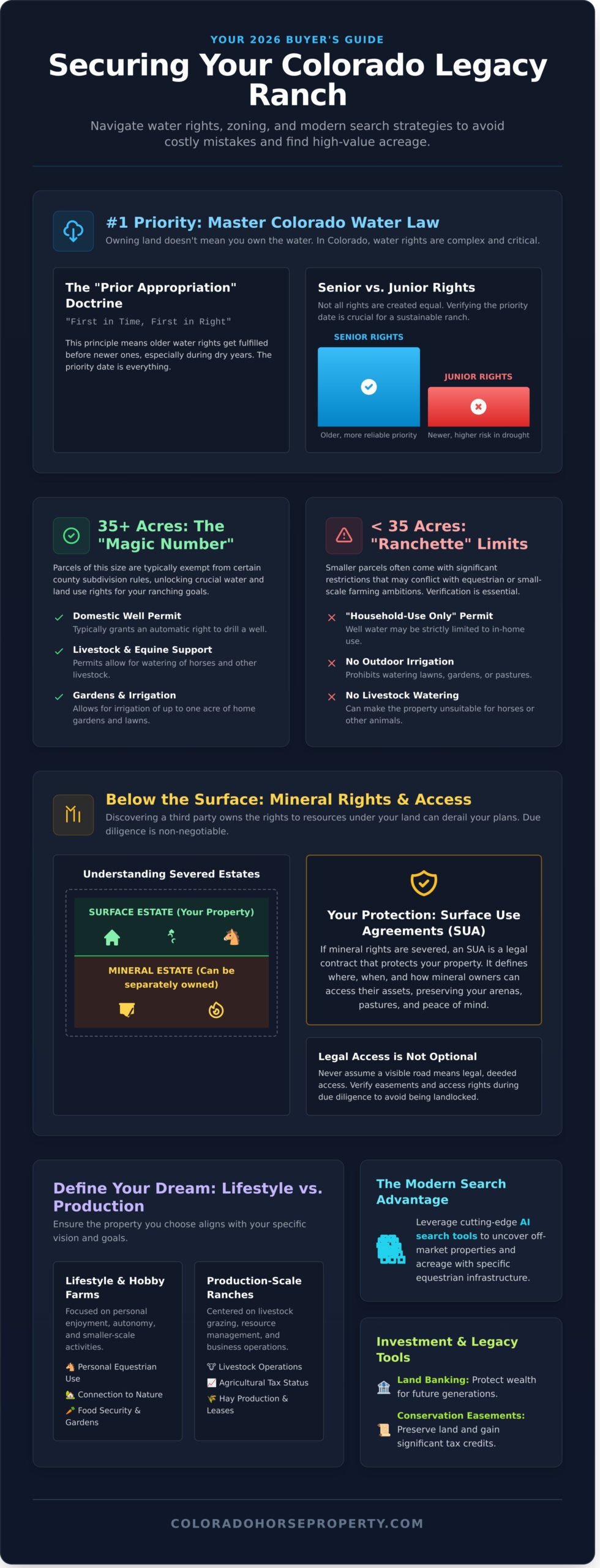
In Colorado, 35 acres is often considered the “magic number” due to state statutes that exempt parcels of this size or larger from certain county subdivision regulations. Most importantly, owning at least 35 acres typically grants an automatic right to a domestic well permit, allowing for the watering of livestock and small gardens. Smaller parcels, often called “ranchettes,” may be limited to “household-use only” well permits, which prohibit outdoor irrigation or equine support. When searching for ranch land for sale, always verify county-specific zoning in areas like Elbert or Douglas County to ensure your equestrian goals align with local animal unit densities.
Investment Potential of Colorado Acreage
The financial drivers of ranch ownership are as compelling as the emotional ones. Land in key corridors-particularly Douglas, Elbert, and Pueblo counties-has shown consistent historical appreciation. Many owners utilize “land banking” as a strategy to protect wealth for future generations while enjoying the immediate lifestyle benefits. Furthermore, conservation easements have become a vital tool for Colorado ranchers; they allow owners to protect the land from future development in exchange for significant tax credits, effectively preserving the ranch’s value and the owner’s legacy simultaneously.
For those looking to deepen their understanding of property as a tool for financial freedom, educational resources can be invaluable. The training company Property-CEO teaches proven strategies for building wealth through real estate, offering principles that can be applied across different markets.
Critical Evaluation: Water Rights, Mineral Rights, and Access
The #1 fear for any buyer looking at ranch land for sale is the nightmare scenario: turning on the pump or checking the stock tank only to find it dry. In the West, owning the “dirt” does not automatically grant you the right to the water flowing across it or the minerals beneath it. Navigating these complexities requires a seasoned perspective to ensure your rural lifestyle remains sustainable for decades to come.
Colorado Water Law: Prior Appropriation 101
Colorado operates under Colorado’s Prior Appropriation System, a “first in time, first in right” doctrine. Senior water rights are older and take priority over junior rights during dry years. When evaluating ranch land for sale, you must verify the priority date of any associated water. We recommend confirming well permits through the Colorado Division of Water Resources to ensure the permit allows for livestock watering. If you intend to produce your own hay, you must also investigate ditch rights and shares in local irrigation companies to guarantee your pastures stay productive.
Mineral Rights and Surface Use Agreements
In Colorado, it is common for the mineral estate to be “severed” from the surface estate. This means a third party may own the rights to the oil, gas, or coal beneath your horse property. Because the mineral estate is often considered “dominant,” the owner may have the right to access the surface to extract those resources. To protect your investment and your animals, it is vital to investigate the chain of title. If minerals are severed, we guide our clients in seeking Surface Use Agreements (SUAs), which provide legal protections regarding where equipment can be placed, helping to preserve your arenas and grazing land.
The Vital Importance of Due Diligence
The “due diligence” period in a land contract is your window to uncover hidden liabilities. Never assume a visible road constitutes legal access. Use this checklist to protect your interests:
- Verify Deeded Access: Ensure the property has direct access to a public road or a recorded, permanent easement.
- Identify Easements: Look for utility or neighbor easements that might restrict where you can build barns or fences.
- Physical vs. Legal Access: Confirm that the legal access is physically traversable for horse trailers and hay semis.
Taking a no-nonsense approach to these legal realities ensures that your dream of owning a Colorado ranch doesn’t turn into a series of costly disputes.
Lifestyle vs. Production: Which Type of Ranch Land Do You Need?
Choosing the right ranch land for sale depends on whether your goal is a working production outfit or a lifestyle-focused retreat. A cattle operation requires heavy-duty perimeter fencing, loading chutes, and extensive water distribution systems. In contrast, a horse property prioritizes safety-conscious fencing (like pipe or vinyl), specialized arenas with specific footing, and proximity to equine veterinary services.
For many buyers, the “ranchette” or hobby farm offers an ideal entry point. These smaller parcels-typically 5 to 35 acres-provide enough space for a few head of livestock or a private stable without the overwhelming maintenance of a multi-thousand-acre spread. Maintenance requirements scale quickly with acreage; while a 10-acre lot can be managed with a riding mower and a small UTV, larger tracts often necessitate tractors, haying equipment, and significant time for weed mitigation and fence repair.
Topography also dictates land utility. Flat, irrigated pastures are essential for hay production and training arenas, whereas mountain timber provides natural shelter for summer grazing and increased privacy. According to the latest Colorado agricultural statistics, land use efficiency is a major factor in regional market value, as different terrains support vastly different carrying capacities for livestock.
Properly managing the trees on a property is a critical aspect of land ownership, affecting everything from fire safety to aesthetics. For those new to acreage, understanding what professional tree care entails can be helpful; for a look at the types of services available, you can visit We Love Trees.
Equestrian-Specific Land Requirements
When evaluating ranch land for sale for horses, soil quality is paramount. Avoid low-lying “muck” areas that lead to hoof rot; instead, seek out sandy loam or well-draining soils that facilitate year-round arena use. Always inspect the structural integrity of existing barns and stalls-retrofitting an old cattle barn for horses can be more expensive than building new. Finally, consider location: properties bordering BLM or National Forest land offer direct access to public trailheads, adding significant lifestyle and resale value.
Agricultural Tax Status (Ag-Status) Benefits
Securing an “Ag” designation with the county assessor is a critical financial strategy. This status can reduce property taxes by up to 90% compared to standard residential rates. To maintain this, you must demonstrate a legitimate profit motive, typically through active grazing, haying, or leasing the land to a local producer. Ag-Status remains the primary driver for ranch profitability in 2026, serving as the essential hedge against rising land carry costs.
The Modern Search: Using AI to Find Hidden Ranch Gems
The days of endlessly scrolling through generic MLS listings are over. Traditional search platforms often fail to distinguish between a large residential lot and true ranch land for sale. Today, savvy buyers use AI-powered tools to bypass the noise and pinpoint properties that align with their specific lifestyle and dreams. While a standard search might show you “land,” an AI-integrated search understands the nuances of rural acreage and equine infrastructure.
Leveraging AI Search Filters
Modern search technology allows you to filter by highly specific criteria that once required hours of manual vetting. At coloradohorseproperty.com, we empower users to search by precise acre ranges-such as 40, 80, or 160+ acres-to ensure the land meets zoning and agricultural requirements. You can now filter for essential “Horse Features” like indoor arenas, round pens, or existing hay sheds. Furthermore, AI-enhanced satellite imagery allows you to pre-screen topography and drainage patterns from your desk, saving you from making long trips to unsuitable sites.
The Human Element: Why Local Expertise Still Matters
Data is powerful, but it requires interpretation. A specialized land broker brings nearly four decades of experience to the table, providing a layer of insight that an algorithm cannot replicate. While AI can identify a property with water, a seasoned expert understands the complexity of senior water rights and how they impact your long-term ranching operations. Furthermore, many of the best opportunities are “pocket listings”-off-market properties that never hit widely accessible public listing sites. A broker with deep roots in the community is your only bridge to these exclusive gems.
This principle of specialized, local expertise holds true in other regions as well. For those interested in the Midwest’s unique land opportunities, you can learn more about Coulee Land Company, a firm that exemplifies this approach in Wisconsin.
Step-By-Step Guide to an Effective Search:
- Define Your Acreage: Start with a specific range (e.g., 35-160 acres) to filter out residential subdivisions.
- Identify Must-Haves: Use filters for “water rights,” “fencing,” or “arenas” to narrow the field.
- Analyze Topography: Use AI satellite tools to check for flat building sites versus steep grazing land.
- Verify with an Expert: Contact a specialized broker to uncover off-market ranch land for sale and navigate complex contract negotiations.
By combining cutting-edge search technology with the authoritative knowledge of a seasoned professional, you can navigate the competitive Colorado market with confidence and precision.
Securing Your Legacy with Colorado Horse Property
Choosing between farm and ranch land is a decision that shapes your future and defines your legacy. At Colorado Horse Property, Mark and Alison Eibner provide a specialized approach that goes beyond traditional real estate. With nearly four decades of experience, they understand that searching for ranch land for sale is about more than just finding acreage; it is about fulfilling a “lifestyle and dreams” philosophy. They act as seasoned guides, helping you navigate the unique nuances of the Colorado landscape to find a property that supports your equine or agricultural ambitions.
Full-Cycle Transaction Management
The transition to a rural lifestyle involves complexities that generalist realtors often overlook. Realty Oasis provides a comprehensive ecosystem of services designed to handle every detail of the process. From navigating complex water rights and zoning laws to professional contract coordination, the team ensures a seamless experience. By working with specialized partners like Meridian Title & Escrow, they provide a level of security that significantly reduces buyer anxiety. This professional management ensures that the technical aspects of your closing are as solid as the land itself.
Our commitment to your success includes:
- Expert Evaluation: Assessing barns, arenas, and pasture quality before you commit.
- Technical Precision: Managing the intricate paperwork required for rural and off-grid properties.
- Specialized Partnerships: Leveraging a network of experts who understand Colorado land law.
Your Next Steps to Owning a Colorado Ranch
If you are ready to move from exploration to ownership, the right tools make all the difference. We have integrated modern technology with old-fashioned expertise to streamline your search. Whether you are looking for a small hobby farm or expansive ranch land for sale, our platform is designed for efficiency and clarity.
Take the next step in your journey today:
- Utilize our AI-Powered Horse Property Search to filter listings by specific equine features and acreage.
- Contact our team to discuss your specific needs for water rights and grazing potential.
- Schedule a tour of Colorado’s best ranch land today to experience the terrain firsthand.
Securing a piece of the Colorado landscape is a significant milestone. With the right partnership, the process of finding and closing on your property becomes a rewarding step toward the fulfillment of your rural lifestyle dream.
Securing Your Colorado Legacy
Owning a piece of the Centennial State is about more than just acreage; it is about securing a future that aligns with your lifestyle and dreams. As we navigate the 2026 market, success depends on a clear understanding of complex factors like water rights, agricultural zoning, and the distinction between production-heavy operations and recreational retreats. Finding the right ranch land for sale requires both a deep respect for the land and the right technology to uncover hidden opportunities in a competitive landscape.
With nearly 40 years of specialized Colorado real estate experience, our team understands the nuances of rural land ownership. We combine this decades-long expertise with proprietary AI search technology designed specifically for equestrian and ranch features, ensuring you never miss a property that meets your exact needs. From navigating intricate mineral rights to identifying the perfect pasture, we are here to turn your vision into a tangible reality.
Start Your AI-Powered Ranch Land Search Now
Your legacy is waiting in the high country-let’s find it together.
Frequently Asked Questions
How much does an average ranch in Colorado cost in 2026?
In 2026, the cost of a Colorado ranch depends heavily on water rights, infrastructure, and proximity to the Front Range. Smaller recreational properties often start around $1.5 million, while productive working ranches with significant acreage and senior water rights typically exceed $5 million. Market demand for the rural lifestyle continues to drive valuations higher for properties with existing barns and arenas.
What is the difference between a ranch and a farm in Colorado?
The primary difference lies in how the land is utilized. A ranch is dedicated to livestock grazing and animal husbandry, requiring vast acreage and specialized fencing. A farm focuses on crop production, emphasizing soil nutrients and irrigation for harvests. When searching for ranch land for sale, buyers should prioritize forage quality and livestock shelter rather than just tillable acreage.
How many acres do I need to qualify for agricultural tax status?
Colorado does not have a strict minimum acreage for agricultural classification, though many counties use 35 acres as a benchmark. To qualify, you must demonstrate that the land is used for a primary purpose of obtaining a monetary profit from livestock or crops. You must provide documentation of consistent agricultural use for at least the two prior years to receive these tax benefits.
Can I build a house on any ranch land I buy in Colorado?
Not every parcel is buildable. While most rural zoning allows for a primary residence, you must confirm the “building envelope” and check for conservation easements that may restrict construction. Before closing on ranch land for sale, it is essential to verify legal access, the ability to permit a septic system, and the availability of a functional domestic well or utility hookups.
What are Colorado water rights and why do they matter for ranch land?
Water rights are legal entitlements to use water from a specific source and are governed by the “prior appropriation” doctrine. In Colorado, owning the land does not automatically mean you own the water. These rights are vital because they determine your ability to irrigate pastures, water livestock, and maintain the property’s value, especially during periods of drought or restricted usage.
Is it possible to find ranch land for sale near Denver?
Yes, though inventory is limited and highly sought after. Areas like Douglas, Elbert, and Jefferson Counties offer excellent ranching opportunities within an hour’s drive of the metro area. These properties are ideal for owners who want to enjoy a rural lifestyle and mountain views while maintaining easy access to Denver’s professional hubs and premier equestrian event centers.
What should I look for in a soil test before buying ranch land?
A soil test should analyze nutrient levels, pH balance, and drainage. For ranching, you need to ensure the ground can support native grasses or high-quality forage for grazing. Additionally, a geotechnical report is recommended to check for expansive soils, which are common in Colorado and can cause significant foundation issues for heavy structures like indoor arenas or large barns.
How do I finance the purchase of a large Colorado ranch?
Financing a large ranch usually requires working with specialized agricultural lenders or land credit associations rather than traditional banks. These lenders understand the complexities of water rights and agricultural valuations. Expect to provide a down payment of 20% to 35% and, in some cases, a business plan demonstrating how the land will be managed for livestock or crop production.