
Imagine walking the pastures of a beautiful new horse property in the spring. You see rolling green hills dotted with bright, attractive yellow flowers. It looks like a pastoral painting. However, those pretty yellow flowers might actually be a massive legal and financial liability.
In Colorado, the fight against invasive species is taken very seriously. When you buy a piece of land, you inherit all the problems growing in the dirt. You might assume that weed control is just a matter of having a neat yard, but the state government views certain plants as ecological disasters.
If you purchase a property heavily infested with “List A” or “List B” noxious weeds, you are not just buying a farm. You are buying a mandatory, multi-year eradication project.
Here is what you need to know about Colorado weed laws, the specific dangers to your herd, and how to spot an infested pasture before you close on a property.
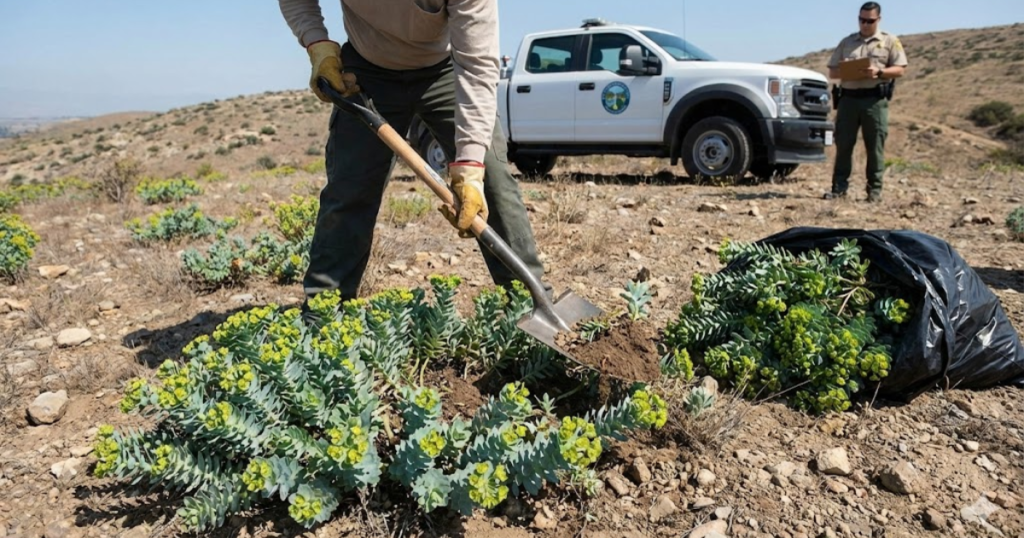
Are There “Noxious Weeds” Like Myrtle Spurge That I Am Legally Required to Kill?
Quick Summary: The Legal Mandate
- The legal mandate: In Colorado, noxious weeds are not just a nuisance. Under state law, property owners are legally mandated to eradicate or suppress specific invasive plants to protect the local ecosystem. :contentReference[oaicite:0]{index=0}
- The danger to livestock: Many mandated weeds, such as Myrtle Spurge and Russian Knapweed, are highly toxic or even fatal to horses and other grazing animals. :contentReference[oaicite:1]{index=1}
- The financial burden: Eradicating a severe infestation is not cheap. It often requires hiring commercial chemical applicators for multiple seasons, which can cost hundreds or thousands of dollars. :contentReference[oaicite:2]{index=2}
- The county enforcement: If you ignore a noxious weed infestation, county weed inspectors can fine you, hire a crew to spray your property, and place a tax lien to collect the bill. :contentReference[oaicite:3]{index=3}
Weeds can be a compliance issue, a horse safety issue, and a multi-year cost line item—all at once.
1. Understanding the Colorado Noxious Weed Act
In the eyes of the law, a “noxious weed” is a non-native invasive species that outcompetes native vegetation, damages agricultural land, and harms ecosystems. Colorado categorizes these weeds into three lists that dictate what you must do as an owner. :contentReference[oaicite:4]{index=4}
List A species (eradication required)
- These are the most destructive weeds that are not yet widespread. If you have them, eradication is legally mandated. :contentReference[oaicite:5]{index=5}
- Example: Myrtle Spurge, a common illegal ornamental that escapes gardens. :contentReference[oaicite:6]{index=6}
List B species (stop the spread)
- These weeds are more common. Depending on your county, you may be required to eradicate them or suppress them to prevent spread. :contentReference[oaicite:7]{index=7}
- Examples: Leafy Spurge, Russian Knapweed, Canada Thistle. :contentReference[oaicite:8]{index=8}
List C species (management encouraged; county may require control)
- These are widespread and often difficult to eradicate statewide, but your county may still require management. :contentReference[oaicite:9]{index=9}
- Examples: Field Bindweed, Puncturevine. :contentReference[oaicite:10]{index=10}
2. The Direct Threat to Your Horses
Horses usually avoid toxic weeds when pasture grass is healthy. The danger increases during drought or overgrazing—when good forage disappears and horses start eating whatever is available. :contentReference[oaicite:11]{index=11}
Myrtle Spurge
- Contains a caustic milky sap that can cause blistering and hair loss on contact. :contentReference[oaicite:12]{index=12}
- If ingested, it irritates the mouth and GI tract and can lead to colic and potential death. :contentReference[oaicite:13]{index=13}
Russian Knapweed
- Highly toxic to equines; chronic ingestion can cause “chewing disease,” a fatal neurologic condition that prevents eating and swallowing. :contentReference[oaicite:14]{index=14}
Leafy Spurge
- Produces a toxic milky sap that blisters mouths and digestive tracts. :contentReference[oaicite:15]{index=15}
- Aggressive growth can quickly take over and eliminate edible forage. :contentReference[oaicite:16]{index=16}
3. The Financial Cost of Eradication
Severe infestations cannot be solved with mowing and a hardware-store spray bottle. Many noxious weeds have deep interconnected root systems and persistent seed banks. :contentReference[oaicite:17]{index=17}
Why it’s expensive
- Deep roots: Species like Canada Thistle and Leafy Spurge can have extensive root systems; cutting tops does not eliminate them. :contentReference[oaicite:18]{index=18}
- Commercial spraying: Often requires licensed applicators and restricted-use herbicides; costs can run hundreds to thousands per season depending on acreage. :contentReference[oaicite:19]{index=19}
- Multi-year commitment: Seeds can remain viable for years; expect 3–5 years of management for meaningful results. :contentReference[oaicite:20]{index=20}
Healthy, thick pasture is the cheapest weed control. Bare dirt is an invitation for invasive plants. :contentReference[oaicite:21]{index=21}
4. The Legal Consequences of Ignoring the Problem
Colorado counties actively enforce weed rules through inspections and neighbor reports. :contentReference[oaicite:22]{index=22}
The enforcement pathway
- Warning notice: You may receive a formal notice with a short deadline (often 10–14 days) to begin an acceptable management plan. :contentReference[oaicite:23]{index=23}
- Forced eradication: If ignored, the county can enter and spray/eradicate, using their crews or contractors. :contentReference[oaicite:24]{index=24}
- Tax lien: The county bills you; unpaid costs can become a lien that must be satisfied before selling/refinancing and can escalate to foreclosure. :contentReference[oaicite:25]{index=25}
- HOA enforcement: Horse-community HOAs may fine and enforce weed rules even faster than the county. :contentReference[oaicite:26]{index=26}
We Inspect the Pastures Before You Buy
We know that a beautiful pasture is only beautiful if it is safe and legal. :contentReference[oaicite:27]{index=27}
When Mark Eibner and Belinda Seville tour a horse property with you, we walk the fields and help identify potential noxious weeds before you make an offer. If the land requires thousands in spraying to become safe for your horses, we use that information to negotiate or require treatment before closing. :contentReference[oaicite:28]{index=28}
Contact Us Today to find a property with healthy, safe, and legal pastures.
Browse Active Colorado Horse Properties: View All Available Listings
Frequently Asked Questions (FAQ) About Noxious Weeds
Can I just mow the weeds down before they seed?
Mowing can suppress some weeds, but it rarely eradicates deep-rooted perennials like Knapweed or Thistle. Mowing should be combined with targeted herbicides or biological controls to truly solve the problem. :contentReference[oaicite:29]{index=29}
Will the weed killer hurt my horses?
Many pasture herbicides target broadleaf weeds while leaving grasses. However, every product has specific grazing restrictions—some allow return once dry, others require weeks. Always follow label instructions. :contentReference[oaicite:30]{index=30}
Are dandelions considered noxious weeds?
No. Dandelions are not classified as noxious weeds by Colorado and horses can safely eat them. The legal focus is on destructive non-native species. :contentReference[oaicite:31]{index=31}