
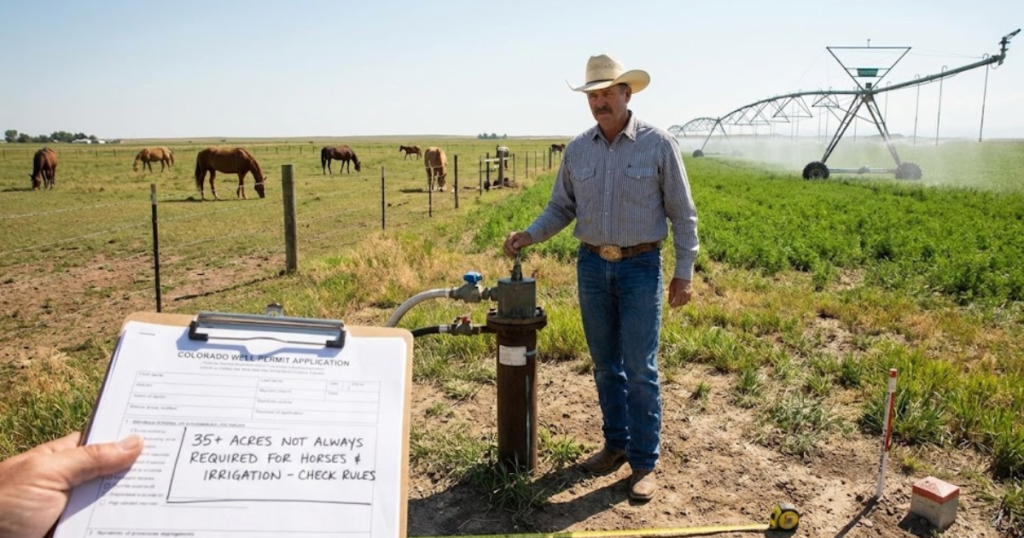
You find a perfect 10-acre parcel. It is manageable, affordable, and flat. You plan to build a barn, drill a well, and plant a small pasture.
Stop right there.
In Colorado, you cannot simply drill a well and use the water however you want. Water rights are tied strictly to land size. The number “35” is etched into every rural realtor’s brain because it is the dividing line between “easy water” and “complicated water.”
If you buy that 10-acre lot without checking the water rights first, you might legally be prohibited from filling a single water trough.
Here is why size matters when it comes to Colorado water.
Do I Need 35+ Acres to Get a Well Permit for Horses and Irrigation?
Quick Summary: The “Magic Number” in Colorado Water Law
- The 35-acre rule: In Colorado, owning 35 acres or more is often the “golden ticket.” It generally entitles you to a Domestic Well permit by right, which can allow livestock watering and irrigation up to one acre.
- The small lot trap: If you own less than 35 acres, you are typically restricted to a “Household Use Only” permit unless an exception applies (no horses, no garden).
- The exception (augmentation): Horses on smaller lots are often legal only if the property is covered by a court-approved Augmentation Plan that replaces water.
- The grandfather clause: Wells drilled prior to May 8, 1972 are often exempt from the 35-acre rule and may retain valuable “domestic” capabilities even on small parcels.
No permit = no water. Before you buy, verify what the well can legally do, not just what the listing implies.
1. Why 35 Acres is the “Magic Number”
Colorado water law draws a bright line at 35 acres. If you are at or above that size, state law generally treats your standard domestic pumping as minimal compared to the land area—making it easier to qualify for a Domestic Well Permit.
What a Domestic Well Permit can allow
- Supply water for up to 3 single-family homes.
- Water domestic animals and livestock (your horses).
- Irrigate up to one acre of lawn and garden.
That permit language is the difference between “turnout-ready” and “haul water forever.”
2. The Problem with 5 to 34 Acres
If your parcel is smaller than 35 acres, you lose the automatic presumption that your domestic pumping won’t injure senior water rights.
The restriction you typically see
- The State Engineer may only issue a “Household Use Only” permit.
What that means in real life
- You can drink water inside the house. You can shower.
- But you typically cannot run a hose outside, water a horse, or plant a garden.
To keep horses on this land without a legal pathway, you may end up installing a cistern and paying for water delivery—expensive and unsustainable for most owners.
3. How to Have Horses on Small Lots (The Workarounds)
People keep horses on 5-acre lots all the time. The question is: how do they do it legally? Usually through one of these paths.
Option A: The Augmentation Plan
- Common in subdivisions where a developer went to water court and secured replacement water.
- The subdivision replaces water back into the river system, and homeowners can receive “Augmented” well permits.
- The check: You must verify the specific plan allows for livestock. Some plans allow only household use and lawn irrigation.
Option B: The Pre-1972 Well
- If the well was drilled and permitted before May 8, 1972, it is often “grandfathered.”
- These wells can be extremely valuable because they may retain domestic status (including livestock) even on small acreage.
Option C: The Denver Basin (Deep Aquifers)
- In areas like Douglas and Elbert counties, permits may be based on the deep Denver Basin aquifers (Dawson, Denver, Arapahoe, Laramie-Fox Hills).
- The catch: the annual volume is tied to acreage. On a small lot, you may not be awarded enough to support livestock.
Ask what permit type is in place (Household, Domestic, Augmented, Denver Basin) and request documentation—don’t rely on verbal assurances.
4. Why You Can’t “Just Irrigate” the Whole Pasture
This is one of the biggest misconceptions buyers have when they see acreage.
The 1-acre limit
- Even with a 35-acre Domestic well, you are usually limited to irrigating one acre.
The reality
- You generally cannot put sprinklers on all 35 acres to grow hay. That typically requires a commercial irrigation well—rare and difficult to obtain.
A practical strategy
- Many horse owners use that one acre for a buffer area near the house/barn (lawn, trees, pens) and leave the remainder as native dryland pasture.
We Check the Math Before You Buy
Water law is complicated, but the consequences are simple: No permit = No water.
Mark Eibner and Belinda Seville specialize in navigating these rules. We verify whether a 5-acre property has a valid Augmentation Plan, confirm whether a 40-acre property has the correct Domestic permit, and help ensure you don’t buy a dry farm.
Contact Us Today to verify the water potential of a property.
Browse Active Colorado Horse Properties with verified water rights for your herd.
Browse Active Colorado Horse Properties: View All Available Listings
Frequently Asked Questions (FAQ) About 35-Acre Wells
Can I buy two adjacent 17.5-acre lots to get a permit?
Yes, but they must be legally combined. If you consolidate them into a single 35-acre parcel through your county’s lot-combination process, you can then apply for a Domestic well permit based on the new total acreage.
Can I collect rainwater for my horses?
Colorado allows limited rainwater collection (two rain barrels with a combined capacity of 110 gallons). That can help a garden, but it won’t sustain a herd of horses for long.
What if I have a creek on my property?
In Colorado, you generally do not have the right to use the water in the creek just because it runs through your land. That water is often governed by downstream senior rights, and taking water without the proper legal authorization is an illegal diversion.