
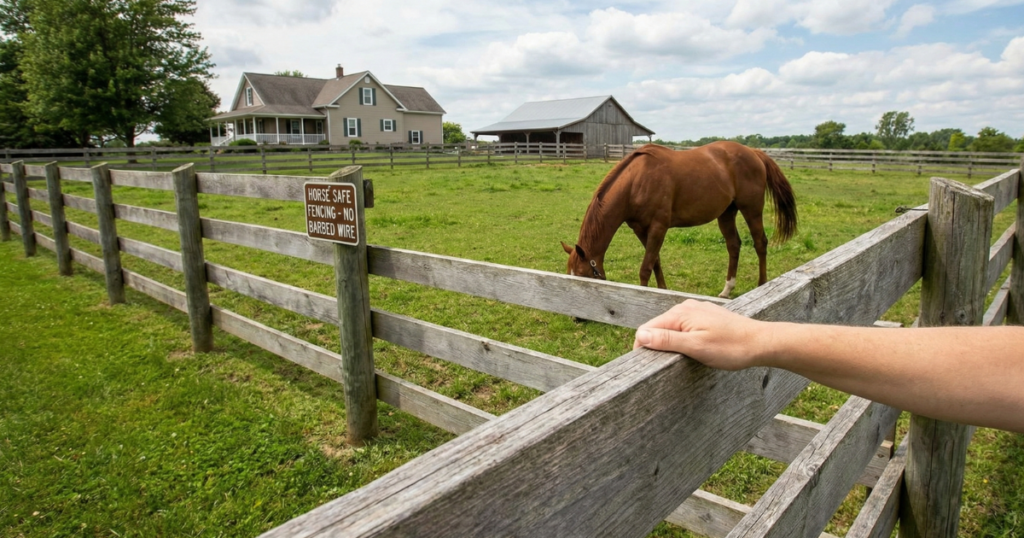
You pull up to the gate. The pasture is green, and the view
is stunning.
But look closer at the perimeter.
Is that rusty barbed wire sagging between rotting cedar
posts? Is it flimsy plastic that a determined pony could walk right through?
Fencing is often the most overlooked asset on a horse
property. Buyers see “fenced pasture” on the listing and assume it is
ready for their warmblood. But in Colorado, many properties are fenced for
cattle, not horses. Putting a horse in a cattle pasture is a recipe for a 2:00
AM emergency vet call.
Here is how to grade the fencing on your potential new home.
What Kind of Fencing Is on the Property? Is It Actually Safe?
Quick Summary: The First Line of Defense
- Barbed wire is for cows: The #1 rule of horse property is that barbed wire is a veterinary disaster waiting to happen. Horses have thin skin and panic easily. If they get tangled in barbed wire, it acts like a saw.
- Visibility is key: Horses are flight animals with poor depth perception. They need to see the barrier. Thin, invisible wire is dangerous. Good fencing has a visual component (a top rail, white tape, or wood).
- The “no-climb” standard: For smaller paddocks, 2" x 4" no-climb woven wire mesh with a top rail is the gold standard. It keeps hooves out of the fence and keeps stray dogs out of the pasture.
- The replacement cost: Fencing is incredibly expensive to build (often $10 to $20 per foot). Buying a property with 10 acres of pristine pipe fencing is like getting a $50,000 discount compared to a property that needs a total fence overhaul.
Before you fall in love with the arena, make sure the fence line won’t become your first emergency expense.
1. The Danger Zone: Barbed Wire
This is the most common fencing you will find in rural Colorado, and it is the most dangerous.
Why it exists
- It is cheap and effective for cattle, who have thick hides and generally move slowly.
Why it kills horses
- Horses are flight animals. If they get spooked and run into a barbed wire fence, they don’t stop; they thrash.
- The barbs slice through skin and muscle instantly.
If a property has barbed wire, you must budget to replace it immediately or, at the very least, run a strand of “hot” electric tape inside it to keep the horses far away.
2. The Gold Standards: Pipe and No-Climb
If you see these materials, you know the previous owner cared about safety (and had a healthy budget).
Continuous steel pipe
- Why it’s great: This is the “forever fence.” It is indestructible, highly visible, and safe.
- Safety profile: If a horse runs into it, they might get a bruise, but they won’t get cut.
- Value impact: It is expensive but adds massive value to the property.
No-climb mesh (2" x 4")
- Why it’s great: Woven wire mesh with small holes prevents a horse from getting a hoof stuck through the fence (a common cause of broken legs).
- Best paired with: A wood or pipe top rail for visibility and stability.
- Bonus: Helps keep stray dogs out of turnout areas.
3. The Psychological Barrier: Electric Braid and Tape
Modern electric fencing is excellent, provided it is maintained. The electricity is the safety feature—because it trains horses to respect the line.
What to look for
- Wide tape: Look for 1.5" or 2" wide white tape. It is highly visible and carries a shock.
- Electro-braid: This looks like climbing rope. It is strong and safe.
The tester: is it actually hot?
- When touring a property, check the energizer (the “fencer”). Is it plugged in? Is it clicking?
- An electric fence that is turned off is just a loose string that a horse can get tangled in. It must be hot to be safe.
If the fence is intended to be electric, it needs to be consistently on (with safe setup and signage as appropriate). “We usually turn it on” isn’t the same as “it’s working.”
4. The “Pretty but Weak” Options: Vinyl and Wood
They look great in photos, but they have hidden weaknesses.
PVC / vinyl
- Looks: White vinyl fencing looks like a Kentucky horse farm.
- The issue: Without an electric wire inside it, it is just decorative plastic. A horse can lean on it and pop the rails out.
- Cold-weather risk: It can shatter into sharp shards during a freeze.
Wood post-and-rail
- Looks: The classic look.
- The issue: Maintenance. Horses love to chew wood (cribbing), and posts rot at the ground level.
- Field test: Walk the fence line and shake a few posts. If they wobble, you are looking at a repair job.
With wood and vinyl, you’re not just buying a fence—you’re buying a maintenance schedule.
We Walk the Perimeter
We don’t just look at the house; we walk the fence line.
When Mark Eibner and Belinda Seville evaluate a property, we are looking for the “widow makers”—loose wires, protruding nails, and sagging gates. We help you estimate the cost of making a cattle pasture safe for your performance horses so you aren’t surprised by a $30,000 fencing bid after closing.
- Contact Us Today to find a property with horse-safe fencing already installed.
- Browse Active Colorado Horse Properties that are ready for turnout.
Browse Active Colorado Horse Properties: View All Available Listings
Frequently Asked Questions (FAQ) About Fencing
Can I keep the barbed wire if I put electric fence on it?
It is a common compromise. If you use “stand-off” insulators to run a hot electric rope about 12 inches inside the barbed wire, it can work. The electric keeps the horse away from the barbs. However, the risk is never zero. If the power goes out or the horse gets chased through the fence, the barbs are still there.
How tall should a horse fence be?
The standard is 4.5 to 5 feet tall. For stallions or vigorous jumpers, you might need 6 feet. Anything under 4 feet is dangerous because a horse might try to jump it and get hung up.
Is smooth wire safe?
Smooth wire (high-tensile) is safer than barbed wire because it doesn’t slice, but it can still act like a cheese slicer if a leg gets wrapped in it. It must be electrified and kept tight (tensioned) to be considered safe. Loose smooth wire is a trap.