
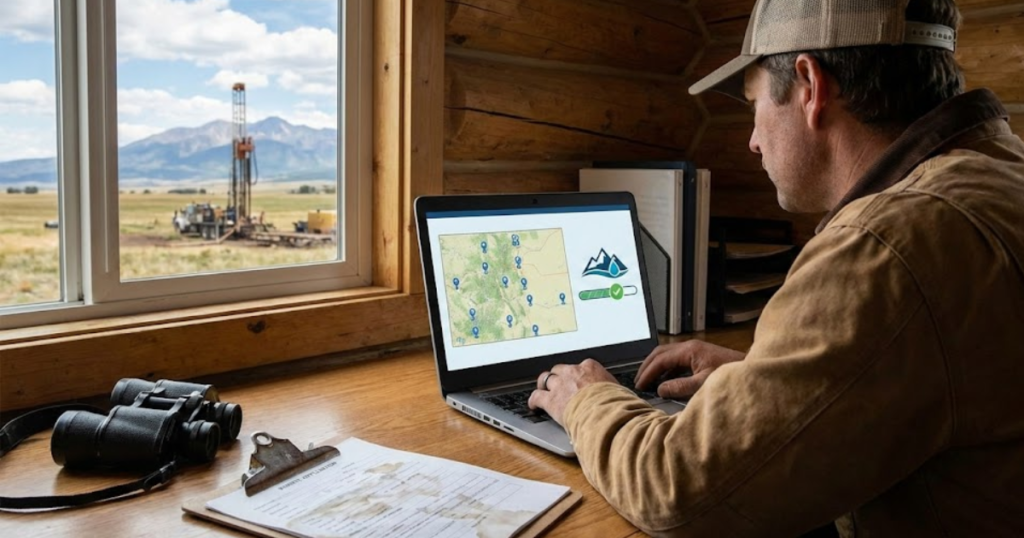
The seller tells you the property has a “good well.” They hand you a piece of paper that looks official. It has a state seal and a permit number.
But is that permit valid? Is the well actually registered in the seller’s name? Or did the permit expire in 1995?
In Colorado, water rights are strict. If you buy a property with a well that was never properly closed out with the state, you inherit the headache. You might find yourself unable to get a building permit or facing fines until the paperwork is fixed.
Here is the step-by-step guide to investigating a well permit like a pro.
How Do I Check the Status of a Well Permit with the Colorado Division of Water Resources?
Quick Summary: Trust But Verify
- The DWR database is public: Colorado’s Division of Water Resources (DWR) maintains a searchable online database of well permits and scanned documents. No login required.
- Permit/receipt numbers matter: Address searches are often unreliable. The most accurate lookup uses the permit number or receipt number.
- A permit is not proof of a well: You must confirm a Well Construction and Test Report was filed (that’s the “it was actually drilled” proof).
- Watch expiration: If a well wasn’t drilled in time, permits can expire after one or two years.
In Colorado, “the seller says it’s a good well” is not a substitute for state records. A clean DWR record protects you from surprise permit problems and helps with financing, building permits, and water-use planning.
1. Access the State Search Tool
The DWR (State Engineer’s Office) has digitized millions of records. The interface looks old, but it’s powerful—especially the “Imaged Documents” view that shows scanned historical paperwork.
- Go to the DWR site and locate the well records search (often labeled “Well Permit Search” / “Well Permit Records” / “Imaged Documents”).
- Expect multiple document scans: Applications, approvals, construction reports, pump installs, and amendments can appear as separate images.
- Plan to open several PDFs: You’re building a timeline, not checking a single page.
2. Find the Record: Permit # Beats Address
If you can get the permit number from the seller, listing agent, or county file, do it. It’s the fastest and most accurate route.
A. Search by Permit Number
- Permit numbers often look like 12345-F or similar formats.
- If you have a receipt number, that can also be a reliable key.
B. If You Don’t Have the Permit Number
- Owner name search: Try the original owner (often the builder), not the current owner.
- Legal description search: Use Section / Township / Range from the county assessor and try location-based searching.
- Why address search fails: Rural addresses change, and older records may use outdated road names or only the legal description.
If you’re buying vacant land, look up neighboring wells in the same area. Their depths and reported pump rates can help you estimate drilling expectations before you spend money.
3. Verify the 3 Documents That Matter
Once you’ve found the permit file, don’t stop at the first scan. You’re looking for evidence that the well exists, was constructed legally, and was put into use.
Document 1: The Permit Application
- Confirms what was requested (domestic, stock water, irrigation, etc.).
- Check that “Proposed Use” matches how you want to use the property (especially if you need horses).
Document 2: The Well Construction and Test Report
- This is the proof the well was actually drilled and reported by the driller.
- Typically includes: depth, casing info, static water level, and test yield (GPM) at drilling time.
- If this is missing: The well may not be legally “constructed,” or the paperwork was never filed.
Document 3: The Pump Installation Report
- Confirms the pump was installed and the system was put into beneficial use.
- Helps validate that the well wasn’t just permitted—but actually finished and functional.
4. Check Expiration and “Permit Expired” Traps
A common buyer mistake: a seller shows a permit and assumes that means a usable, valid well. Colorado permits can expire if the well wasn’t drilled within the required time.
- Typical expiration window: Often one to two years if not drilled.
- “Permit expired” can mean two different realities:
- Well drilled, paperwork incomplete: sometimes fixable with proper filings.
- Well never drilled: you may need a brand new permit under current rules (often stricter).
5. Confirm the Use: Domestic vs Household-Only vs Stock Water
For horse property buyers, the “use” language matters as much as the existence of the well. The permit/application should match your intended lifestyle.
- Domestic permits commonly allow household use and certain non-commercial livestock watering (subject to local conditions and permit language).
- Household-use-only permits are the nightmare scenario for horse owners: they may not allow livestock.
- Subdivision/augmentation contexts may impose strict volume math and reporting requirements—so you can’t “just add horses.”
6. Fix the Ownership Trap
Even if the well exists and is valid, it may still be registered under a prior owner. That creates avoidable risk.
- Common issue: The well is still registered to the person who drilled it years ago.
- What to file after closing: A Change of Owner Name/Address form (often referenced as Form GWS-11).
- Why it matters: If the state sends notices, they go to the registered owner. You want those notices.
7. Red Flags Buyers Miss
- Permit exists, but no construction report: suggests the well may not have been drilled or reported properly.
- Use doesn’t match reality: “Household use only” while the property is marketed for horses.
- Expired permit presented as “existing well”: could require a new permit under stricter standards.
- Owner mismatch: the record is under an old owner with no transfer filed.
- “It’s always worked” language: history is not a substitute for compliance—especially in regulated or subdivided areas.
We Do the Detective Work
Checking well status is part of due diligence. We pull the records, confirm validity, and make sure the well’s permitted use matches your plans—especially if horses are part of the lifestyle.
Contact Us Today if you need help verifying a well permit on a property.
Browse Active Colorado Horse Properties: View All Available Listings
Frequently Asked Questions (FAQ) About Well Status
What if the well is not registered at all?
This can be a late-registration scenario. Older wells sometimes require additional filings, fees, and documentation to bring them into compliance.
Can I look up my neighbor’s well?
Yes. Well records are public in Colorado. Checking nearby wells can help you estimate local drilling depth and typical yields.
What does “Permit Expired” mean?
It means the permission to drill ran out. If the well was drilled, missing paperwork may be fixable. If it was never drilled, you’ll likely need a new permit under current rules.