
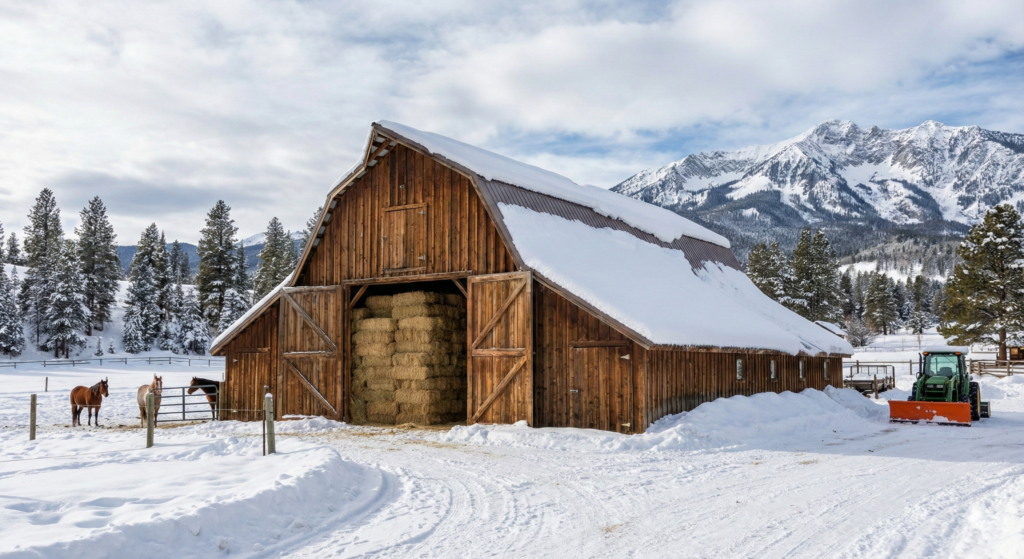
You see a cute barn with a small loft. It looks like a storybook.
But then you do the math. You have three horses. Winter in Colorado lasts from October to May. That means you need to buy and store about 450 small square bales or 15 large round bales to get through the season without panicking in February when prices spike.
Does that cute loft actually hold that much? Probably not.
Hay storage is the most underestimated infrastructure need on a horse property. Without it, you are at the mercy of the fluctuating hay market and delivery drivers who might not be able to reach you in deep snow.
Here is how to calculate if a property has the storage muscle you need.
Is There Adequate, Dry Hay Storage for a Winter’s Supply?
Quick Summary: The Logistics of Winter Feeding
- Volume reality: A single horse can consume roughly 3 tons of hay over a Colorado winter.
- Fire risk: Large hay volumes stored in the main barn significantly increase fire danger.
- Dry standard: Leaks and ground moisture ruin hay quickly and create health risks.
- Access matters: Storage must accommodate commercial delivery equipment and winter access.
1. The Math: How Much Space Do You Need?
- Consumption rule: A 1,000 lb horse eats about 2% of body weight per day.
- Colorado winter budget: Owners often plan ~3 tons per horse to avoid shortages.
- Space estimate: One ton of small square bales takes about 250 cubic feet.
- Example: Four horses (about 12 tons) can require ~3,000 cubic feet of storage.
2. Attached vs. Detached: The Safety Factor
- Loft hazard: Hay stored above stalls increases dust exposure and amplifies fire risk.
- Detached shed: A separate hay shed reduces respiratory issues and prevents a hay fire from becoming a barn fire.
- Insurance factor: Some policies price risk lower when hay is stored away from the main barn.
3. Floor and Ventilation: Keeping Hay Dry
- Moisture barrier: Avoid stacking hay directly on dirt or bare concrete; use pallets or an air gap.
- Roof integrity: Any leak can ruin a large portion of the stack quickly.
- Airflow: Ventilation helps prevent condensation and mold growth in the stack.
4. Delivery Logistics
- Door height/width: Many deliveries use a hay “squeeze,” requiring ~12–14 ft clearance.
- Hand-stack risk: If doors are too small, hay may be dumped outside and you’ll be moving tons by hand.
- Truck access: Tight turnarounds and winter snow conditions can prevent large trailers from delivering.
We Measure the Hay Barn
We check cubic footage, signs of moisture damage, ventilation, and whether delivery equipment can actually access the structure.
Contact Us Today to confirm a property’s winter feed readiness.
Browse Active Colorado Horse Properties: View All Available Listings
Frequently Asked Questions (FAQ) About Hay Storage
Can I store hay outside under a tarp?
You can, but expect spoilage. Even with tarps, weather can ruin a meaningful percentage of the stack.
How many small bales are in a ton?
Typically about 30 to 35 bales per ton, depending on bale weight and cut.
Is spontaneous combustion a real risk?
Yes. Hay baled too wet can heat internally. Poor ventilation and large stacks increase the danger.