
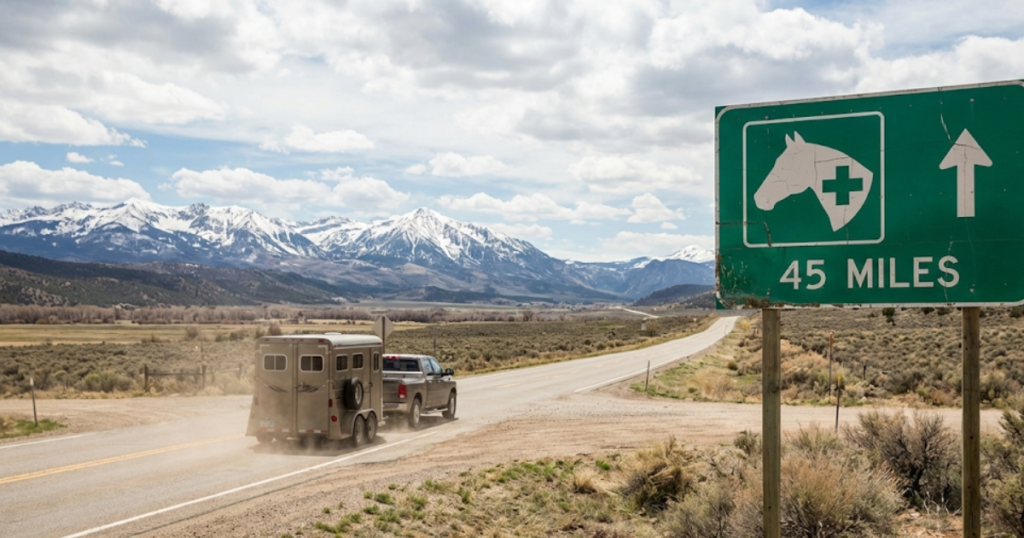
You found the dream property. It is 40 acres of bliss, tucked away in a private canyon, far from the noise of the city.
But then your horse colics at 2:00 AM on a Tuesday.
Suddenly, that privacy feels like isolation. You call your vet, and they say, “He needs surgery now.” You load the trailer, but the nearest surgical table is a three-hour drive over a mountain pass.
When you are buying horse property, you aren’t just buying land. You are buying a timeline for emergency care. While we all hope to never need a surgeon, the distance to a major medical center is a critical factor in your risk management plan.
Here is how to evaluate a property based on its access to veterinary care.
How Far Is the Property From the Nearest Equine Hospital?
Quick Summary: The “Golden Hour” Rule
- Minutes change outcomes: In severe colic or trauma, being within roughly 45–60 minutes of a surgical facility can be the difference between recovery and loss.
- Two types of access: You need a field vet for routine and on-farm care, and a referral hospital for surgery and complex emergencies.
- Winter changes the math: A short drive on paper can become impassable with steep, unplowed roads and mountain passes.
- Remote locations carry added risk: Deep mountains or far eastern plains can mean longer transport times and fewer options.
1. Field Vet vs. Referral Hospital
When evaluating a property, separate routine care from true emergencies.
- Field service (ambulatory): Vaccines, dentistry, lameness checks, minor wounds, and many farm-call emergencies.
- Referral hospital (surgical): Colic surgery, complicated foaling, fractures, ICU-level care, and 24/7 staffing.
- The test question: “Who is the local field vet?” and “Where is the nearest surgical table?”
2. Major Surgical Hubs in Colorado
Colorado has a few key centers that function as regional lifelines.
- Littleton area: A major referral hub for the southern Denver metro corridor (including Parker, Castle Rock, Franktown).
- Fort Collins (CSU): A top-tier teaching hospital and primary referral center for Northern Colorado.
- Foothills / Denver metro: Additional surgical and lameness centers serve Jefferson/Douglas areas.
- Western Slope: Regional centers reduce the need to haul over mountain passes in winter emergencies.
3. The Winter Access Reality Check
Emergency care is only “close” if you can actually haul out at 2:00 AM in February.
- Driveway grade: Steep, north-facing dirt roads can become trailer traps during storms.
- County road response: Remote roads may not be plowed quickly, especially after heavy drifting snow.
- Plan B: If you choose remote living, have a realistic haul-out plan and vetted emergency supplies under your vet’s guidance.
4. Distance Affects Property Value
Veterinary proximity is a premium feature for performance and breeding buyers.
- Near-hub advantage: Properties closer to major hospitals and showgrounds often hold value more strongly.
- Remote discount: Far-out properties can trade lower partly due to higher emergency risk and service logistics.
We Check the Map For You
When evaluating a horse property, we look at real-world logistics, not just the listing description.
We help you understand routine-vet coverage, referral-hospital haul time, and winter access risks so you can balance privacy with safety.
Contact Us Today to evaluate a property’s vet access and emergency-haul reality.
Browse Active Colorado Horse Properties: View All Available Listings
Frequently Asked Questions (FAQ) About Vet Access
Do all vets offer 24/7 emergency service?
No. Some practitioners do not offer round-the-clock coverage, or they rotate on-call duties with a local cooperative. Always ask what happens if you call at 3 AM.
Can a helicopter transport a horse in an emergency?
While rare rescue situations exist, medical air transport for horses is not a practical plan. You should assume your trailer is the transport method.
What if I am too far from a hospital?
Have a serious plan with your field vet: emergency protocols, realistic haul-out decisions, and contingency planning for conditions that require surgery.