
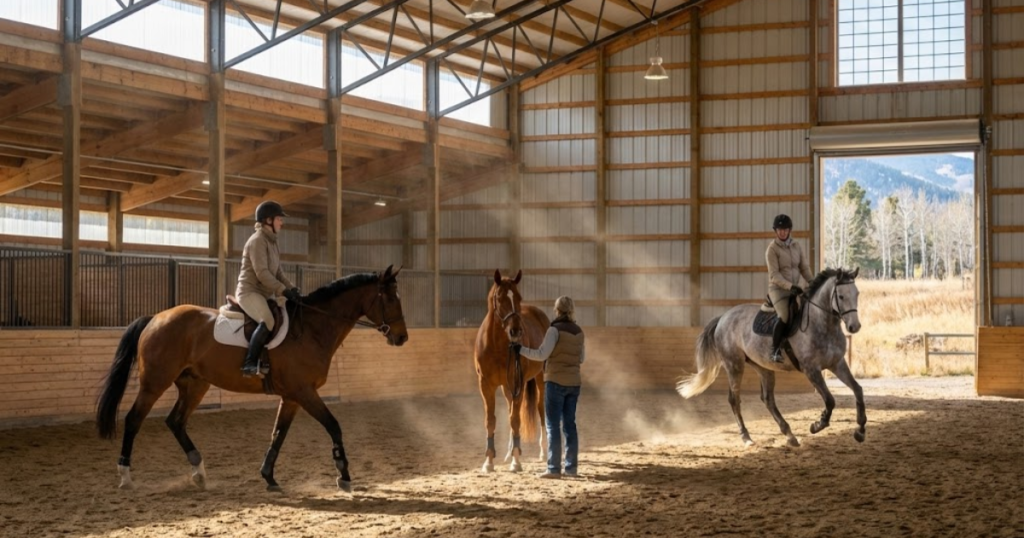
It is the ultimate dream for the Colorado equestrian. No
more frozen toes in January. No more cancelled rides because of afternoon
thunderstorms. An indoor arena changes your entire relationship with your
horse.
But it is also one of the largest financial investments you
will ever make.
We often see buyers estimate “Maybe $100,000” for
an indoor arena, only to be shocked when the bids come in at triple that
amount. Between supply chain costs for steel and strict county building codes,
the price of “going indoors” has changed drastically in the last few
years.
Here is a realistic breakdown of what it takes to build an
indoor arena in Colorado today.
How Much Does It Cost to Build an Indoor Riding Arena in Colorado?
Quick Summary: The 2025 Price Tag
- Total range: A functional, permitted indoor arena in Colorado typically lands between $200,000 and $550,000+.
- Price per square foot: A basic uninsulated shell often starts around $30–$50/sq ft. Fully finished builds commonly run $60–$100+/sq ft.
- The “Colorado factor”: Snow loads and wind ratings require heavier engineering and structure, adding roughly 10–15% compared to many states.
- Hidden budget killers: Excavation, electrical upgrades, and permitting can eat $50,000 before the first post is set.
1. The Size: How Big Do You Really Need?
The footprint drives everything—steel, excavation, permits, lighting, and footing.
- Small (60' x 120'): Minimum for safe riding. Great for flatwork; tight for jumping.
Estimated: $180,000 – $250,000 - Standard (80' x 160'): The “sweet spot” for most private barns—better turning radius and room for a course.
Estimated: $300,000 – $450,000 - Pro (100' x 200'): Commercial-grade width for roping, reining, or bigger courses.
Estimated: $500,000+
2. The Structure: Steel vs. Wood
Colorado arenas need wide, clear spans. That’s why the “skeleton” choice matters so much.
- Wood post-frame: Traditional look and feel. For wide spans (80' and up), engineered trusses get massive, and costs can climb fast.
- Pre-engineered steel: The modern standard. Steel spans 100'+ without interior columns and tends to hold up better to sun, wind, and long-term wear.
3. The “Invisible” Costs: Dirt and Paper
This is where budgets get ambushed—because these costs happen before the building arrives.
- Excavation & pad prep: You need a flat, stable pad. Rocky foothills can mean serious earthwork, and expansive soils can require over-excavation and structural fill.
Budget: $20,000 – $60,000 (and sometimes more) - Engineering: Colorado-licensed engineering is not optional if you want permits approved for specific snow and wind loads.
- Permits & use tax: County fees commonly run 2–3% of project valuation (yes, that’s a real check you write).
4. The Footing: Don’t Skimp on the Surface
Bad footing turns a beautiful building into an expensive headache.
- The base: Expect 4–6 inches of properly compacted road base. If the base fails, you’ll fight soft spots, holes, and inconsistent depth.
- Sand (entry-level): Lower upfront cost, but needs watering and can get dusty in dry climates.
Typical: $5,000 – $10,000 - Sand + additives (fiber/rubber): Less dust, less water, better joint protection.
Typical: $15,000 – $30,000 - Premium synthetic (wax-coated): Dust-free and low-water, but high ticket.
Typical: $50,000 – $80,000+
5. Buying vs. Building: The Value Equation
Once you see the real numbers, existing indoor arenas make a lot more sense.
- Building new: More control, but you take on permitting, excavation uncertainty, electrical upgrades, and cost overruns.
- Buying existing: Sellers often don’t recoup 100% of what they spent—meaning buyers can sometimes acquire the infrastructure at a discount compared to building from scratch.
Browse Colorado Properties with Indoor Arenas and skip the construction headache: View All Available Listings
Frequently Asked Questions (FAQ) About Indoor Arenas
Do I need to insulate my arena?
In Colorado, insulation is strongly recommended. An uninsulated metal roof can create condensation that drips inside (“it rains indoors”). Roof insulation is a common minimum; full wall insulation adds comfort but increases cost.
Can I build an arena on 5 acres?
Legally it depends on zoning, but physically it can be tight. An 80' x 160' footprint is large, and you still need grading area, setbacks, and access for construction trucks.
Does an indoor arena increase property value?
Yes—especially to equestrian buyers. The value jump is real, but it’s buyer-specific. To non-horse buyers it may read like a warehouse; to horse buyers it’s a premium feature.