
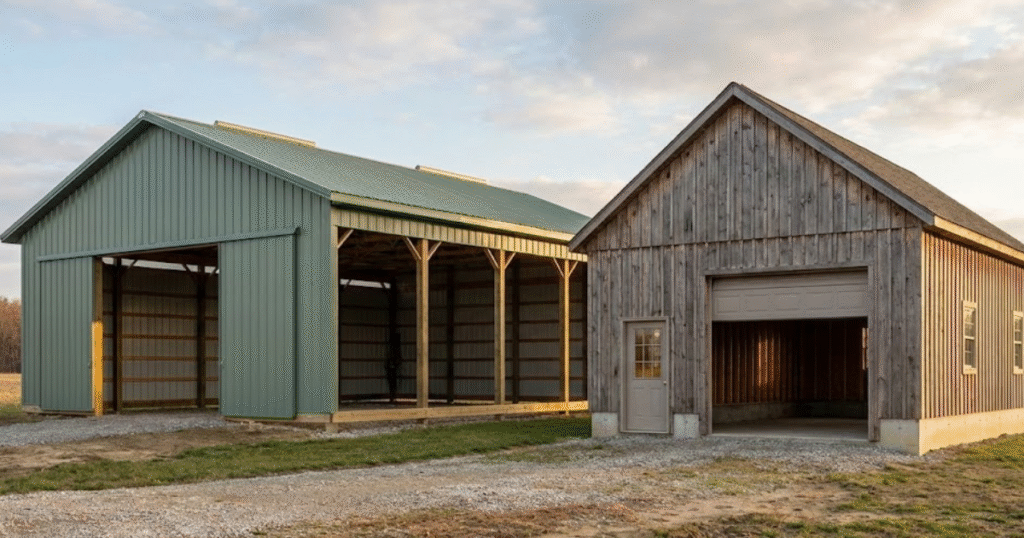
In Colorado, most horse barns are pole barns (post-frame construction) cheaper, faster, and ideal for open interiors. Stick-built barns cost more… but are easier to insulate and seal.
The construction method affects cost, ventilation, insulation, financing, insurance, and even your ability to convert it into living space.
Is It a "Pole Barn" or a "Stick-Built" Barn? Why the Difference Matters
Quick Summary: Knowing What You Are Buying
- The Pole Barn (Post-Frame): This is the industry standard for horse barns. It uses large posts buried in the ground (or set on piers) to support the roof. It is cost-effective, builds fast, and offers wide-open interiors without load-bearing walls.
- The Stick-Built Barn: This is built like a house. It sits on a continuous concrete foundation and uses 2x4 or 2x6 studs for the walls. It is easier to insulate and seal against rodents, but it is significantly more expensive to build.
- The Cost Factor: In Colorado, a stick-built barn can cost 20% to 30% more than a pole barn of the same size. The difference is almost entirely in the excavation and concrete work.
- The "Barndominium" Confusion: If you plan to put a living quarter in your barn, lenders often prefer stick-built structures. Converting a pole barn into a permitted residence requires specific engineering that not all older barns have.
You are walking through a property listing. The description says "Large 4-stall barn with shop." It looks great in the photos.
But is it a pole barn or is it stick-built?
To the untrained eye, they look the same once the metal siding is on. But the difference in how they are built affects everything from your property taxes and insurance to your ability to finance a renovation. It also dictates how warm your horses will be in January and how much money you will spend if you ever want to expand.
1. The Pole Barn (Post-Frame)
When you see a barn in a rural area, it is almost certainly a pole barn. The technical term is Post-Frame Construction.
- How It Is Built: Instead of a solid concrete foundation, the builder drills holes into the ground (usually every 8 to 12 feet). They set massive pressure-treated posts into these holes and pour concrete around the base of the post. The walls are then attached horizontally between these posts.
- Why Horse Owners Love It: It is efficient. Because the posts carry the weight of the roof, you don't need interior load-bearing walls. This allows for massive, open indoor arenas and wide center aisles.
- The Ventilation Factor: Pole barns naturally "breathe" better than stick-built structures. For horses, this is a good thing. It reduces respiratory issues caused by dust and ammonia buildup.
2. The Stick-Built Barn
When you see a barn that looks like a detached garage or a small house, it is likely stick-built.
- How It Is Built: First, a crew digs a trench around the entire perimeter of the building. They pour a continuous concrete "footer" and a foundation wall. Then, framers build walls using vertical 2x4 or 2x6 studs spaced 16 inches apart, exactly like in a residential home.
- Why It Is More Expensive: The concrete work is massive. In Colorado, that foundation must go down 36 to 48 inches to get below the "frost line." If you are building on the rocky soil of the Foothills or Black Forest, digging that trench can cost a fortune.
- The "Sealed" Advantage: Because it sits on a concrete lip, a stick-built barn is much easier to seal against mice, bugs, and drafts. If you are building a heated workshop or a high-end tack room with a bathroom, stick-built is often the superior method.
3. The Financing and Permit Trap
This is where the construction method hits your wallet.
- Appraisals: Residential appraisers understand stick-built structures perfectly. They sometimes struggle to value pole barns, especially if they include living quarters (Barndominiums). Some banks will not issue a residential mortgage on a property where the primary home is a pole barn.
- The "Ag Exempt" Loophole: In some counties (like Weld or Elbert), you can get a permit for an agricultural pole barn much faster than a stick-built structure. Stick-built structures often trigger full residential building codes, requiring more inspections and higher permit fees.
We Know What to Look For
You shouldn't have to crawl under a building to know what you are buying.
When we tour a property with you, we look at the foundation. We check if the posts are rotting at the ground level (a common issue in older pole barns) or if the concrete foundation is heaving from frost (a risk in poorly built stick barns).
Mark Eibner and Belinda Seville have inspected thousands of barns across Colorado. We can tell you if that "luxury barn" is a solid investment or a structural nightmare waiting to happen.
Contact Us Today if you are looking for a property with the right kind of barn for your needs.
Browse Active Colorado Horse Properties to compare different barn styles currently on the market. View All Available Listings
Frequently Asked Questions (FAQ) About Barn Construction
Can I turn a pole barn into a house (Barndominium)?
Yes, but it is complicated. You have to "fur out" the walls to add insulation and drywall, and you often need to retroactively engineer the slab foundation to handle plumbing. It is often cheaper to build a Barndominium from scratch than to convert an old hay barn.
Which one handles snow load better?
Both handle snow well if they are engineered correctly. However, pole barns are incredibly strong at transferring heavy roof loads (like 4 feet of snow) directly into the ground through the posts. This is why you see so many post-frame buildings in high-snow areas like Steamboat or Conifer.
Do pole barns have dirt floors?
They start with dirt floors. Most horse owners pour a concrete aisle and put mats over crushed rock in the stalls. However, because there is no continuous foundation, pouring a concrete slab in a pole barn is a separate step that happens after the shell is up.