
Colorado horse property doesn’t have one statewide price per acre. Agricultural benchmarks help explain why acreage alone can’t show what an equestrian property is worth.
If you’re considering a sale or trying to understand a property’s value, the land’s usefulness matters as much as its size. Water access, pasture quality, equestrian improvements, and development pressure can all influence how buyers assess acreage. This article explains how prices differ across Colorado regions and counties, how land quality and amenities can affect value, and how market conditions fit into the picture. You’ll get a clearer framework for judging a property without mistaking a broad per-acre figure for a valuation of the entire horse property.
Key Takeaways
- Assess how water access, usable pasture, and equestrian improvements affect a property’s practical value, not just its acreage.
- Use land-type and county comparisons as context, then account for the features and intended use of the specific property.
- Consider how development pressure and limited availability can influence buyer interest alongside agricultural value.
- Build a more informed valuation by weighing market trends against the land’s utility, location, and horse-ready amenities.
Buyer selectivity by land quality and amenities
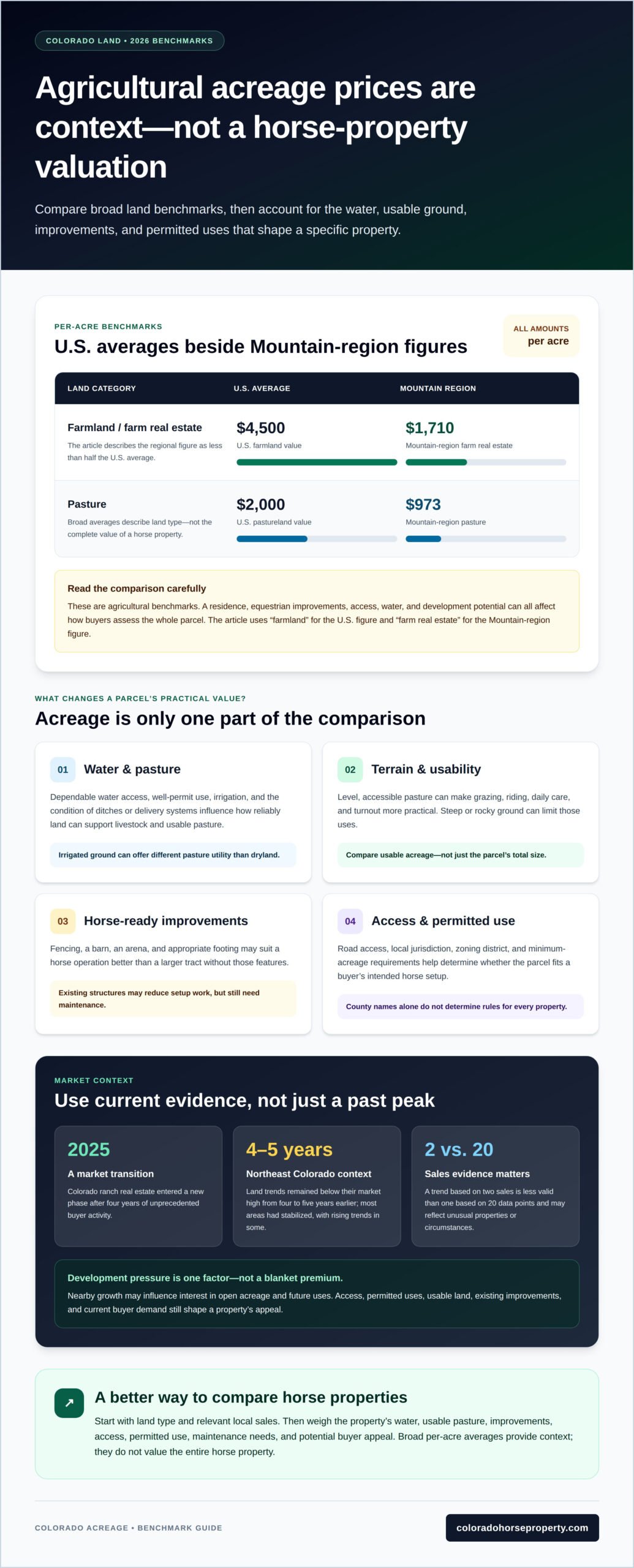
Horse-property buyers consider whether acreage supports their intended use, not just how many acres it includes. A parcel with usable pasture, dependable water access, fencing, and a barn or arena may suit a working horse operation better than a larger tract without those features. For example, steep or rocky ground can limit grazing and riding, while level, accessible pasture can make daily care and turnout more practical. These differences influence buyer interest and how a property compares with nearby listings.
Migration patterns also influence where equestrian buyers look. In 2026, Florida, North Carolina, Texas, and Idaho were among the states attracting equestrians. Colorado, Idaho, and Montana drew interest for expansive land, privacy, lifestyle appeal, and migration trends. For Colorado sellers, that broader interest can bring attention to rural properties, but buyers still weigh location and land utility against their plans. A property suited to private horse ownership may appeal to a different buyer than one designed for a larger equestrian operation.
Buyer activity has shifted from the intense period that preceded it. Colorado ranch real estate entered a new phase in 2025 after four years of unprecedented buyer activity. That transition makes property-specific comparisons important: strong demand in an earlier period doesn’t establish today’s value for every parcel. National figures provide context, not a direct valuation. In 2026, average U.S. farmland value was $4,500 per acre, while average pastureland value was $2,000 per acre. Neither figure captures a Colorado horse property’s improvements or local market conditions.
Water rights, well permits, and irrigation can affect value by determining how reliably land can support livestock and usable pasture. A well permit’s authorized use and documented water access matter alongside irrigation equipment and the condition of ditches or delivery systems. Irrigated ground, for example, may offer different pasture utility than dryland, so buyers consider water access and infrastructure when comparing acreage.
Horse-property acreage prices
Colorado agricultural land benchmarks vary by land type and county. These figures describe agricultural land, not a complete horse-property valuation. A residence, equestrian improvements, access, and development potential can also influence how buyers assess the whole parcel.
Colorado horse property price per acre trends make the most sense alongside agricultural and residential land comparisons. Agricultural benchmarks describe land type, while a residential parcel may reflect its location and development potential. Horse-property buyers may consider both, along with acreage and improvements. A house and barn, for example, make a property different from an undeveloped dryland tract, even if the parcels contain similar acreage.
County names alone don’t determine horse-keeping rules for every property. Zoning and minimum-acreage requirements can depend on the local jurisdiction and zoning district. The key question is whether the parcel’s permitted use fits the buyer’s intended horse setup. Colorado horse property price per acre trends provide context, but permitted use and practical suitability also influence how buyers compare acreage.
Purchase decisions also involve ongoing upkeep and property-specific risks. Fencing, barn maintenance, arena footing, road access, and water delivery can affect the cost and practicality of operating a horse property. Existing improvements may reduce setup work, but structures still require maintenance. Comparing Colorado horse-property listings can help put acreage, land type, and property features in context.
Ocala, Florida, is described as a market with more affordable acreage and growing infrastructure, offering a distinct comparison point without a stated price or acreage figure.
Land scarcity and development pressure
In Colorado, development pressure can influence how buyers compare a horse-ready tract with nearby land. A ranch parcel near expanding residential areas may attract interest for its open acreage and possible future uses, while a more remote tract may appeal mainly for privacy and horse keeping. Buyers may therefore have different priorities. This doesn’t make every nearby property more valuable by the same amount: access, permitted uses, usable land, and existing improvements still shape its appeal.
Northeast Colorado land trends remain below their market high from four to five years earlier. The market had stabilized in most areas, with rising trends in some. For landowners, that pattern matters: a past peak alone doesn’t establish today’s asking value, and a regional recovery doesn’t mean every parcel has increased in value. Development pressure is one factor, alongside current buyer demand and the property’s agricultural or equestrian utility.
Sales evidence also affects how confidently a trend can be applied. In Northeast Colorado, a trend based on two sales is statistically possible, but less valid than one based on 20 data points. A small sample may reflect unusual property features or buyer circumstances rather than a broad shift. For example, two distinct ranch sales may not represent the wider market for horse properties with different access, improvements, or land characteristics.
To assess how scarcity affects value, separate the property’s current use from its potential appeal to other buyers. Consider whether nearby development competes for open acreage, changes access, or shifts interest toward land with a horse-ready layout. Then compare relevant sales with similar locations and utility instead of relying on a broad regional trend. In Colorado, this approach helps distinguish genuine demand for equestrian land from a signal driven by a few sales or changing development interest.
How do horse property prices per acre vary across Colorado regions and counties?
Colorado comparisons depend on whether a figure describes farm real estate, pasture, dryland, or irrigated acreage. In 2026, Mountain-region farm real estate averaged $1,710 per acre, less than half the U.S. average. Mountain-region pasture averaged $973 per acre that year. These regional benchmarks offer context, but they don’t represent a direct price for every horse property. A residence, barn, fencing, or arena changes what a buyer is comparing.
County pasture benchmarks show a narrower but still meaningful spread. These figures describe pasture, not improved equestrian estates, so use them for land context rather than as a ready-made valuation.
For a practical comparison, match the land type first, then compare counties and property features. For example, compare Phillips County pasture with pasture acreage, not automatically with irrigated cropland or a residential parcel. Next, consider usable ground, water access, improvements, and location. A horse property with a barn and established fencing differs from a vacant tract, even when both contain similar acreage. The right comparison depends on the property’s actual use and features.
Ranges also reflect variation within a county. A Washington County parcel at the lower end of its pasture range differs from one near the upper end; acreage alone doesn’t explain that gap. Treat regional and county figures as starting points, then narrow the comparison to similar land and improvements. To explore current properties by acreage and equestrian features, compare Colorado horse-property listings as part of your market review.
Colorado Horse Property
Colorado Horse Property can help connect acreage comparisons with the details that matter in a horse-property transaction. If you’re buying, its AI-powered Horse Property Search can help identify listings with equestrian features such as barns, arenas, water rights, and pasture. Buyer representation supports your search, while real estate listing services help sellers present a property’s land and improvements.
Turn to Colorado Horse Property when you’re ready to move from broad county benchmarks to a specific purchase or sale. Transaction management can support the process once you’re moving forward. Share the features and intended use that matter most, such as turnout space, water access, or an existing arena, so your search or listing can reflect your priorities. For help with your next horse-property move, contact Colorado Horse Property.
Turn Your Land Questions Into a Clear Next Step
Use Colorado horse property price-per-acre trends as a starting point, then define what you need the land to do. If you’re selling, organize the property’s story around its intended use, acreage, access, and existing equestrian improvements. If you’re buying, identify the features essential to your plans and those you could add later. Clear priorities make it easier to assess whether a property fits your goals and discuss its value in context.
When you’re ready to apply that perspective to a specific property or search, contact Colorado Horse Property. Take the next step toward a horse property that fits the way you want to live and ride.
Frequently Asked Questions
So What is my Land Worth?
Estimate your land’s worth by comparing it with recent closed sales of similar Colorado properties and accounting for the differences. Match the market area, land type, usable acreage, permitted horse use, and improvements. For example, compare a pasture parcel with similar pasture, not an irrigated tract or finished equestrian estate. Asking prices show seller expectations; closed sales show what buyers paid.
How have Colorado horse property prices per acre changed over the past 5 to 10 years?
Colorado hasn’t followed one uniform price path across every county and land type. Ranch real estate entered a new phase in 2025 after four years of unprecedented buyer activity. In Northeast Colorado, land trends remained below the high reached four to five years earlier, with stabilization in most areas and increases in some. These patterns make local, like-for-like comparisons more useful than a statewide growth assumption.
How do acreage, home size, barns, arenas, and fencing affect Colorado horse property prices?
Each feature can affect a property’s appeal differently, so compare the whole package rather than assigning a fixed value to each feature. A larger home, for instance, may matter to a family buyer, while a usable barn or arena may better fit an equestrian buyer’s needs. Fencing layout and condition can also affect how readily the property supports the owner’s intended setup.
What are recent Colorado horse property sale prices and days on market?
Recent sale prices and days on market are most useful when based on closed Colorado transactions involving similar property types. Compare sales within the same market area, then account for acreage, home size, and equestrian improvements. A listing price is not a sale price, and days on market can’t be interpreted alone: pricing strategy, property condition, and buyer demand all affect how quickly a sale proceeds.