
A tract under 35 acres can still qualify for agricultural tax status. Minimum acreage rules vary by state and county and are often 5-20 acres, so qualifying for ag status on less than 35 acres depends on the land’s use and local criteria. In Colorado, land generally must have been used for agriculture in the past 2 years and the current year, or be under Conservation Reserve Management, to meet one listed agricultural-classification requirement, according to the Colorado Division of Property Taxation.
Acreage is an obvious concern for horse-property owners, but it is only part of the picture. In some jurisdictions, land used for qualifying agriculture may receive a tax assessment based on its agricultural value, potentially lowering property taxes. The rules and savings vary by location.
This article explains how agricultural assessments work, what county appraisal districts may consider, when applications are due, and how equestrian use can affect classification. You’ll also see why the operation on the land, its production, and supporting records can matter as much as the acreage itself.
Key Takeaways
- Assess the land’s actual agricultural use alongside its acreage, since local rules can weigh both.
- Plan around application timing and renewal requirements so a filing deadline doesn’t pass unnoticed.
- Prepare to show how the property is managed and used when a county evaluates agricultural classification.
- Understand how equestrian activities may fit agricultural rules before weighing a property’s tax value.
Learn What It Takes to Qualify as an Agricultural Property?
Eligibility depends on local acreage thresholds and how the land is used. Sales, livestock, and management practices may also affect qualification.
Acreage, Sales, and Agricultural Use
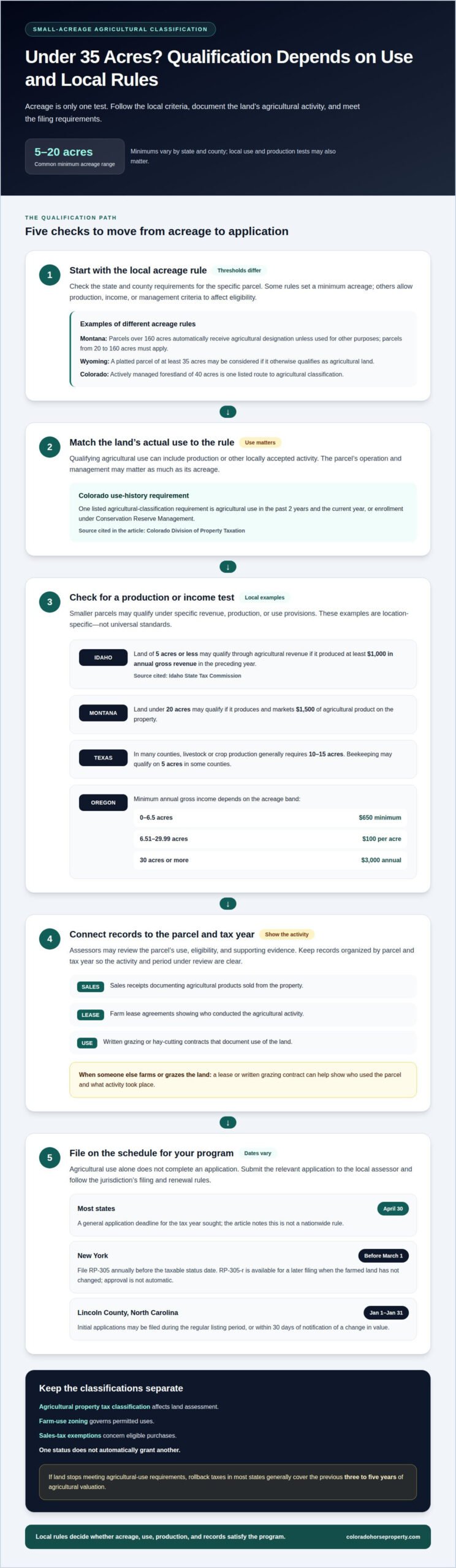
Owners qualifying for ag status on less than 35 acres must match the parcel’s actual use to local rules. In Colorado, land generally must have been used for agriculture in the past 2 years and the current year, or be under Conservation Reserve Management, to meet one listed agricultural-classification requirement, according to Colorado Division of Property Taxation. Idaho land of 5 acres or less may qualify through agricultural revenue if it produced at least $1,000 in annual gross revenue in the preceding year, according to Idaho State Tax Commission.
State and County Acreage Thresholds
Minimum acreage requirements vary by state and county, and are often 5-20 acres. Montana parcels over 160 acres automatically receive agricultural designation unless used for other purposes; parcels between 20 and 160 acres must apply. Land under 20 acres may qualify if it produces and markets $1,500 of agricultural product on the property. In Colorado, actively managed forestland of 40 acres is one listed route. A platted Wyoming parcel of at least 35 acres may be considered if it otherwise qualifies as agricultural land, according to Wyoming Department of Revenue.
Regional Production and Income Criteria
Production and income tests can make a difference on a smaller parcel. In many Texas counties, livestock or crop production generally requires 10-15 acres; beekeeping may qualify on 5 acres in some counties. Oregon qualifying land of 0-6.5 acres must show minimum annual gross income of $650. For 6.51-29.99 acres, the threshold is $100 per acre annual; at 30 or more acres, it is $3,000 annual. These rules show why qualifying for ag status on less than 35 acres depends on the local criteria, not acreage alone.
Tax Status Versus Other Land Uses
Agricultural property tax classification affects land assessment; farm-use zoning governs permitted uses, while sales-tax exemptions concern eligible purchases. One status doesn’t automatically grant another. If land stops meeting agricultural-use requirements, rollback taxes in most states generally cover the previous three to five years of agricultural valuation. To apply, submit the relevant application to the local assessor and provide records of agricultural use, such as sales receipts, leases, or grazing agreements. Application requirements can vary by location, so check with your local assessor before applying.
Annual application and filing deadline
Filing dates depend on the state and assessment program, so a parcel’s agricultural use alone doesn’t complete the application. Agricultural valuation applications are due by April 30th in most states for the tax year sought. Treat that as a broad deadline, not a nationwide rule: New York and Lincoln County, North Carolina, have distinct filing schedules.
New York requires an agricultural assessment application annually, and approval isn’t automatic. Owners file before the taxable status date, March 1, using form RP-305. For later filings, form RP-305-r is available when the land used for farming hasn’t changed. This means a grazing operation that qualified last year still needs its annual filing and supporting information.
- New York: File RP-305 before March 1 each year. Use RP-305-r for a subsequent filing when the farmed land remains unchanged.
- Lincoln County, North Carolina: File an initial application during the January 1-January 31 regular listing period, or within 30 days of notification of a change in value.
- Most states: April 30th is the stated general application deadline for the tax year in which valuation is sought.
Build your application around the parcel’s actual agricultural activity. Sales receipts, farm lease agreements, and written grazing or hay-cutting contracts can help document production. Organize records by tax year so the assessor can connect each document to the land and its claimed use. A lease or grazing contract is especially relevant when someone other than the owner conducts the farm activity.
For a buyer reviewing horse acreage, the application calendar belongs alongside the property’s land-use history. Explore horse-property listings to compare parcels and land features as you plan for ownership and future filings.
County appraisal district requirements
A local assessor evaluates the parcel’s use, eligibility, and supporting evidence under the jurisdiction’s process. In Los Angeles County, the Assessor estimates the tax reduction and checks whether the application meets program and property-allotment limits. The review considers both the requested benefit and whether the property meets the program’s requirements.
Records connect agricultural activity to the land and the period under review. Examples include sales receipts, farm lease agreements, and written grazing or hay-cutting contracts. These documents can show who used the parcel, what activity took place, and whether the property generated production or income. Organize records by parcel and tax year instead of grouping unrelated farm activity together.
Lincoln County, North Carolina, applies specific ownership and compliance tests. An individually owned property must have been the owner’s primary residence or owned by the current owner or a relative for 4 years before January 1 of the benefit year. The county reviews compliance primarily using data from the preceding three years. An initial application may also be filed within 30 days of notification of a change in value.
- Production evidence: Keep sales receipts that document agricultural products sold from the property.
- Use agreements: Retain farmer leases and written grazing or hay-cutting contracts tied to the parcel.
- Management details: Describe how the land supports qualifying agricultural purposes, including conservation or timber activity where applicable.
For a small property, organize the application around the land’s actual use, not just its acreage. Match each record to the parcel and explain how the documented activity supports the requested classification. In Lincoln County, the evidence should align with the preceding three years of compliance data. Clear parcel-level records also help distinguish agricultural use from residential or other activity on the same property.
Equestrian property classification
A horse property’s tax classification depends on its actual use and the rules in its jurisdiction. Keeping horses for personal riding does not, by itself, establish qualifying agricultural production. The key question is whether the operation meets the applicable agricultural criteria. Review the use of each parcel, including whether horses are boarded commercially or the land supports livestock production.
New York provides a specific example for commercial horse boarding. An operation can qualify for agricultural assessment if at least 10 horses are boarded at a time and the other eligibility requirements are met. The horse count alone does not establish eligibility. The application must also fit the program’s remaining requirements, so distinguish commercial boarding from keeping horses solely for personal use.
New York also recognizes silvopasturing under specific acreage limits. Eligibility is limited to up to ten fenced acres per large livestock animal, including horses and cattle. For small livestock, such as sheep, goats, hogs, and poultry, the limit is up to five fenced acres per animal. These limits tie the acreage claimed to the livestock being raised, rather than automatically treating an entire horse property as agricultural.
For a small equestrian parcel, describe each use accurately, whether boarding, grazing, or personal riding. Separate the acreage used for agriculture from areas serving other purposes. Keep records that document the operation and land management, such as boarding arrangements or grazing agreements. These details help explain the property’s use when the local assessor evaluates its classification.
The practical takeaway is to assess the operation, not just the barn, arena, or horse count. New York’s 10-horse boarding rule illustrates how a state can set a specific threshold, while silvopasturing applies acreage limits tied to livestock type. Explore equestrian property listings to find parcels suited to your intended horse use.
Colorado Horse Property
Colorado Horse Property helps equestrian buyers connect their property needs with practical real estate decisions. Its AI-powered Horse Property Search can narrow options by features such as barns, arenas, water, and pasture. This can help you assess whether a parcel’s layout and features fit your horse operation, separately from any tax classification decision.
For buyers weighing acreage, facilities, and agricultural use, Buyer Representation supports the property search and purchase process. Real Estate Listing Services help owners bring equestrian properties to market, while Transaction Management supports the steps involved in a real estate transaction. These services address real estate decisions, not county tax determinations.
If you’re evaluating a horse property or preparing to buy or sell one, contact Colorado Horse Property to discuss your real estate needs.
Choose a Property That Fits the Plan
For owners qualifying for ag status on less than 35 acres, the next move is to connect a real estate decision with the horse operation they intend to pursue. Consider how the property supports daily routines, future improvements, and the kind of equestrian use that matters to you. Keep tax classification as a separate consideration, rather than assuming a property’s features or intended use establish eligibility.
A clear picture of your priorities can focus your property search. Identify the land, facilities, and setting that fit your plans, then evaluate each option on its own merits. Colorado Horse Property can help you consider equestrian real estate as you decide what to do next.
Contact Colorado Horse Property to discuss your real estate needs and move toward a property that fits your goals.
Frequently Asked Questions
Why apply for agricultural assessments?
An agricultural assessment can lower property taxes by valuing qualifying land according to its agricultural use rather than its market value. The benefit depends on whether the land’s farm use meets local rules and remains active. Before making plans based on the tax treatment, consider whether the operation can continue and whether the property’s use may change.
Can I lease my land to a farmer to maintain an ag exemption?
Leasing land to a farmer can support an application when the lease documents qualifying agricultural use, but a lease alone doesn’t establish eligibility everywhere. Keep a written agreement that identifies the parcel and farming activity. New York, for example, requires a written lease of at least 5 years for farmland rented to a qualifying farmer seeking agricultural assessment.
Can I lose my ag exemption if I build a house on the land?
Building a house does not automatically determine whether the remaining land retains its agricultural classification. The outcome depends on how the property is used and how local rules treat the residence and surrounding acreage. If construction converts land from agricultural use, the affected area may no longer qualify. Consider the possibility that a change in use could trigger tax recapture.
Does an ag exemption affect how I can sell the land?
An agricultural assessment generally does not prevent a property sale, but selling the property and changing its use are different events. The new owner’s eligibility depends on continued qualifying use and the local application process. If the land is converted to nonagricultural use, rollback or recapture taxes may apply under state rules, so account for that possibility when planning a sale.
Does an ag exemption transfer automatically when I buy land?
Do not assume an agricultural assessment transfers automatically with ownership. The buyer may need to apply or file again under local procedures and show that the property’s use qualifies. New York requires annual applications, and its assessment is not automatic. Include the land’s existing agricultural use and available records in your purchase review, then plan for the requirements that apply locally.
How Does an Agricultural Exemption Work?
An agricultural exemption, often called an assessment or valuation, can reduce property taxes by valuing eligible land according to agricultural use instead of market value. Owners apply under state and local criteria, which may consider acreage, production, income, and records. Approval does not mean every part of a property qualifies: the assessment depends on eligible use and local rules.