
A home with usable acreage and established equestrian features can cost very differently from a residence with little space for horses.
That makes the land and facilities behind a listing just as important as the house. Property type, acreage, barns, paddocks, and arenas all affect the purchase cost, while the space and setup your horses need determine which listings suit your plans.
The sections ahead compare property types and equestrian estates, explain how acreage and horse-keeping needs affect a property’s fit, and highlight details to weigh when comparing listings. The aim is to clarify the trade-offs between location, usable land, and facilities that are ready to use.
Key Takeaways
- Compare listings by usable acreage and property type, not just the asking price, to understand which options fit your budget and plans.
- Assess barns, paddocks, arenas, and trailer access as practical features that shape how well a property supports your horses.
- Match the parcel size to your horse-keeping needs, since smaller hobby farms and larger rural properties can suit different setups.
- Look beyond the house to understand how land, equestrian infrastructure, and property use combine to shape the overall cost.
Affordable regions for buying horse property
Franktown’s horse-property market includes everything from modest acreage to large equestrian parcels.
Nearby Elizabeth listings can provide another acreage comparison. These are land listings, not finished horse properties, so the purchase price alone won’t reflect the full cost of building a home and equestrian setup. Franktown’s country setting also brings seasonal considerations: winter weather can affect riding plans, road access, fencing, and outdoor facilities.
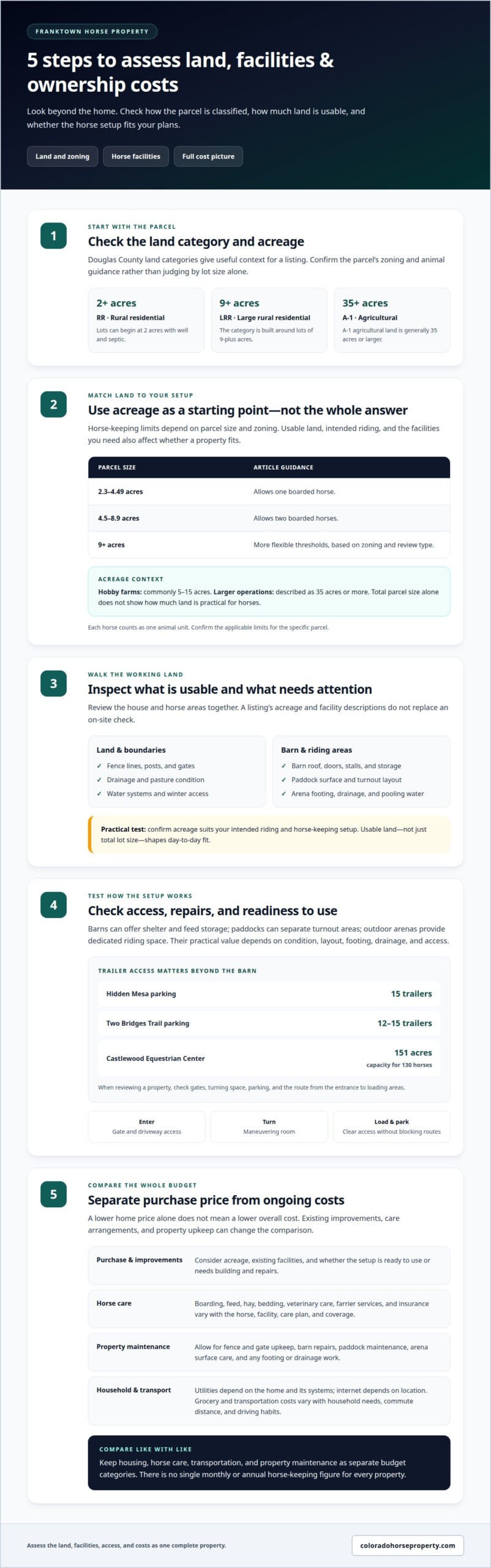
Douglas County zoning and animal guidance shape horse-keeping limits. A-1 agricultural land is generally 35 acres or larger; LRR large rural residential land is built around lots of 9-plus acres. RR rural residential lots can begin at 2 acres with well and septic. Parcels from 2.3 to 4.49 acres allow one boarded horse, while 4.5 to 8.9 acres allow two. Each horse counts as one animal unit, and 9-plus-acre parcels have more flexible thresholds based on zoning and review type.
During an inspection, assess the house and working land together. Check fencing, gates, drainage, pasture condition, barn function, and trailer access. Confirm that the acreage suits your intended riding and horse-keeping setup rather than relying on total lot size alone. Winter access and water systems also shape day-to-day use.
Utilities, internet, groceries, and transportation costs vary among Franktown properties. Utility bills depend on the home and its systems, and internet options depend on location. Grocery spending reflects household needs; transportation costs depend on commute distance and driving habits. Include these recurring expenses alongside the listing price when comparing properties.
Barns, paddocks, arenas, and trailer access
Equestrian facilities shape how a Franktown property works day to day. A barn can provide shelter and feed storage, while paddocks help separate turnout areas. An outdoor arena offers dedicated riding space, but its usefulness depends on footing, drainage, and access. Judge each feature against your horse-care routine, not just the listing description. A well-equipped property may need fewer immediate improvements, while deferred repairs can limit its practical value.
Trailer access is another key detail in Colorado horse country. Hidden Mesa has parking for 15 horse trailers, and Two Bridges Trail has parking for 12 to 15. These examples show why maneuvering room matters beyond the barn: assess gates, turning space, parking, and the route from the entrance to loading areas. Nearby Castlewood Equestrian Center spans 151 acres and has capacity for 130 horses, illustrating the scale of facilities in the area.
What should owners budget for fencing, barns, arenas, and maintenance? There is no single figure for every property. Costs depend on the condition and extent of existing improvements, the materials needed, and any arena footing or drainage work. Plan for routine fence and gate upkeep, barn repairs, paddock maintenance, and arena surface care. Outdoor facilities exposed to Colorado weather may need different upkeep from enclosed spaces.
During a property review, walk fence lines and check posts, gates, and the condition of paddock surfaces. Inspect barn roofs, doors, stalls, and storage areas, then look for uneven footing or water pooling in arenas. Confirm that trailers can enter, turn, and park without blocking access. For a canyon-area property, also assess how the driveway and horse facilities connect across the terrain. These practical details help distinguish usable equestrian features from improvements that may require attention. Browse Franktown horse-property listings with facilities and land suited to your plans.
Costs and features of equestrian estates
Franktown equestrian estates combine a home with land and horse facilities. Their purchase price reflects acreage, improvements, and how much of the setup is ready to use.
Comparing Nearby Community Expenses
Community expense comparisons distinguish property prices from ongoing horse-care costs. These figures describe different property samples, not a like-for-like cost-of-living comparison.
Horse-keeping expenses in Franktown, Parker, Castle Rock, and Elizabeth depend on each property’s facilities and care arrangement. An estate with usable barns and turnout differs from a home that requires outside boarding or facility improvements. Compare housing, horse care, and transportation as separate budget categories; a lower home price alone does not mean a lower overall cost.
Monthly Boarding and Supply Costs
Monthly boarding and supply costs cover care services and consumables. Boarding charges depend on the facility and included care; feed, hay, and bedding needs vary with the horse, storage, and feeding plan.
There is no single monthly figure for every Franktown horse owner. Owners with suitable on-site facilities face different recurring expenses from those relying on boarding. When comparing properties, identify the care and supplies your intended arrangement requires, and keep those costs separate from mortgage and property maintenance.
Annual Veterinary, Farrier, and Insurance Costs
Veterinary care, farrier services, and insurance are recurring annual horse-care budget categories. Veterinary spending depends on the horse’s health and care needs; farrier costs depend on hoof-care requirements, and insurance depends on the horse and selected coverage.
Douglas County ownership budgets should account for all three categories, as well as feed and property upkeep. A horse needing more veterinary attention has a different annual care profile from one with routine needs. Treat these as horse-specific expenses, not fixed costs shared by every equestrian property.
Hobby farms and horse-keeping space
Franktown hobby farms commonly range from 5 to 15 acres, while larger operations are described as 35 acres or more. That acreage can shape the balance between home, turnout, and equestrian facilities. A larger parcel may offer more room to arrange those uses, but total acreage alone doesn’t show how much land is practical for horses.
Douglas County’s land categories provide context for evaluating a parcel. A-1 agricultural land is generally 35 acres or larger, and LRR large rural residential land is built around lots of 9-plus acres. RR rural residential lots can begin at 2 acres with well and septic. These categories help explain why two properties with similar homes may have different land-use frameworks.
Horse-keeping allowances also vary by parcel size and zoning. County animal guidance allows one boarded horse on parcels from 2.3 to 4.49 acres, and two boarded horses on parcels from 4.5 to 8.9 acres. Each horse counts as one animal unit. For parcels of 9-plus acres, allowance thresholds are more flexible and depend on zoning and review type. Match the parcel’s rules to your intended use, not just its listed acreage.
For a hobby-farm layout, consider how the home, barn, paddocks, and access routes fit together. Terrain, drainage, fencing, and facility placement all affect usable acreage. Around Castlewood Canyon, landscape and parcel shape may influence how space can be arranged. Assess the ground, including slopes and the connections between turnout areas and shelter, before deciding whether a property suits your plans.
A square, easily divided parcel may offer different layout options from narrow or irregular acreage. Identify the land you need for turnout, movement between paddocks, and future improvements. Franktown properties can range from hobby farms to large rural holdings, so define your priorities before comparing listings. Explore horse properties with suitable acreage to find options aligned with your intended setup.
Colorado Horse Property
Colorado Horse Property helps buyers match property requirements with the practicalities of horse ownership. When acreage, zoning, existing facilities, and purchase priorities matter, its AI-Powered Horse Property Search can narrow the options around equestrian features. Real Estate Listing Services and Buyer Representation support the search and purchase, while Transaction Management helps coordinate the transaction.
Turn to Colorado Horse Property when you’re ready to compare listings with your horse-keeping plans or move forward with a suitable property. Clear priorities for usable land, facilities, and location can focus your search. Contact Colorado Horse Property to discuss your horse-property goals.
Make Your Property Priorities the Next Step
Planning the cost of living in Franktown, CO, with horses starts with defining what your property needs to support. Decide which trade-offs matter most: more usable acreage, existing equestrian facilities, or a home that leaves room in your budget for future improvements. Clear priorities can keep your search focused on the way you plan to live and care for your horses.
Consider each listing as a complete setup, not just a house and parcel. Land, facilities, access, and ongoing care arrangements all affect whether a property fits your goals. You may not need every feature from day one, but knowing what you’re willing to build or maintain can guide your next move.
When you’re ready to discuss your property goals, contact Colorado Horse Property. Your horse-property plans can take shape one informed decision at a time.
Frequently Asked Questions
What is the average cost of living in Franktown, Colorado?
The cost of living in Franktown, Colorado, with horses varies with housing, acreage, facilities, and horse-care arrangements. Build a realistic household budget by separating housing and utilities from horse-related expenses, then account for transportation and property upkeep based on your intended setup.
What are home prices and property taxes in Franktown, Colorado?
Franktown home prices vary by property type, land, and equestrian improvements. Property taxes are a recurring ownership expense, but the amount depends on assessed value and applicable tax rates. Include taxes in your estimate rather than comparing listings by purchase price alone.
How much does it cost to buy or rent horse-property acreage in Franktown?
Purchase costs depend on whether the acreage comes with a finished home, horse facilities, or undeveloped land. A ready-to-use equestrian estate and a bare parcel require different budgets because the latter may need improvements. Rental costs also vary by property and arrangement. In either case, consider usable acreage, access, water systems, and facilities alongside the advertised payment.
What local risks affect horse ownership in Franktown, such as drought, wildfire, water access, and snow?
Water reliability, wildfire exposure, and winter access are important considerations for a Franktown horse property. Douglas County requires a well test showing at least 1 gallon per minute as proof of adequate water supply for building permits. For horse use, also consider how seasonal conditions may affect pasture, access routes, fencing, and outdoor facilities. Property layout and water infrastructure shape how owners plan for these conditions.
How do horse-keeping costs and cost of living in Franktown compare with nearby Parker, Castle Rock, and Elizabeth?
Horse-keeping costs in Franktown, Parker, Castle Rock, and Elizabeth depend on facilities and care arrangements. Compare housing, horse care, and transportation separately.