
A property with direct access to endurance trails for sale in Colorado should be judged by the route from the land to the trail, not just by its proximity on a map. Road access, public-land boundaries, acreage, terrain, elevation, and vegetation all affect how well a property suits your riding plans.
Trail access shapes the kind of riding you can do and how easily you can get started. Nearby public land or a large acreage does not automatically provide a usable connection, so find out where the route runs and what the land is like.
This guide explains what to review when evaluating Colorado land for sale near endurance trails. Learn how to assess road access and public-land proximity, weigh acreage against terrain, and consider how elevation and vegetation may affect a property’s fit for your goals.
Key Takeaways
- Match the property’s trail access to your riding plans, including how you’ll reach backcountry routes.
- Distinguish practical road access from nearby public land, and consider how an easement or seasonal route may shape use.
- Assess acreage alongside terrain, elevation, and vegetation to understand how the land may work for horses and recreation.
- Compare Colorado ranches and land by the features that matter to your goals, then use a focused property search to narrow the options.
What should be reviewed first when evaluating Colorado land for sale?
Start by defining your intended use: endurance riding, day rides, hiking, or a broader backcountry retreat. Then compare the parcel’s trail connection, road approach, terrain, and usable acreage with those plans. Direct access matters only when the route works for your riding and recreation, and your right to use it is clear.
Consider the setting as well as the trail mileage. Sendero Verde in Edwards is listed on 145± acres and has 10 miles of custom-built trails for hiking, snowshoeing, or snowmobiling. That example shows why a named trail network, its intended activities, and the property’s acreage belong in the same review. For horseback riding, assess how the terrain and trail connection suit your intended routes.
Colorado zoning and land-use rules for equestrian properties vary by county and parcel. Compare the applicable land-use designation, permitted uses, and recorded restrictions with your plans for horses, riding facilities, and other improvements.
For water, fencing, and grazing, review documented water rights, existing fence lines, and available pasture. These details help clarify how water access and livestock management fit your intended use. For example, a creek crossing can be an appealing landscape feature, but its presence alone does not establish usable water rights or grazing capacity.
Property taxes and insurance costs for horse ranches depend on property-specific factors, including assessed value, improvements, land use, and exposure to local hazards. Review the parcel’s tax information and the condition and location of its structures when estimating ongoing ownership costs. Another ranch’s expenses are not a direct comparison.
Recreation differs by county and region. The Trails at Crowfoot Community Park in Parker covers 15.4 acres, while Lake Fork River Ranch in Hinsdale County offers over 6 miles of trout fishing. These examples point to different priorities: hiking and local trails, or water-based recreation. Compare each named amenity with your riding plans, the route beneath your feet, and the landscape you want around an incredible Colorado property.
Road access and public-land proximity
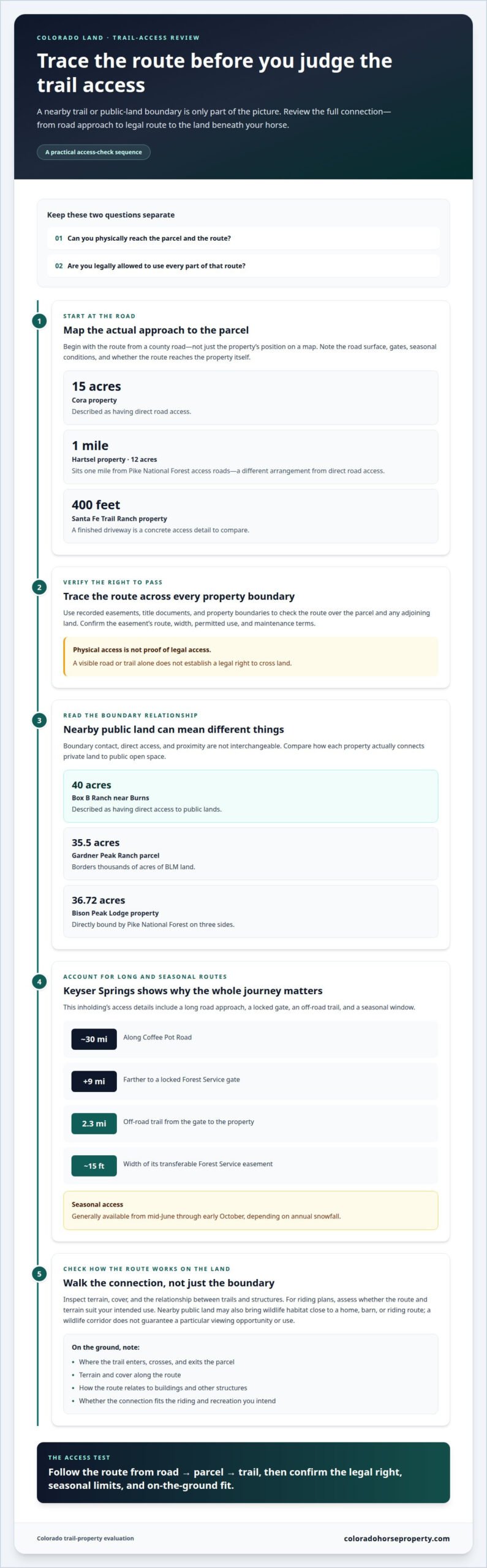
Begin with the actual route from a county road to the parcel. A 15-acre property in Cora is described as having direct road access, while a 12-acre Hartsel property sits one mile from Pike National Forest access roads. Those are different access arrangements. Consider road surface, gates, seasonal conditions, and whether the route reaches the property itself. A finished driveway, such as the 400-foot driveway on a Santa Fe Trail Ranch property, offers a concrete detail to compare.
To verify legal trail access, trace the route across the parcel and any adjoining land using recorded easements, title documents, and property boundaries. Confirm the easement’s route, width, permitted use, and maintenance terms. Physical access alone does not establish a legal right to cross land.
Public-land proximity can create a valuable riding opportunity, but boundary contact and usable access aren’t the same. The 40-acre Box B Ranch near Burns is described as having direct access to public lands. A 35.5-acre Gardner Peak Ranch parcel borders thousands of acres of BLM land. For comparison, a 36.72-acre property at Bison Peak Lodge is directly bound by Pike National Forest on three sides. Each arrangement shapes the connection between private ownership and nearby open space.
Look closely at longer or seasonal routes. Keyser Springs Inholding requires about 30 miles along Coffee Pot Road, then nine additional miles to a locked Forest Service gate. A 2.3-mile off-road trail leads from that gate to the property. Access is generally available from mid-June through early October, depending on annual snowfall. Its transferable Forest Service easement is approximately 15 feet wide. These details matter more than an alpine view alone.
Nearby public land may also bring wildlife habitat close to a home, barn, or riding route. Walk the boundary and note the terrain, cover, and relationship between trails and structures. A wildlife corridor does not guarantee a particular viewing opportunity or use.
Public recreation can add amenities beyond riding. Trails at Crowfoot Community Park in Parker include a nine-hole disc golf course at 14090 Alpine Phlox Street. For a luxury retreat or working ranch, weigh such community features alongside access, boundaries, and the square-mile landscape around the property.
Acreage, terrain, elevation, and vegetation
Acreage sets the scale, but usable ground matters more than the total alone. Colorado examples range from Buck Basin Ranch’s 83 acres to Camel Point Ranch’s approximately 1,515 acres. A smaller parcel may suit focused riding or hiking, while a larger ranch can offer more room to plan routes. Compare open ground, slopes, creek corridors, and wooded sections rather than relying on the acreage figure by itself.
Elevation changes the character of a mountain property and the effort required for outdoor use. Red Rock Ranch near Steamboat Springs ranges from 6,800 feet to 7,800 feet. Keyser Springs Inholding sits at approximately 9,250 feet, while Glenwood Springs is approximately 5,700 feet. Terrain north of Glenwood Springs rises above 11,000 feet. These contrasts help frame how a property fits your riding and recreation plans.
Walk the land by terrain type. On a valley parcel, identify level ground, drainage paths, steep sections, and natural barriers. Consider where a trail could run without frequent sharp turns or difficult footing. Note the balance of grass, brush, and tree cover across the parcel, and assess how these conditions affect visibility, movement, and access for hunting, riding, and hiking.
Use a consistent review for each property: map the boundaries, identify elevation changes, and trace potential routes across representative terrain. Compare usable areas with the land’s full acreage, especially where slopes or dense vegetation limit movement. A 156.30-acre inholding such as Keyser Springs illustrates why acreage and elevation belong in one assessment. The goal is to understand how the ground works, not just how it looks from a scenic overlook.
Creek frontage can add another dimension to a terrain review. The 20-acre Jefferson Gold #1 mining claim in Park County, Colorado, has Jefferson Creek running through it for more than 660 feet. When walking the parcel, assess the creek corridor alongside slopes, open ground, and vegetation, and consider how it relates to possible routes across the land. This keeps water frontage in the same practical assessment as terrain and usable acreage.
Lake Fork River Ranch in Hinsdale County, Colorado, comprises 1,065± acres, while Morrow Point in Gunnison County, Colorado, comprises 35.1± acres. These examples reinforce the value of comparing parcel scale with the ground features that shape movement. Review each property for continuity between its open areas, wooded sections, and natural corridors, then judge how much of the acreage supports your intended use.
Colorado ranches and land for sale
Colorado land for sale ranges from working ranches to smaller recreational holdings. Compare properties by acreage, water features, improvements, and trail potential, rather than treating a ranch’s total size as the deciding factor. East Dolores Creek Ranch in Montrose County comprises approximately 840 acres, while Silver View Ranch in Gunnison County covers approximately 167.5 acres. Their different scales illustrate how a buyer’s priorities shape the search.
Water and terrain can influence both recreation and day-to-day land use. Doc Utterback Ranch near Steamboat Springs spans 1,144± deeded acres and has nine springs. South Valley Yampa River Ranchette covers 37± acres and includes 1,000 feet of Yampa River frontage. Those features offer distinct settings for a property, from a broad ranch landscape to a smaller river-oriented estate. Assess how water features relate to living areas, pasture, and possible riding routes.
Listing details also help separate a pristine-looking setting from a practical fit. Ayer Ranch in Delta County comprises approximately 1,160 acres, while Lela Belle Springs Ranch in Ouray County covers approximately 109 acres. Consider each property’s documented improvements and access alongside its acreage. For endurance riding, identify how the land connects to usable routes and whether its terrain suits the distances and riding conditions you want.
Build a shortlist around priorities you can compare consistently: acreage, trail connections, water features, terrain, and existing structures. Then weigh the trade-offs. A larger parcel may offer more room to plan routes, while a smaller holding may better suit a focused recreation or retreat plan. Listing details help frame the comparison, but the property’s layout determines how its features work together.
Ready to narrow your search by land features and riding goals? Explore Colorado ranch listings to compare properties with your priorities in mind.
Colorado Horse Property
Colorado Horse Property helps buyers match land features to their riding and ownership goals. Its AI-powered search can narrow listings by equestrian features, and buyer representation supports the purchase process. Use these services once you have defined priorities such as trail connections, acreage, terrain, water, or existing improvements and need help finding and evaluating suitable listings.
For a property with direct access to endurance trails, look beyond the trail’s proximity. Road approach, recorded access, public-land boundaries, elevation, and usable ground all affect how the parcel fits your plans. Colorado Horse Property also provides transaction management as your purchase moves forward.
Ready to discuss your land and riding priorities? Contact Colorado Horse Property.
Turn your riding priorities into a focused search
A property with direct access to endurance trails for sale in Colorado can mean different things to different riders. Before taking the next step, decide which trade-offs matter most: an immediate trail connection, room to plan your own routes, or a balance between riding land and a comfortable home base. Clear priorities make it easier to assess each opportunity against your day-to-day plans.
Colorado Horse Property helps move your search forward with AI-Powered Horse Property Search, Real Estate Listing Services, and Buyer Representation. These services help you find relevant properties and navigate a purchase around your goals. A focused conversation can turn your priorities into a practical search plan.
Connect with Colorado Horse Property to plan your next search, and take the next step toward a Colorado property that fits the way you want to ride and live.
Frequently Asked Questions
Are there Colorado properties for sale with direct access to endurance riding trails?
Colorado listings vary, so distinguish an on-property trail from a route across adjoining land or access to a nearby trailhead. For each candidate, note where the riding route begins, whether it is intended for horseback use, and whether reaching it requires a trailer. This comparison helps distinguish a convenient ride-out location from a property that is simply close to trails.