
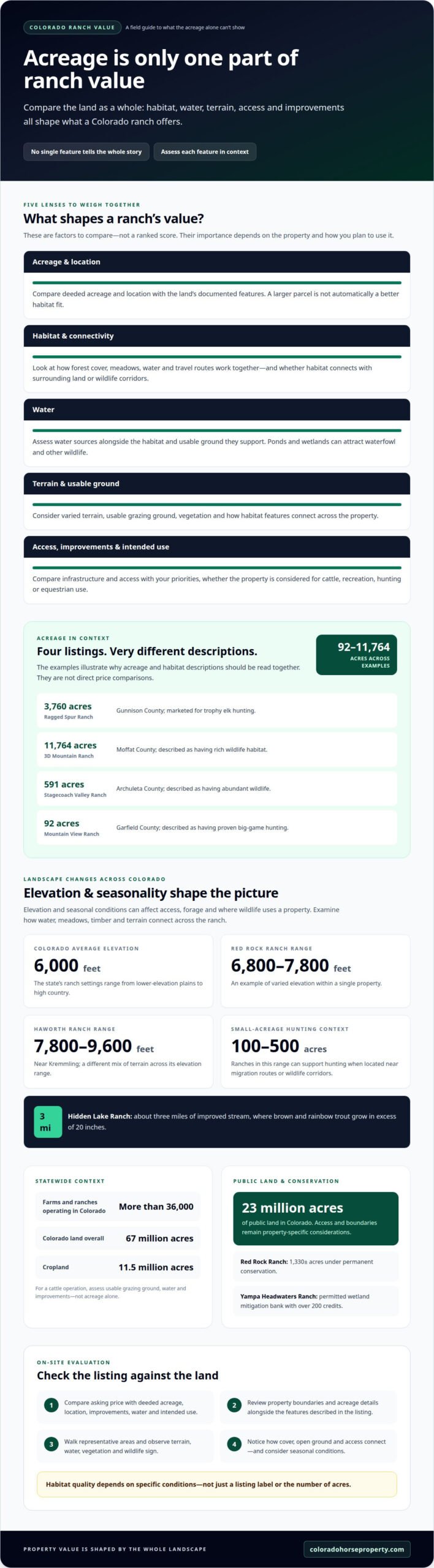
A ranch’s wildlife value isn’t measured by acreage alone. Colorado listings range from 92 acres at Mountain View Ranch to 11,764 acres at 3D Mountain Ranch, but land value also reflects water, usable terrain, habitat, access, and improvements. For buyers considering Colorado ranches with wildlife habitat for sale, the species and seasonal patterns a property supports matter alongside its size.
It’s natural to focus first on acreage and scenery when searching for Colorado ranches with wildlife habitat for sale. Yet a smaller property near a wildlife corridor may offer different habitat value than a much larger ranch with a different mix of terrain and water. Colorado ranches may support elk, mule deer, black bear, and mountain lion, while ponds and wetlands can attract waterfowl and other wildlife. This guide explains the features that shape ranch values, how elevation and seasonal conditions affect a property, and what to assess in its water, access, terrain, and improvements. You’ll also learn which wildlife may be present and why habitat matters when evaluating a ranch.
Key Takeaways
- Assess ranch value through more than acreage: habitat, water, terrain, access, and improvements all shape what a property offers.
- Consider how elevation and seasonal wildlife movement affect habitat quality and the ranch’s potential for hunting.
- Evaluate practical features such as water sources, usable ground, and connections to surrounding habitat when reviewing listings.
- Learn which wildlife may use Colorado ranches and how varied habitat features can support different species.
What influences Colorado ranch and land values most?
Colorado ranch prices vary by location, acreage, improvements, and habitat quality.
These examples show why acreage alone doesn’t explain asking prices. A smaller property may offer valuable water or wildlife habitat, while a larger ranch may have different terrain, infrastructure, or agricultural uses.
Ranch Acreage and Asking Prices
Compare each listing’s asking price with its deeded acreage, location, and documented land features. Ragged Spur Ranch in Gunnison County is marketed for trophy elk hunting across 3,760 acres. The 3D Mountain Ranch in Moffat County is listed at 11,764 acres and described as having rich wildlife habitat.
Colorado’s agricultural footprint also gives context. More than 36,000 farms and ranches operate in the state, which has 67 million acres of land overall. Cropland accounts for 11.5 million acres. For a cattle operation, assess the balance of usable grazing ground, water, and improvements, rather than acreage alone.
Wildlife Habitat Considerations
Habitat value depends on how land features work together. Forest cover, meadows, water, and connected travel routes can support wildlife use across a property. A 591-acre Stagecoach Valley Ranch in Archuleta County is described as having abundant wildlife, while the 92-acre Mountain View Ranch in Garfield County is described as having proven big-game hunting.
To assess an investment, compare the listing’s acreage with its habitat features and location. Consider whether the ranch is located near public land, has varied terrain, or includes water sources that support wildlife. Colorado has 23 million acres of public land, but access and boundaries are property-specific considerations. For Colorado ranches with wildlife habitat for sale, evaluate the documented habitat alongside the deeded acre count to understand what the asking price reflects.
How do elevation and seasonality affect Colorado properties?
Wildlife habitat occurs across Colorado, from the lower-elevation plains to the high country. Promising habitat often combines varied terrain, water, and connections to wildlife corridors. Ranches near Steamboat Springs, Kremmling, and McCoy are examples of areas where buyers may find that mix.
Elevation shapes the habitat and the practical use of a ranch. Colorado’s average elevation is 6,000 feet, while Red Rock Ranch ranges from 6,800’ to 7,800’. Haworth Ranch near Kremmling rises from 7,800 to 9,600 feet, offering a different mix of terrain across its elevation range.
Seasonal conditions can affect access, forage, and where wildlife uses a property. A ranch with meadows, timber, and water may offer a variety of habitat as conditions change. Look at how those features connect across the land rather than treating one elevation or habitat type as a complete measure of hunting potential.
Small acreage can still offer hunting opportunities. Colorado ranches as small as 100-500 acres can support hunting when located near migration routes or wildlife corridors. That makes surrounding habitat and the ranch’s position in the landscape important considerations for big-game hunting and elk use.
Higher-elevation examples show the range of settings available. Wild Canyon Ranch near Lake George is located at 8,600 feet, Independence Mountain Ranch sits at roughly 8500 feet, and Hidden Lake Ranch in the San Juans is situated at about 9000 feet. More than 1,000 Colorado mountain peaks exceed 10,000 feet, so elevation varies sharply across the state.
For fishing and outdoor recreation, water features add another dimension. Hidden Lake Ranch has about three miles of improved stream, where brown and rainbow trout grow in excess of 20 inches. Match these features to your priorities, then use an AI-powered horse property search to narrow real estate options by property needs.
Ranches near Steamboat Springs, Kremmling, and McCoy may appeal to wildlife-focused buyers. Look for varied terrain, water, and connections to wildlife corridors; meadows and timber can add habitat variety.
What are the key features to look out for when buying a Colorado ranch?
Colorado listings range from expansive recreational holdings and equestrian estates to smaller properties with distinctive habitat features. Compare asking price with deeded acreage, water, improvements, access, and any conservation status. For wildlife use, consider how those features work together across the property.
To assess a ranch and its habitat, arrange an on-site visit and compare the listing description with the land’s terrain, water, vegetation, and wildlife sign. Review the property boundaries and acreage details alongside what you observe. Habitat quality depends on specific conditions, not just a listing label.
Compare Listing Prices With Property Features
Asking prices vary widely across Colorado listings. These examples differ in location and property characteristics, so they aren’t direct price comparisons.
Look beyond the headline figure. Compare each listing’s deeded acreage, improvements, water features, and intended use. A recreational property and an equestrian estate may offer different combinations of usable land and infrastructure. A valley parcel with productive ground may suit different priorities than an expansive mountain holding.
Assess Conservation and Recreation
Conservation features can shape how a ranch is used. Red Rock Ranch near Steamboat Springs has 1,330± acres under permanent conservation. Yampa Headwaters Ranch has a permitted wetland mitigation bank with over 200 credits. These details distinguish properties, but buyers should consider them alongside acreage, habitat, and intended use.
During an inspection, walk representative parts of the property and note how water, cover, open ground, and access connect. Compare what you observe with the listing’s stated acreage and features. A recreational ranch may emphasize wildlife habitat, while an equestrian property may need suitable facilities and usable ground. Matching your priorities to documented property details helps you evaluate the opportunity.
Wildlife species found on Colorado ranches
Colorado ranch habitats can support big game, smaller game birds, and waterfowl. Listings may identify elk, mule deer, black bear, and mountain lion among the wildlife associated with ranch land. Species vary with the habitat: open ground, timber, creek corridors, ponds, and wetlands provide different conditions. In western Colorado, a property’s mix of cover and water can help explain its wildlife appeal.
Several named ranches illustrate that variety. Doc Utterback Ranch near Steamboat Springs spans 1,144± acres and offers habitat for mule deer, elk, bear, and moose. Little Blacktail Creek Ranch near McCoy encompasses nearly 950 acres and provides habitat for Rocky Mountain elk, mule deer, moose, and black bear. Upper Sheep Creek Ranch is also described as habitat for those four species.
Water features broaden the picture. Double K Ranch near Brush has 896± acres with ponds, waterfowl, turkey, and deer. Doc Utterback Ranch has nine springs, while other properties feature creeks or ponds. Buyers can assess how water, vegetation, and terrain combine across deeded acres, rather than relying on a single species mention.
Look at the surrounding landscape, too. Blacktail Creek Ranch near Kremmling encompasses 522 acres with wildlife habitat and is bordered by Routt National Forest on three sides. That location and its habitat description provide useful context, but acreage alone doesn’t establish which animals use a property. Listing descriptions can identify species and habitat features; an on-site visit can help you understand how those features occur across the ranch. Water rights are another distinct property detail to consider alongside natural water features.
A ranch marketed as a retreat may appeal to buyers seeking wildlife and outdoor use, but specific habitat features define the opportunity. Explore Colorado ranch listings to find properties whose land, water, and wildlife characteristics fit your priorities.
Colorado Horse Property
Colorado Horse Property helps buyers connect wildlife and land priorities with a practical property search. Its AI-powered Colorado Horse Property Search helps identify equestrian features such as barns, arenas, water rights, and pasture sizes. For buyers weighing those features alongside habitat, water, acreage, and access, buyer representation supports the search and purchase process. Transaction management helps coordinate the steps involved in a real estate purchase. Sellers can use Real Estate Listing Services to present their ranch property to prospective buyers. Whether you’re narrowing options or preparing to buy, Colorado Horse Property can help you move from property criteria toward a ranch that fits your goals. Contact Colorado Horse Property to discuss your ranch search.
Choose a Ranch That Fits the Life You Want
As you consider Colorado ranches with wildlife habitat for sale, define what you want daily life on the property to look like. A ranch can serve as a private retreat, a working operation, or a base for outdoor recreation. The right fit depends on how those goals align with the land and the responsibilities you’re prepared to take on.
Turn your priorities into a practical decision framework. Separate essential features from preferences, consider how you plan to use the property over time, and weigh the trade-offs between a ranch’s setting and its day-to-day practicality. That clarity can make each conversation and property tour more focused.
When you’re ready to move from research to a property search, contact Colorado Horse Property to discuss your goals. Your next step can bring the right landscape and lifestyle into clearer view.
Frequently Asked Questions
Are there any conservation or tax benefits to owning a ranch in Colorado?
Conservation status and tax treatment are separate considerations. A recorded conservation easement sets restrictions on land use, while any tax outcome depends on the easement terms and applicable tax rules. Review the document’s limits, duration, and permitted activities before treating conservation status as a financial benefit. A tax professional can assess how those documented terms relate to your circumstances.
Is it legal to stock ponds or manage wildlife on Colorado land?
Whether pond stocking or wildlife management is allowed depends on the specific activity and applicable requirements. Colorado Parks & Wildlife Code Chapter 17 addresses private-land wildlife activities such as habitat modification, hunting, or trapping. Identify the proposed action, pond conditions, and species involved, then review relevant state and local requirements. Land ownership alone shouldn’t be treated as blanket permission for every wildlife activity.
What are the zoning regulations and restrictions for ranches in Colorado?
Ranch zoning and restrictions are tied to the parcel’s land-use designation and recorded documents, not simply its listing description. Review county zoning, permitted uses, easements, covenants, access rights, and building limitations before planning changes. For example, if you hope to add an arena, establish whether the proposed structure and use fit the parcel’s governing documents and land-use designation.
What hunting opportunities are available on Colorado ranches?
Opportunities include hunting on private ranch habitat and properties with access to nearby public hunting land. Ragged Spur Ranch in Gunnison County is located in Game Management Unit 521. Assess the wildlife species identified, habitat connectivity, property boundaries, and access arrangements. The game unit and surrounding landscape offer useful context for understanding a property’s hunting potential alongside its terrain and habitat.
What should be reviewed first when evaluating Colorado land for sale?
Start with title and parcel boundaries, then examine recorded access, water rights, easements, and land-use restrictions. Compare those documents with the listing’s deeded acreage and improvements. Next, match the property to your intended use. An equestrian buyer can assess pasture layout and facilities, while a wildlife-focused buyer can consider how habitat features extend across the parcel.
What types of wildlife are commonly found on Colorado ranches?
Colorado ranches can support elk, mule deer, black bear, mountain lion, moose, turkey, and waterfowl. Stream properties can also provide fish habitat. The species associated with a ranch depend on its terrain and water features. Use wildlife descriptions as a starting point, then consider whether the property’s cover, forage, wetlands, and stream corridors suit the animals you hope to observe.